


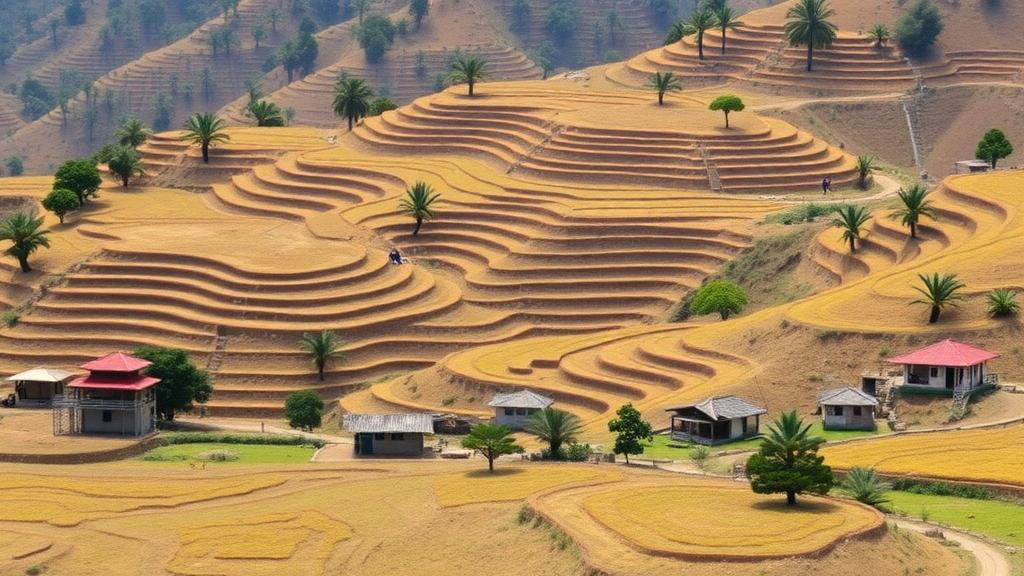
High in the mist-covered hills of Nagaland, one of India’s most remote and biodiverse corners, an ancient farming tradition is quietly teaching scientists a lesson in climate survival. A new study published in Environmental Monitoring and Assessment has, for the first time, systematically quantified how vulnerable the indigenous agroecological systems of the Angami people are to climate change, and how their centuries-old agroforestry practices buffer entire villages against environmental shocks. The findings suggest that traditional knowledge, far from being a relic, may be one of the most effective climate adaptation tools available in the Eastern Himalayas, a region where warming temperatures and erratic rainfall are already reshaping agricultural lifeways.
The research, led by Meribeni Tsopoe and Kambam Boxen Meetei of the ICFRE-Rain Forest Research Institute in Jorhat, together with Krishna Giri and Rajiv Pandey of the Indian Council of Forestry Research and Education in Dehradun, focused on four Angami villages in Kohima district: Khonoma, Mima, Viswema, and Jotsoma. These communities practice sophisticated agroforestry systems, including the celebrated alder-based jhum cultivation of Khonoma, in which the nitrogen-fixing Himalayan alder is managed alongside crops in a rotational cycle that sustains soil fertility without external inputs. The team applied the Intergovernmental Panel on Climate Change vulnerability framework, integrating both socio-economic and ecological dimensions into a single assessment, an approach the authors argue fills a significant gap in the literature on indigenous farming systems in the region.
The IPCC framework conceptualizes vulnerability as a function of three interacting components: exposure to climatic stresses, sensitivity of the system to those stresses, and adaptive capacity, meaning the ability of a community to anticipate, cope with, and recover from impacts. Translating this into measurable indicators, the researchers combined qualitative and quantitative datasets gathered through household surveys and environmental sampling. Socio-demographic factors such as income, education, and livelihood diversity were weighed alongside ecological variables including soil health, carbon stocks, and biodiversity. The result was a Climate Vulnerability Index for each village, a single composite score that allows direct comparison across the landscape.
The rankings revealed striking contrasts between neighboring communities. Viswema emerged as the most vulnerable village, with an index value of 0.293, followed closely by Jotsoma at 0.278. Mima recorded 0.270, while Khonoma, the famed home of alder-based jhum, proved the least vulnerable at 0.268. The differences, though numerically small, are meaningful: the study attributes Khonoma’s and Mima’s relative resilience to higher adaptive capacity, whereas Viswema and Jotsoma face greater exposure to climatic hazards combined with fewer resources to respond. In other words, vulnerability in these hills is not simply a matter of where the rain falls hardest, but of what a community can do when it does.
Underlying these scores is a deeper ecological story. The study demonstrated that agroforestry systems actively enhance ecological resilience by improving soil fertility, increasing carbon sequestration, and supporting biodiversity. The alder trees that anchor Khonoma’s farming landscape fix atmospheric nitrogen through symbiotic bacteria, enriching the soil for the crops grown beneath them, a natural fertilization process documented in earlier work that identified indigenous free-living diazotrophs in the system. Deep root systems stabilize slopes against erosion, while the multi-layered canopy mimics forest structure, providing habitat for a wide range of species. These are precisely the ecosystem functions that conventional intensive agriculture tends to erode.
One of the study’s most commercially and politically significant findings concerns the relationship between the Climate Vulnerability Index and per capita income. The analysis showed that villages with higher per capita income exhibited lower vulnerability and greater economic stability, suggesting that economic diversification acts as a form of insurance against climatic uncertainty. Households that can draw on multiple income streams, whether from integrated farming, forest products, or off-farm employment, are better positioned to absorb losses when harvests fail. This echoes a growing body of research from across the Himalayas showing that livelihood diversification is among the most reliable predictors of household resilience in mountain communities.
The timing of this research could hardly be more critical. The Eastern Himalayas are recognized as one of the world’s major biodiversity hotspots, yet they are warming faster than many lowland regions, and rainfall patterns across Nagaland have shown significant trends in recent decades. Regional assessments, including India’s national 4×4 climate assessment and the Nagaland State Action Plan on Climate Change, have flagged the state’s predominantly agrarian and forest-dependent communities as acutely exposed. For smallholder farmers practicing subsistence agriculture on steep terrain, even modest shifts in the timing of monsoon rains can cascade into food insecurity, making the identification of low-vulnerability models a matter of survival rather than academic interest.
What makes the Angami case especially compelling is the explicit link the researchers draw between ecosystem services and adaptive capacity. Rather than treating ecology and economics as separate domains, the study argues that the services flowing from well-managed agroforestry, fertile soils, stored carbon, biodiversity, and water regulation, are themselves components of a community’s capacity to adapt. This integrated framing carries implications well beyond Nagaland. Globally, agroforestry is increasingly promoted as a nature-based solution to climate change, capable of delivering both mitigation through carbon storage and adaptation through reduced sensitivity of farming systems. The Angami experience offers a living, functioning proof of concept refined over generations.
The authors emphasize that their results argue for village-specific policies rather than one-size-fits-all interventions. Because Viswema and Jotsoma face different combinations of exposure and capacity deficits than Khonoma and Mima, adaptation strategies must be tailored accordingly. The study points to three priorities: sustainable ecological management that maintains the health of agroforestry landscapes, the formal integration of traditional knowledge into climate adaptation planning, and economic diversification that broadens household livelihoods. Such targeted approaches, the researchers suggest, could serve as a template for future research on resilient agroecosystems throughout the Himalayan arc and similar mountain regions worldwide.
For a world searching for climate solutions that work at the scale of real communities, the message from the hills of Kohima is quietly radical. The most resilient farming systems in the study were not those with the most modern infrastructure, but those where ecological knowledge accumulated over centuries continues to govern the relationship between people and land. As funding for the work came from India’s Department of Science and Technology, and as the researchers acknowledge the participating farming communities whose information made the study possible, the findings stand as both a scientific validation and a tribute. If the world’s mountain farmers are to weather the coming decades, the Angami agroecological systems of Nagaland may well be one of the blueprints worth studying, and protecting, now.
Subject of Research: Climate vulnerability and resilience of indigenous Angami agroforestry systems in Nagaland, Northeast India
Article Title: Climate change vulnerability, ecological resilience, and adaptive capacity of Angami agroecological systems in Kohima, Nagland, Northeast India
Article References: Tsopoe, M., Meetei, K. B., Giri, K., & Pandey, R. (2026). Climate change vulnerability, ecological resilience, and adaptive capacity of Angami agroecological systems in Kohima, Nagland, Northeast India. Environmental Monitoring and Assessment, 198(10), Article 1096. https://doi.org/10.1007/s10661-026-15940-8
Image Credits: AI Generated
DOI: 10.1007/s10661-026-15940-8
Keywords: climate change vulnerability, agroforestry, Angami, Nagaland, Eastern Himalayas, adaptive capacity, ecological resilience, ecosystem services, indigenous knowledge, jhum cultivation, Climate Vulnerability Index, smallholder farmers
Cite Scienmag News
Sloane Callahan. (October 6, 2026). Ancient Angami Farming Systems Emerge as Climate Shields in India’s Eastern Himalayas. Scienmag. https://scienmag.com/ancient-angami-farming-systems-emerge-as-climate-shields-in-indias-eastern-himalayas/
Sloane Callahan. "Ancient Angami Farming Systems Emerge as Climate Shields in India’s Eastern Himalayas." Scienmag, 6 October 2026, https://scienmag.com/ancient-angami-farming-systems-emerge-as-climate-shields-in-indias-eastern-himalayas/. Accessed 6 October 2026.
Sloane Callahan. "Ancient Angami Farming Systems Emerge as Climate Shields in India’s Eastern Himalayas." Scienmag. October 6, 2026. https://scienmag.com/ancient-angami-farming-systems-emerge-as-climate-shields-in-indias-eastern-himalayas/


