


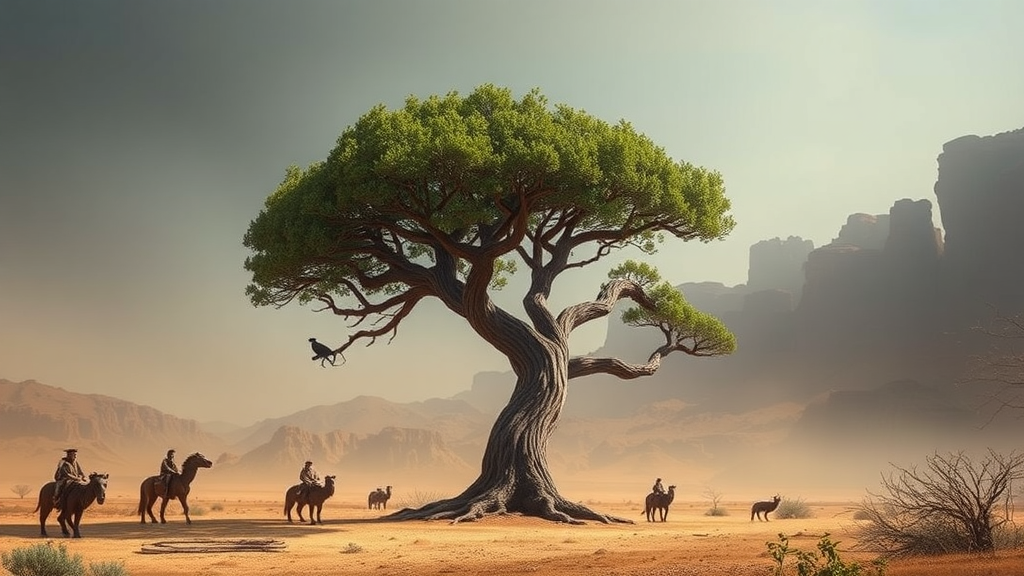
Deep in the arid lowlands of northern Ethiopia, a towering, umbrella-shaped tree is quietly being kept alive not by rangers or fenced reserves, but by a web of centuries-old customary rules passed down through generations of pastoralists. A new study published in the journal Discover Conservation reveals that the endangered dragon tree, Dracaena ombet, survives in the Erebti district of Ethiopia’s Afar Region largely thanks to an intricate system of Indigenous knowledge and institutions, most notably the Mada’a, the customary law of the Afar people. The findings challenge the assumption that formal, state-led conservation is the only path to saving globally threatened species, and they arrive at a moment when this ancient tree is vanishing across much of its range.
Dracaena ombet is a multipurpose dryland tree native to the northern dry Afromontane and dryland forests of Ethiopia and found more widely across the Horn of Africa. Its distinctive branching crown makes it an emblem of arid ecosystems, but the species is in trouble. Researchers report that climate change, overgrazing, the cutting of leaf rosettes for livestock fodder, road construction, and mining are all eroding its populations, while natural regeneration is declining under the combined pressure of habitat degradation and livestock browsing. The tree is now classified as globally endangered, and previous studies have warned that without a suitable conservation approach, its remaining stands may not survive the century.
The research team, led by Mohammed Shumbahri of Samara University and Mekelle University together with colleagues from Nord University and PELUM Ethiopia, set out to document what local communities actually know about the tree and how they govern its use. The study combined Indigenous standpoint theory, ethnobotany, and ethnoecological theory, drawing on semi-structured interviews with 217 households selected through a multistage purposive sampling design, four focus group discussions with clan leaders, village leaders and residents in the Aba’a, Saaso, Botali and Gala’ato sites, and sixteen key informant interviews with clan leaders, community elders, local administrators, and natural resource experts. Data were analyzed through discourse, narrative, thematic, and content analysis.
The results paint a picture of deep, intergenerational ecological knowledge. Local households classified woodland plants by habit into woody, grass, and climber categories, and by benefit into medicinal, timber and construction, shade, forage, and food plants, with Dracaena ombet placed among the woody species. Communities use the tree to make household utensils, beehives, traditional medicine, and construction materials, including porridge containers, milking taps, and containers for cheese and cosmetics. Knowledge about the tree flows primarily from parents, who were cited as the source of this ecological knowledge by 50.7 percent of surveyed households, followed by daily learning from social and cultural interactions, observation of elders and herbalists, and trial-and-error monitoring of the tree’s life cycle.
What makes the Afar system distinctive is its institutional architecture. At the grassroots level, the household, known locally as Buxa, demarcates and protects a forest area around the family compound; outsiders may not harvest products without permission, and beehive owners claim custodianship over the trees surrounding their hives. Groups of related households, the Ganda, share responsibility for managing multipurpose trees, and gender-based organizations of age mates, called Nado and Fiima, protect rare species like Dracaena ombet from overexploitation, even barring livestock from entering forest patches where the tree occurs. Above these local units sits the clan system, Kedo siirata, which administers the Mada’a, the Afar customary law governing everything from natural resource use to conflict resolution.
The Mada’a operates through clear customary rules enforced by clan and community leaders. Harvesting of Dracaena ombet products is season-based: collection is permitted only at specified times, and harvesting during critical drought periods is strictly unacceptable. The amount of product each household may take is limited according to household size, and the purposes for which products can be used are constrained. Because the rules have been inherited orally through generations, they are no longer announced at meetings, yet community members respect them, and violators face punishments decided by clan and community leaders. The researchers identified five distinct variants of the Mada’a operating across the Afar Region and into Eritrea and Djibouti, each anchored to the traditional leaders, or Dardar, of particular zones.
Religious institutions reinforce this governance. Under Islamic teaching, trees like Dracaena ombet are regarded as gifts from God to be used, managed, and protected, and Muslim judges, known as Kaadi, help mobilize communities for conservation activities such as soil and water conservation and planting. Local practices further embed the tree within a broader rangeland strategy. Pastoralists maintain pasturelands, called Desso, that are closed to livestock during the rainy season and opened only in the dry season, allowing trees and grasses to recover. They also practice transhumance, known as Guuro, moving livestock from lowland to highland areas, including the highlands of the neighboring Tigray region, in the dry season and returning to the Afar lowlands when the rains come. When fodder from pastureland trees is needed, herders take only branches or leaves without cutting the main stem, because they know the branches of a dragon tree can yield for many years while the felled trunk offers a single use.
The study found, however, that this sophisticated system is under strain. The abandonment of traditional culture, beliefs, and values, combined with weak coordination between Indigenous and formal institutions, is challenging the sustainable utilization and management of the tree. Ethiopia’s natural resource governance follows a top-down approach, and most government policies do not include Indigenous institutions, a pattern of ignorance and non-recognition that the authors say undermines multipurpose dryland forest resources. Long bureaucratic procedures for licensing, difficulties in legally trading tree products, and the lack of integration with other productive activities all push some community members toward illegal harvesting and trade, prompting the local administration to strengthen the legal market for Dracaena ombet products as a remedy. One respondent summarized the tension plainly: the governmental structure alone is not effective in guiding the Afar people to protect their natural resources, and it must integrate with Indigenous knowledge and institutions whose effectiveness has been built on a solid foundation for centuries.
The authors argue that complementing existing conservation schemes with the Indigenous management system, particularly the Mada’a and its season-based harvesting, monitoring, and sanction mechanisms, is crucial for the survival of endangered Dracaena ombet and for dryland biodiversity more broadly. Because the study focused on a single species at a specific site and assessed management dynamics historically and through the lens of sustainable utilization, it offers a template for understanding how dynamic institutional complexes, rather than static protected areas, can regulate the intensity of harvest and keep threatened species viable. As the researchers conclude, community knowledge is a key component in overcoming the challenges facing globally endangered species, biodiversity development, and poverty reduction, all integral parts of the 2030 sustainable development goals. For a tree that has anchored pastoral livelihoods for generations, the best hope for survival may lie not in excluding people from the forest, but in recognizing the laws they have long lived by.
Subject of Research: Indigenous knowledge and customary institutions governing the conservation of the endangered dragon tree Dracaena ombet in Ethiopia's Afar drylands
Article Title: Indigenous knowledge and institutions associated with the management of Dracaena ombet and implications to biodiversity conservation
Article References: Shumbahri, M., Birhane, E., Girmay, G., Tesfay, G., & Araya, H. (2026). Indigenous knowledge and institutions associated with the management of Dracaena ombet and implications to biodiversity conservation. Discover Conservation, 3(1), Article 32. https://doi.org/10.1007/s44353-026-00102-1
Image Credits: AI Generated
DOI: 10.1007/s44353-026-00102-1
Keywords: Dracaena ombet, dragon tree, Indigenous knowledge, Mada'a customary law, Afar Region, Ethiopia, biodiversity conservation, ethnobotany, dryland forests, pastoralism, community-based conservation, endangered species
Cite Scienmag News
Margaret Porter. (September 12, 2026). Ancient Afar Customary Law Emerges as Lifeline for Endangered Dragon Tree. Scienmag. https://scienmag.com/ancient-afar-customary-law-emerges-as-lifeline-for-endangered-dragon-tree/
Margaret Porter. "Ancient Afar Customary Law Emerges as Lifeline for Endangered Dragon Tree." Scienmag, 12 September 2026, https://scienmag.com/ancient-afar-customary-law-emerges-as-lifeline-for-endangered-dragon-tree/. Accessed 5 October 2026.
Margaret Porter. "Ancient Afar Customary Law Emerges as Lifeline for Endangered Dragon Tree." Scienmag. September 12, 2026. https://scienmag.com/ancient-afar-customary-law-emerges-as-lifeline-for-endangered-dragon-tree/


