


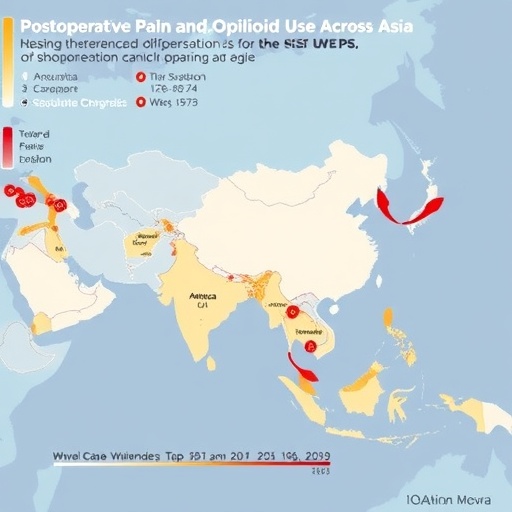
Postoperative pain is often treated as if it were a single symptom with a single solution: assess its intensity, prescribe an analgesic, and monitor whether the patient improves. A large analysis of the PAIN OUT registry now challenges that simplified model, showing that postoperative pain is embedded in a much wider network of biological, psychological, and treatment-related factors. Examining patients from seven Asian regions, researchers mapped the relationships among pain-related outcomes, opioid dosages, and psychosocial variables, while also asking whether these relationships differed between women and men. Their findings suggest that sex differences after surgery may be expressed less through isolated symptom scores than through the way symptoms and experiences connect to one another.
The study, published under the title “Differentiating network structures and sex differences of pain-related outcomes, analgesic opioid dosages, and psychosocial factors for postoperative management,” uses data from the international PAIN OUT registry. This registry was developed to collect standardized information about acute postoperative pain in routine clinical settings. Patients report pain intensity, pain-related interference with daily activities, unpleasantness, sleep disruption, emotional distress, and satisfaction with pain management, while clinical records provide information about analgesic treatment, including opioid administration. By bringing these measurements together, researchers can examine postoperative recovery as a multidimensional system rather than as a number on a visual analogue scale.
The analytical approach is based on network analysis, a method increasingly used in medicine and psychology to study complex conditions. In a network model, each measured characteristic is represented as a node, while statistical relationships between characteristics are represented as connections. Instead of asking only whether pain is associated with anxiety, for example, researchers can examine whether that relationship remains after accounting for other variables such as sleep disturbance, pain interference, opioid dose, and depression. These adjusted relationships, often estimated through partial correlations or related statistical procedures, can reveal which factors are most central and which may act as bridges linking different symptom domains.
This distinction matters because two patients can report similar pain intensity while experiencing very different postoperative trajectories. For one patient, pain may be tightly connected to movement limitation and sleep loss. For another, pain may be more closely linked to fear, emotional distress, or a sense that treatment is ineffective. A conventional analysis based on average scores may treat these patients as equivalent. A network analysis can identify different configurations, making it possible to ask whether an intervention aimed at sleep, mobility, anxiety, or expectations could influence the broader pain system.
The researchers found that postoperative pain outcomes, analgesic opioid dosages, and psychosocial factors did not form an identical structure across sexes. The results indicate that women and men can show different patterns of association among pain intensity, pain interference, emotional responses, and medication use, even when their overall scores appear similar. Such differences do not mean that every woman or every man experiences pain in the same way. Rather, they suggest that sex may modify the pathways through which postoperative symptoms interact, creating distinct statistical profiles at the population level.
One important implication concerns the interpretation of opioid dosage. Opioid administration is often viewed as a direct response to pain severity, but the network framework treats dosage as part of a feedback system. Higher doses may reflect more severe pain, but they can also be influenced by clinician decisions, patient expectations, previous opioid exposure, anxiety, surgical factors, or concerns about inadequate relief. Opioids may reduce pain while simultaneously contributing to nausea, drowsiness, impaired mobility, or other postoperative problems. By placing analgesic dosage within the same network as pain and psychosocial measures, the study highlights why medication use should not be evaluated independently from the patient’s wider recovery experience.
The findings also reinforce the importance of psychosocial variables in acute postoperative care. Anxiety, depressive symptoms, pain-related worry, catastrophizing, and perceived control can affect how patients interpret bodily signals and how they respond to treatment. These factors do not imply that pain is imaginary or merely psychological. Pain is a genuine sensory and emotional experience produced by the nervous system, and its intensity is shaped by nociceptive input, inflammation, neural processing, attention, memory, and context. Psychosocial factors can influence these processes while also affecting sleep, movement, communication with clinicians, and adherence to rehabilitation. Their position in a network may therefore help explain why two patients undergoing similar procedures can require very different forms of support.
For postoperative teams, the practical message is not that every patient needs an elaborate psychological assessment or a completely separate treatment protocol. Instead, the study points toward more individualized monitoring. A patient whose network profile is dominated by pain interference may benefit from early mobilization and functional rehabilitation. A patient whose symptoms are strongly connected to anxiety or catastrophic thinking may require clear explanations, reassurance, and targeted psychological support alongside analgesia. Someone whose pain is closely linked with poor sleep, nausea, or opioid-related sedation may need medication adjustment and closer observation for adverse effects. These possibilities remain to be tested in prospective clinical trials, but the network approach offers a framework for identifying them.
The analysis also exposes the limits of applying uniform postoperative pain protocols across diverse populations. The PAIN OUT data span multiple Asian regions, where healthcare systems, surgical practices, prescribing cultures, languages, social expectations, and attitudes toward pain can differ substantially. Such variation is scientifically valuable because it allows researchers to examine whether observed relationships are robust across settings rather than being confined to one hospital. At the same time, registry-based research cannot establish that one factor causes another. Network connections may reflect shared causes, measurement overlap, clinical decision-making, or feedback loops. Differences between sexes may also be shaped by age, procedure type, comorbidities, cultural context, and unequal exposure to treatment.
The study’s broader significance lies in its shift from asking how much pain a patient has to asking how the patient’s postoperative experience is organized. Pain intensity remains clinically important, but it is only one component of recovery. A patient may report moderate pain yet be unable to walk, sleep, or participate in rehabilitation; another may report severe pain but remain functionally engaged with effective support. By distinguishing network structures and identifying sex-related differences, the PAIN OUT analysis offers a more precise language for this complexity. Its findings could encourage future research to test network-informed interventions, improve opioid stewardship, and design postoperative care that responds to individual symptom patterns rather than relying solely on average responses. The next step will be determining whether changing highly connected factors actually improves the entire recovery network—or whether the observed structures are best used as tools for prediction and clinical decision-making.
Cite Scienmag News
Courtney Benton. (August 25, 2026). Analysis Reveals Sex Differences in Postoperative Pain and Opioid Use Across Asia. Scienmag. https://scienmag.com/analysis-reveals-sex-differences-in-postoperative-pain-and-opioid-use-across-asia/
Courtney Benton. "Analysis Reveals Sex Differences in Postoperative Pain and Opioid Use Across Asia." Scienmag, 25 August 2026, https://scienmag.com/analysis-reveals-sex-differences-in-postoperative-pain-and-opioid-use-across-asia/. Accessed 5 September 2026.
Courtney Benton. "Analysis Reveals Sex Differences in Postoperative Pain and Opioid Use Across Asia." Scienmag. August 25, 2026. https://scienmag.com/analysis-reveals-sex-differences-in-postoperative-pain-and-opioid-use-across-asia/


