

Sunday, August 16, 2026
Science
No Result
View All Result
  • Login
  • HOME
  • SCIENCE NEWS
  • CONTACT US
  • HOME
  • SCIENCE NEWS
  • CONTACT US
No Result
View All Result
Scienmag
No Result
View All Result
Home Science News Technology and Engineering

An approach for robust facial attribute classification

July 10, 2024
in Technology and Engineering
Reading Time: 2 mins read
0
An approach for robust facial attribute classification
67
SHARES
608
VIEWS
Share on FacebookShare on Twitter
ADVERTISEMENT

Face attribute classification (FAC) is a high-profile problem in biometric verification and face retrieval. Although recent research has been devoted to extracting more delicate image attribute features and exploiting the inter-attribute correlations, significant challenges still remain. 
To solve the problems, a research team led by Na LIU published their new research on 15 June 2024 in Frontiers of Computer Science co-published by Higher Education Press and Springer Nature.
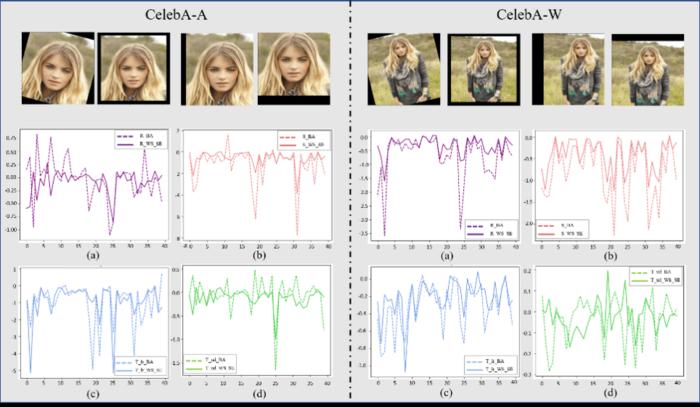
The team proposed a scattering-based hybrid block, termed WS-SE, to incorporate frequency-domain (WST) and image-domain (CNN) features in a channel attention manner. Compared with CNN, WS-SE achieved a more efficient FAC performance and compensated for the model sensitivity of the small-scale affine transform.
In addition, to further exploit the relationships among the attribute labels, the team proposed a learning strategy from a causal view. The cause attributes defined using the causality-related information can be utilized to infer the effect attributes with a high confidence level. 
Future work will consider the design of hybrid networks based on non-average integration at different scales and rotations, as well as the direct application of WST to local texture enhancement to achieve lightweight fusion models and improve the performance of FAC. 
DOI: 10.1007/s11704-023-2570-6

The mean accuracy change of small-scall affine transformation.

Credit: Na LIU, Fan ZHANG, Liang CHANG, Fuqing DUAN.

Face attribute classification (FAC) is a high-profile problem in biometric verification and face retrieval. Although recent research has been devoted to extracting more delicate image attribute features and exploiting the inter-attribute correlations, significant challenges still remain. 
To solve the problems, a research team led by Na LIU published their new research on 15 June 2024 in Frontiers of Computer Science co-published by Higher Education Press and Springer Nature.
The team proposed a scattering-based hybrid block, termed WS-SE, to incorporate frequency-domain (WST) and image-domain (CNN) features in a channel attention manner. Compared with CNN, WS-SE achieved a more efficient FAC performance and compensated for the model sensitivity of the small-scale affine transform.
In addition, to further exploit the relationships among the attribute labels, the team proposed a learning strategy from a causal view. The cause attributes defined using the causality-related information can be utilized to infer the effect attributes with a high confidence level. 
Future work will consider the design of hybrid networks based on non-average integration at different scales and rotations, as well as the direct application of WST to local texture enhancement to achieve lightweight fusion models and improve the performance of FAC. 
DOI: 10.1007/s11704-023-2570-6


Journal

Frontiers of Computer Science

DOI

10.1007/s11704-023-2570-6

Method of Research

Experimental study

Subject of Research

Not applicable

Article Title

Scattering-based hybrid network for facial attribute classification

Article Publication Date

15-Jun-2024

Share27Tweet17
Previous Post

Risky drinkers most at risk: Ads from sports broadcasts significantly increase alcohol urges

Next Post

Does living in America’s wealthiest communities make you safer? 

Related Posts

KAIST develops semiconductor neuron that harnesses noise to selectively process signals
Technology and Engineering

KAIST develops semiconductor neuron that harnesses noise to selectively process signals

August 16, 2026
Imagining natural and extra robotic thumbs together strengthens kinesthetic sensorimotor networks
Technology and Engineering

Imagining natural and extra robotic thumbs together strengthens kinesthetic sensorimotor networks

August 15, 2026
Epoxy-Engineered PZT Nanocomposite Sensor Array Enables Noise-Resistant Health and Swallowing Monitoring
Technology and Engineering

Epoxy-Engineered PZT Nanocomposite Sensor Array Enables Noise-Resistant Health and Swallowing Monitoring

August 15, 2026
Scientists Increasingly Rely on Black-Box Tools They Neither Control Nor Understand
Technology and Engineering

Scientists Increasingly Rely on Black-Box Tools They Neither Control Nor Understand

August 15, 2026
NIH Pediatric Research Funding Trends and Structural Patterns, 2015–2024
Technology and Engineering

NIH Pediatric Research Funding Trends and Structural Patterns, 2015–2024

August 15, 2026
Anxiety and Mood Disorders Across Lifespan in Very Preterm and Term-Born Individuals
Technology and Engineering

Anxiety and Mood Disorders Across Lifespan in Very Preterm and Term-Born Individuals

August 15, 2026
Next Post
Does living in America’s wealthiest communities make you safer? 

Does living in America’s wealthiest communities make you safer? 

  • Mothers who receive childcare support from maternal grandparents show more

    Mothers who receive childcare support from maternal grandparents show more parental warmth, finds NTU Singapore study

    27656 shares
    Share 11059 Tweet 6912
  • University of Seville Breaks 120-Year-Old Mystery, Revises a Key Einstein Concept

    1061 shares
    Share 424 Tweet 265
  • Bee body mass, pathogens and local climate influence heat tolerance

    682 shares
    Share 273 Tweet 171
  • Researchers record first-ever images and data of a shark experiencing a boat strike

    546 shares
    Share 218 Tweet 137
  • Groundbreaking Clinical Trial Reveals Lubiprostone Enhances Kidney Function

    531 shares
    Share 212 Tweet 133
Science

Embark on a thrilling journey of discovery with Scienmag.com—your ultimate source for cutting-edge breakthroughs. Immerse yourself in a world where curiosity knows no limits and tomorrow’s possibilities become today’s reality!

RECENT NEWS

  • Tropical Forest Biomass Responds to Diverse Climate Controls
  • Survey-Based Model Reveals How Preparedness Constraints Shape Cholera Transmission in Sudan
  • Waste-Based Retrofits Improve Thermal Performance in North Sinai Social Housing
  • KAIST develops semiconductor neuron that harnesses noise to selectively process signals

Categories

  • Agriculture
  • Anthropology
  • Archaeology
  • Athmospheric
  • Biology
  • Biotechnology
  • Blog
  • Bussines
  • Cancer
  • Chemistry
  • Climate
  • Earth Science
  • Editorial Policy
  • Marine
  • Mathematics
  • Medicine
  • Pediatry
  • Policy
  • Psychology & Psychiatry
  • Science Education
  • Social Science
  • Space
  • Technology and Engineering

Subscribe to Blog via Email

Success! An email was just sent to confirm your subscription. Please find the email now and click 'Confirm Follow' to start subscribing.

Join 5,149 other subscribers

© 2025 Scienmag - Science Magazine

Welcome Back!

Login to your account below

Forgotten Password?

Retrieve your password

Please enter your username or email address to reset your password.

Log In
No Result
View All Result
  • HOME
  • SCIENCE NEWS
  • CONTACT US

© 2025 Scienmag - Science Magazine
