

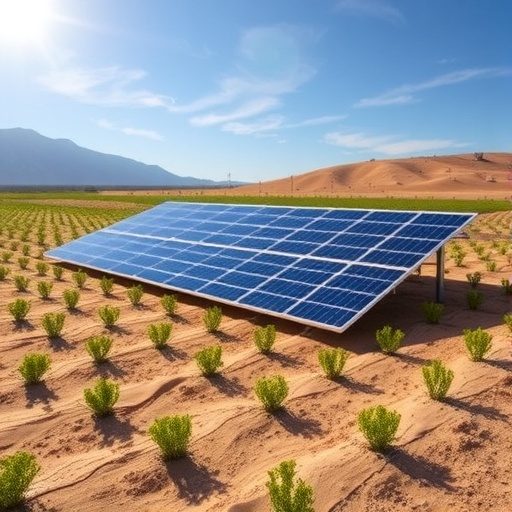
In a groundbreaking advancement poised to revolutionize the future of agriculture, a team of researchers has unveiled a novel solar-powered circular desalination agriculture system. This innovative approach addresses two of the most pressing challenges in modern farming—freshwater scarcity and the environmental toll of conventional, resource-intensive agricultural practices. By integrating solar-driven desalination with a closed-loop, waste-minimizing cycle, this system offers a sustainable and scalable alternative capable of transforming coastal farming regions worldwide.
Conventional agriculture, especially in coastal zones, faces severe constraints due to the dwindling availability of freshwater resources. Traditional farming methods rely heavily on irrigation water from terrestrial sources, which are increasingly under stress from overuse and climate change. Additionally, linear agricultural systems generate significant waste and environmental pollution, from nutrient runoff to greenhouse gas emissions, exacerbating ecological degradation. These challenges have prompted researchers to seek circular approaches that maximize resource efficiency and minimize environmental impact.
The innovative solution centers around harnessing abundant seawater, a virtually limitless resource for coastal regions, and transforming it into boron-free irrigation water using solar-powered desalination technologies. This process leverages sunlight to drive desalination, thus reducing dependence on fossil fuels and minimizing carbon emissions associated with water purification. The removal of boron, a micronutrient toxic to many plants in elevated concentrations, is a critical enhancement that makes seawater suitable for agriculture, particularly for sensitive crop species.
Central to the system’s productivity is soybean cultivation, chosen for its dual role in food production and provision of value-added derivatives. Soybeans are a protein-rich crop with substantial global demand, making them an ideal candidate for testing and demonstrating the feasibility of the desalination agriculture framework. Importantly, the integration of soybeans within the circular system ensures not only food security but also economic viability, as soy can be processed into various products that cater to local and global markets.
Perhaps the most remarkable feature of this innovation is the ingenious use of residual biomass from the soybean harvest. Instead of discarding the leftover plant material, researchers have developed a method to convert this biomass into bioevaporators and organic fertilizers. These bioevaporators exploit the natural properties of amyloid fibrils—protein aggregates known for structural robustness—to enhance water evaporation rates under sunlight, aiding the desalination process. Meanwhile, the fertilizers produced replenish soil nutrients, sustaining crop growth without the need for synthetic chemical inputs, thus fostering a genuinely circular agricultural cycle.
The efficacy of the system has been empirically validated through a rigorous three-month field trial conducted on Hainan Island. This tropical setting provided a real-world environment to test each component of the cycle in sequence, starting from seed germination, progressing through cultivation and harvest, and culminating in biomass processing and waste upcycling. Results demonstrated not only the successful removal of seawater boron but also the quality and yield of the soybeans grown, alongside the viability of the biomass-derived bioevaporators and fertilizers.
Scaling considerations are pivotal for any agricultural technology aimed at global impact. The research team calculated that scaling the system to cover 0.6 hectares—the approximate agricultural land area allocated per person on average worldwide—could satisfy the daily nutritional needs of 47 individuals. This finding underscores the high land-use efficiency and productivity of the solar desalination agriculture model, positioning it as a compelling solution to feed growing coastal populations sustainably.
Beyond soybeans, the researchers explored the adaptability of the circular system for diverse crops, including those that are more salt-tolerant or commercially valuable. Soil salinity, often a constraint in coastal agriculture, was effectively remediated by the system, restoring soil health and enabling the cultivation of various food and cash crops. This adaptability expands the system’s utility across different agroecological zones and cropping systems, enhancing economic resilience for farmers.
From an energy perspective, solar power plays a critical role in underpinning the sustainability of the circular agriculture framework. By utilizing renewable energy, the system reduces reliance on grid electricity or fossil fuels, significantly lowering greenhouse gas emissions linked to agricultural water pumping and treatment. The synergy between solar desalination and bioevaporative processes creates a low-energy loop that maximizes water-use efficiency without compromising crop yields.
Environmental benefits extend beyond water conservation and energy efficiency. By minimizing waste generation and enabling upcycling of biomass into functional components, the system reduces pollution and soil degradation. The bioevaporators, fabricated using amyloid fibril technology, exemplify a novel utilization of biological materials in environmental engineering, presenting an eco-friendly alternative to synthetic materials commonly used in water treatment and evaporation enhancement.
Economically, the circular desalination agriculture model holds great promise for coastal communities often marginalized by water scarcity and soil salinization. Its ability to generate multiple products—from food to fertilizers—within an integrated system supports diversified income streams and lessens vulnerability to market fluctuations. Such an approach aligns well with emerging models of regenerative and resilient agriculture prioritizing sustainability and community empowerment.
Scientifically, this research merges innovations from materials science, environmental engineering, and agronomy, heralding a new interdisciplinary paradigm for addressing global resource challenges. The use of amyloid fibril-based bioevaporators is particularly noteworthy, representing an innovative material science breakthrough applied pragmatically for agricultural water management. This cross-disciplinary synergy showcases how fundamental scientific discoveries can be translated into tangible solutions for food and water security.
Looking ahead, the research team envisions broader implementation of solar-powered circular desalination agriculture in other coastal and saline-affected regions globally. Ongoing studies aim to refine system components for different climatic conditions and crop types, optimizing performance and cost-effectiveness. The scalability and modularity of the system imply its potential for smallholder farms as well as commercial agricultural enterprises, signaling a transformative pathway for future food production systems.
In summary, by leveraging the synergistic power of seawater, solar energy, soybean biomass, and advanced biomaterials, this new agricultural paradigm presents a comprehensive solution to entwined water, food, and energy insecurities. It offers a promising model to sustainably increase food production, remediate degraded lands, and reduce environmental footprints in coastal farming systems—critical imperatives as the world grapples with the impacts of climate change and population growth.
This innovative solar-powered circular desalination agriculture strategy exemplifies the cutting-edge potential of marrying technological innovation with ecological insight. It rewrites the narrative of what is possible in farming under resource-constrained conditions, setting the stage for resilient, prosperous, and environmentally harmonious agrarian communities. As the global climate crisis intensifies, such visionary approaches will be indispensable in securing a sustainable future for food and water systems worldwide.
Strong foundational research like this not only advances scientific understanding but also inspires actionable pathways for policymakers, industry leaders, and farming communities. By demonstrating that agriculture can be both productive and environmentally regenerative through intelligent design and circular engineering, it challenges entrenched paradigms and opens new horizons for global food security and sustainability.
Subject of Research: Solar-powered circular desalination agriculture utilizing amyloid fibril-based bioevaporators for sustainable food production and soil remediation in coastal environments.
Article Title: Solar-powered circular desalination agriculture enabled by amyloid fibril-based bioevaporators.
Article References:
Xia, M., Song, Y., Yu, J. et al. Solar-powered circular desalination agriculture enabled by amyloid fibril-based bioevaporators. Nat Water (2026). https://doi.org/10.1038/s44221-026-00615-y
Image Credits: AI Generated


