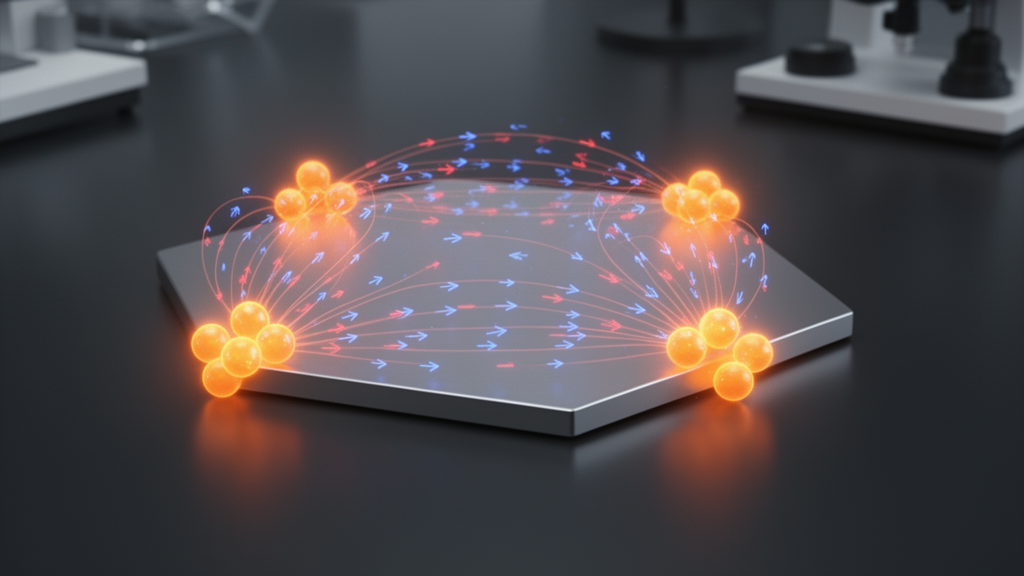
Physicists have been quietly adding new items to the short list of things an electron can be used to count with. Charge came first, then spin, then valley, and now a team of researchers is championing something far more obscure: the corner of a crystal flake. In a mini review published in Frontiers in Physics, Yang Li of Chongqing Youth Vocational & Technical College and Tianjin University surveys a young research field called altermagnetic cornertronics, in which the topological states pinned to the corners of a two-dimensional insulating nanodisk serve as an information degree of freedom, and altermagnetism supplies the spin.
The basic ingredient is a two-dimensional second-order topological insulator. Such a material has a gapped bulk and gapped one-dimensional edges, but it hosts zero-dimensional in-gap states localized at its corners. Because these corner states are well separated in real space, they can in principle be individually addressed and manipulated. Han and colleagues showed that quantum dots built from such insulators possess what they termed corner freedom, and cornertronics aims to use that freedom for information encoding. For the idea to become practical, however, the corner index must be coupled to another physical quantity that can distinguish and selectively address different corner states.
The original proposal achieved this through corner-layer coupling in a nonmagnetic material. In a nanodisk with finite out-of-plane thickness, each corner state carries a layer polarization describing whether it is predominantly localized in the upper or lower part of the structure. If two groups of corner states carry opposite layer polarizations, corner and layer degrees of freedom are coupled, and an out-of-plane electric field shifts the two groups in opposite directions, lifting their degeneracy and enabling electrical control. The TiSiCO-family monolayers, with Ti, Zr, or Hf combined with Si or Ge, were proposed as the first material realization of this mechanism.
Altermagnets add spin to the picture in a distinctive way. In these materials, collinear magnetic moments compensate in real space, so the net magnetization is zero, yet the opposite-spin sublattices are related by crystal rotation rather than by translation or inversion. That symmetry difference allows momentum-dependent spin splitting even without spin-orbit coupling, combining magnetic compensation with spin-polarized electronic bands. When higher-order topology is present as well, corner states can acquire position-dependent spin polarization, opening a route to connect spin with corner freedom.
Two related coupling patterns have emerged. In spin-corner coupling, corner states at different positions carry opposite spin polarizations. In spin-corner-layer coupling, the position of a corner state is correlated with both its spin polarization and its vertical layer localization. Gong and colleagues predicted spin-corner coupling in monolayer Cr2Se2O, an altermagnetic real Chern insulator. This material preserves horizontal mirror symmetry, which forces the layer polarization to vanish and leaves spin as the relevant quantity for distinguishing corner states. In the nanodisk spectrum, two corners on one axis are spin-up while the two on the perpendicular axis are spin-down, so the disk remains spin compensated as a whole while its corner states exhibit position-dependent spin polarization.
Han and colleagues reported spin-corner-layer coupling in the monolayer real Chern insulator Mg(CoN)2. Although it is a monolayer, it consists of five atomic planes arranged as cobalt-nitrogen-magnesium-nitrogen-cobalt, with the magnetic moments on the two outer cobalt planes aligned antiparallel. Its spin-split bands reflect spin-layer locking: the conduction state at one valley is spin-up and mainly localized on the upper cobalt plane, while the state at the opposite valley is spin-down and mainly localized on the lower cobalt plane. The corresponding square nanodisk hosts four in-gap corner states divided into two spin-layer-locked groups. Wang and colleagues subsequently introduced the spin-corner-layer concept explicitly in an AA-stacked bilayer, where a symmetric hexagonal nanodisk hosts four groups of threefold-degenerate corner states, each localized at three of the six corners and carrying a specific spin and layer polarization.
The review also catalogs the material platforms. Beyond Cr2Se2O, a screening of 170 pentagonal two-dimensional materials identified MnS2, MnC2, and CoPSe as altermagnetic semiconductors and established MnS2 as a d-wave altermagnetic second-order topological insulator with spin-polarized corner states; spin-corner coupling with nearly flat edge bands was reported in pentagonal MnC2, and Cr2Se2O with chlorine, bromine, or iodine was proposed as a family of d-wave altermagnetic real Chern insulators that also exhibits ferroelasticity. Engineered routes exist as well: a bismuthene/MnF2 sandwich structure was proposed in which proximity-induced altermagnetism opens an edge gap of roughly 30 meV in a bismuthene layer with a calculated bulk gap near 0.69 eV, producing two in-gap corner states, and stacking two ferromagnetic monolayers with opposite magnetizations was predicted to yield an A-type antiferromagnetic bilayer with d-wave altermagnetism, higher-order topology, and four in-gap corner states in a square nanoflake.
Control strategies are a central theme. Electric fields are the most widely studied: in Cr2Se2O, a potential step shifts the two corner pairs in opposite directions and reversing it switches the net magnetization at half filling, while an in-plane field separates the four corners by position and, at quarter filling, rotating the field selects corner states with opposite spin polarizations. In the AA-stacked bilayer, reversing an out-of-plane field switches both the spin and layer polarizations of the direction-dependent corner states, and increasing the field shifts a calculated absorption peak from roughly 0.5 to 2 terahertz while reducing its intensity, pointing to an electrically tunable terahertz response. In Mg(CoN)2, opposite gate fields shift the spin-layer-locked corner groups in opposite directions. Néel-vector orientation offers another handle: rotating it switches corner-state localization between diagonal pairs in the bismuthene sandwich, and reversing it reverses the spatial distribution of spin-polarized corner states in Cr2Se2O, with ferroelasticity offering a structural route to that reorientation. Mechanical control includes layer sliding, which in the bilayer splits four degenerate corner states into two pairs along diagonal and antidiagonal directions, and strain, where about 1.7 percent biaxial compression drives Cr2Se2O from a second-order topological insulator with corner states to a topological crystalline insulator with mirror-protected edge states, and a broader strain phase diagram has been mapped for related chromium oxides.
Li emphasizes that all of these results are theoretical predictions, and a central next step is connecting them with boundary-resolved measurements. Corner states have already been directly identified in a monolayer of (HITP)2 grown on Au(111), where scanning tunneling microscopy and spatially resolved measurements distinguished corner-localized states from bulk and edge states. For the altermagnetic systems discussed here, however, the predicted corner-dependent spin polarization remains to be experimentally confirmed, and a natural approach would be to extend such real-space measurements to spin-polarized scanning tunneling microscopy or spectroscopy. Finite geometry also matters: the size, shape, and boundary termination of a nanodisk can affect the localization and hybridization of corner states, and preserving the couplings depends on whether the flake geometry retains the relevant global symmetries, which is why the reported calculations used carefully chosen quadrangular and hexagonal nanodisks built from complete unit cells.
The concept may not stop at two dimensions. Three-dimensional materials have been predicted as altermagnetic higher-order topological insulators with fully spin-polarized one-dimensional hinge states, in which the higher-order topological charge depends on the choice of symmetry-related unit cell and the spin polarization of the hinge states depends on the exposed boundary, producing spin-hinge coupling. That extension highlights boundary engineering as a common element linking corner states in two dimensions to hinge states in three. Altermagnetic cornertronics, as the review frames it, brings together higher-order topology, real-space electronic degrees of freedom, and compensated spin polarization, and continued progress in symmetry analysis, material prediction, nanoscale fabrication, and spin-resolved characterization will be needed to establish control of corner and hinge states and to assess their possible roles in topological spintronics.
Subject of Research: Altermagnetic cornertronics, the proposed use of spin-polarized topological corner states in two-dimensional altermagnets as an information degree of freedom
Article Title: Cornertronics meets altermagnetism
Article References: Li, Y. (2026). Cornertronics meets altermagnetism. Frontiers in Physics, 14, Article 1992029. https://doi.org/10.3389/fphy.2026.1992029
Image Credits: AI Generated
DOI: 10.3389/fphy.2026.1992029
Keywords: altermagnetism, cornertronics, topological insulators, spintronics, second-order topology, corner states, spin-corner coupling, layer polarization, two-dimensional materials, real Chern insulator, higher-order topology, condensed matter physics
Cite Scienmag News
Katie Riggs. (October 28, 2026). Altermagnetic Corner States Could Encode Information in the Shape of a Nanodisk. Scienmag. https://scienmag.com/altermagnetic-corner-states-could-encode-information-in-the-shape-of-a-nanodisk/
Katie Riggs. "Altermagnetic Corner States Could Encode Information in the Shape of a Nanodisk." Scienmag, 28 October 2026, https://scienmag.com/altermagnetic-corner-states-could-encode-information-in-the-shape-of-a-nanodisk/. Accessed 29 October 2026.
Katie Riggs. "Altermagnetic Corner States Could Encode Information in the Shape of a Nanodisk." Scienmag. October 28, 2026. https://scienmag.com/altermagnetic-corner-states-could-encode-information-in-the-shape-of-a-nanodisk/