

Friday, November 13, 2026
Science
No Result
View All Result
  • Login
  • HOME
  • SCIENCE NEWS
  • CONTACT US
  • HOME
  • SCIENCE NEWS
  • CONTACT US
No Result
View All Result
Scienmag
No Result
View All Result
Home Science News Technology and Engineering

Almond Shell Waste Turned Into High-Performance Supercapacitor Electrode

October 24, 2026
in Technology and Engineering
Denise Maddox
By Denise Maddox Scienmag Editorial Profile - Mechanical Engineering
Reading Time: 2 mins read
0
Almond Shell Waste Turned Into High-Performance Supercapacitor Electrode

Almond Shell Waste Turned Into High-Performance Supercapacitor Electrode

65
SHARES
587
VIEWS
Share on FacebookShare on Twitter
ADVERTISEMENT

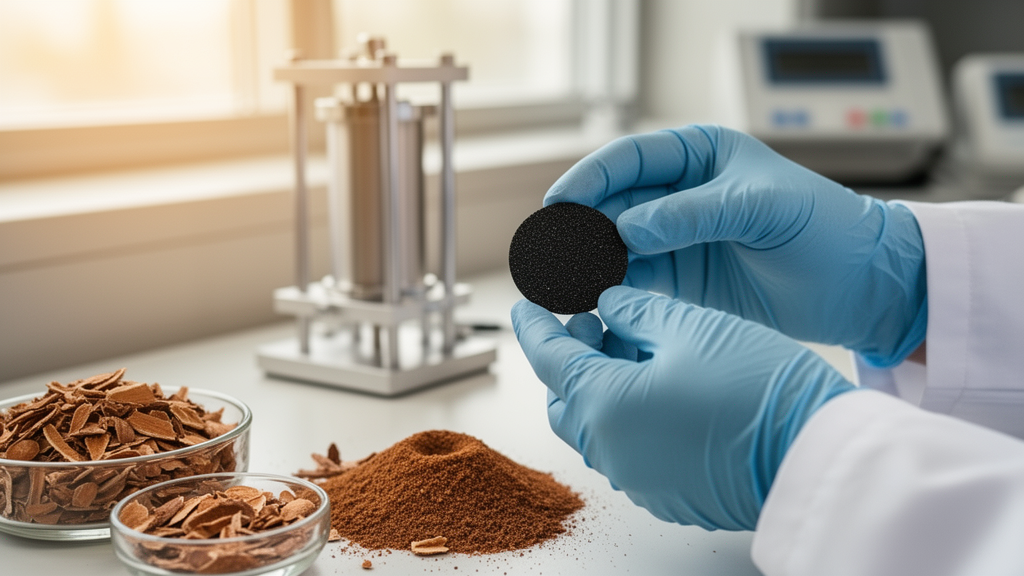
Researchers have converted waste almond shells into an activated carbon electrode material that, when combined with titanium dioxide nanoparticles, delivers a specific capacitance of 914 farads per gram at a current density of 1 ampere per gram. The study, published in the journal Ionics, reports that the composite outperformed the pristine carbon derived from the same biomass, which achieved 599.9 farads per gram under identical testing conditions in 3 molar potassium hydroxide electrolyte.

The team, led by Bernard Amankwah, Perseverance Dzikunu and Emmanuel Gikunoo, processed the Ghanaian agricultural waste stream through a dual chemical treatment. The almond shells were first pre-activated with calcium chloride and then subjected to potassium hydroxide chemical activation, a route the authors describe as a sustainable means of valorizing an underutilized biomass precursor. A portion of the resulting activated carbon was further modified with titanium dioxide nanoparticles to form an AC-TiO2 composite electrode, introducing pseudocapacitive charge storage mechanisms alongside the electrical double-layer capacitance of the carbon scaffold.

Structural characterization confirmed the composition and porosity of the two materials. X-ray diffraction identified the anatase phase of titanium dioxide in the composite, matching reference pattern JCPDS 21-1272, while Fourier-transform infrared spectroscopy and energy-dispersive X-ray analysis verified successful surface modification and elemental integration. Nitrogen adsorption measurements using the BET method revealed a mesopore-dominated structure in both electrodes, with the specific surface area rising from 105.5 square meters per gram for the pristine activated carbon to 144.6 square meters per gram after titanium dioxide incorporation.

Electrochemical performance was assessed using cyclic voltammetry, galvanostatic charge-discharge and electrochemical impedance spectroscopy. The composite’s capacitance advantage translated into higher energy density, which the authors attribute to the synergistic contribution of the metal oxide phase. Both electrodes demonstrated strong cycling durability, retaining at least 95 percent of their capacitance over 5000 charge-discharge cycles, a result the researchers describe as excellent stability for hybrid supercapacitor applications.

Quantitative analysis of the charge storage kinetics distinguished the mechanisms at work in the electrodes. B-value analysis and Dunn’s model both confirmed a mixed capacitive and diffusion-controlled charge storage process, indicating that energy is stored through a combination of fast surface adsorption and slower faradaic reactions rather than a single mechanism. This hybrid behavior is characteristic of composite electrodes in which carbon-based double-layer storage is augmented by pseudocapacitive materials such as transition metal oxides.

The findings position almond shell-derived activated carbon modified with titanium dioxide as a cost-effective and scalable electrode material for high-performance hybrid supercapacitors. By coupling an abundant agricultural waste product with a straightforward two-step chemical activation and a nanoparticle modification, the study offers a route to electrode materials that combine competitive electrochemical metrics with the sustainability credentials increasingly demanded in energy storage research.

Subject of Research: Waste almond shell-derived activated carbon modified with TiO2 as a hybrid supercapacitor electrode

Article Title: Electrochemical performance of waste almond shell-derived activated carbon as a hybrid supercapacitor electrode

Article References: Amankwah, B., Dzikunu, P., & Gikunoo, E. (2026). Electrochemical performance of waste almond shell-derived activated carbon as a hybrid supercapacitor electrode. Ionics. https://doi.org/10.1007/s11581-026-07608-7

Image Credits: AI Generated

DOI: 10.1007/s11581-026-07608-7

Keywords: supercapacitors, activated carbon, almond shells, titanium dioxide, biomass waste, pseudocapacitance, energy storage, electrochemistry, Ghana, cycling stability, Electrochemical, performance

Cite Scienmag News

Denise Maddox. (October 24, 2026). Almond Shell Waste Turned Into High-Performance Supercapacitor Electrode. Scienmag. https://scienmag.com/almond-shell-waste-turned-into-high-performance-supercapacitor-electrode/

Denise Maddox. "Almond Shell Waste Turned Into High-Performance Supercapacitor Electrode." Scienmag, 24 October 2026, https://scienmag.com/almond-shell-waste-turned-into-high-performance-supercapacitor-electrode/. Accessed 13 November 2026.

Denise Maddox. "Almond Shell Waste Turned Into High-Performance Supercapacitor Electrode." Scienmag. October 24, 2026. https://scienmag.com/almond-shell-waste-turned-into-high-performance-supercapacitor-electrode/

Tags: activated carbonAlmond shell waste recycling for supercapacitor electrodesalmond shellsapplication of potassium hydroxide in biomass activationbiomass wastebiomass-derived activated carbon for energy storagecycling stabilitydevelopment of eco-friendly energy storage materialsdual chemical treatment of agricultural wasteelectrochemicalelectrochemistryenergy storageenhanced capacitance in bio-based supercapacitorsGhanaperformanceperformance comparison of pristine vs composite electrodesporosity and surface characterization of activated carbonpseudocapacitancepseudocapacitive charge storage mechanismsstructural analysis of composite electrode materialssupercapacitorssustainable biomass activation methodstitanium dioxidetitanium dioxide nanoparticle composites in supercapacitors
Share26Tweet16
Previous Post

Bait-capture sequencing resolves respiratory virus genomes but often misses co-infections

Next Post

Symmetry-aware Mamba network boosts ultrasound diagnosis of infant hip dysplasia from limited scans

Related Posts

Hybrid Algorithm Improves 6G Massive MIMO Spectral Efficiency in Simulated IoT Networks
Technology and Engineering

Hybrid Algorithm Improves 6G Massive MIMO Spectral Efficiency in Simulated IoT Networks

November 13, 2026
High-Entropy Alloy Particles Substantially Strengthen Friction Stir Processed Aluminum Composites
Technology and Engineering

High-Entropy Alloy Particles Substantially Strengthen Friction Stir Processed Aluminum Composites

November 13, 2026
Machine Learning Models Classify Frailty in Adults With Mild Cognitive Impairment
Medicine

Machine Learning Models Classify Frailty in Adults With Mild Cognitive Impairment

November 13, 2026
Reduced-Order Computational Strategy Accelerates Nonlinear Coupled Thermo-Poroelasticity Simulations
Technology and Engineering

Reduced-Order Computational Strategy Accelerates Nonlinear Coupled Thermo-Poroelasticity Simulations

November 13, 2026
Hypergraph Network Optimizes Solar Electric Vehicle Charging in Grid Simulation Study
Technology and Engineering

Hypergraph Network Optimizes Solar Electric Vehicle Charging in Grid Simulation Study

November 13, 2026
AI Cuts Educational Storage Latency by 71% Using Teaching Cycles
Technology and Engineering

AI Cuts Educational Storage Latency by 71% Using Teaching Cycles

November 13, 2026
Next Post
Symmetry-aware Mamba network boosts ultrasound diagnosis of infant hip dysplasia from limited scans

Symmetry-aware Mamba network boosts ultrasound diagnosis of infant hip dysplasia from limited scans

  • Mothers who receive childcare support from maternal grandparents show more optimized

    Mothers who receive childcare support from maternal grandparents show more parental warmth, finds NTU Singapore study

    27656 shares
    Share 11059 Tweet 6912
  • University of Seville Breaks 120-Year-Old Mystery, Revises a Key Einstein Concept

    1061 shares
    Share 424 Tweet 265
  • Bee body mass, pathogens and local climate influence heat tolerance

    682 shares
    Share 273 Tweet 171
  • Researchers record first-ever images and data of a shark experiencing a boat strike

    546 shares
    Share 218 Tweet 137
  • Groundbreaking Clinical Trial Reveals Lubiprostone Enhances Kidney Function

    531 shares
    Share 212 Tweet 133
Science

Embark on a thrilling journey of discovery with Scienmag.com—your ultimate source for cutting-edge breakthroughs. Immerse yourself in a world where curiosity knows no limits and tomorrow’s possibilities become today’s reality!

RECENT NEWS

  • Agricultural Expansion Accelerates Extreme Runoff in Western Rwanda’s Satinsyi River Basin
  • Patient With Multiple System Atrophy Displays Preserved Striatal Glucose Metabolism
  • Indigenous Fungi Eradicate Invasive Red Palm Weevils in Laboratory Trials
  • Hybrid Algorithm Improves 6G Massive MIMO Spectral Efficiency in Simulated IoT Networks

Categories

  • Agriculture
  • Anthropology
  • Archaeology
  • Athmospheric
  • Biology
  • Biotechnology
  • Blog
  • Bussines
  • Cancer
  • Chemistry
  • Climate
  • Earth Science
  • Editorial Policy
  • Marine
  • Mathematics
  • Medicine
  • Pediatry
  • Policy
  • Psychology & Psychiatry
  • Science Education
  • Science News
  • Social Science
  • Space
  • Technology and Engineering

Subscribe to Blog via Email

Enter your email address to subscribe to this blog and receive notifications of new posts by email.

Join 5,150 other subscribers

© 2026 Scienmag - Science Magazine

Welcome Back!

Login to your account below

Forgotten Password?

Retrieve your password

Please enter your username or email address to reset your password.

Log In
No Result
View All Result
  • HOME
  • SCIENCE NEWS
  • CONTACT US

© 2026 Scienmag - Science Magazine

Discover more from Science

Subscribe now to keep reading and get access to the full archive.

Continue reading

