


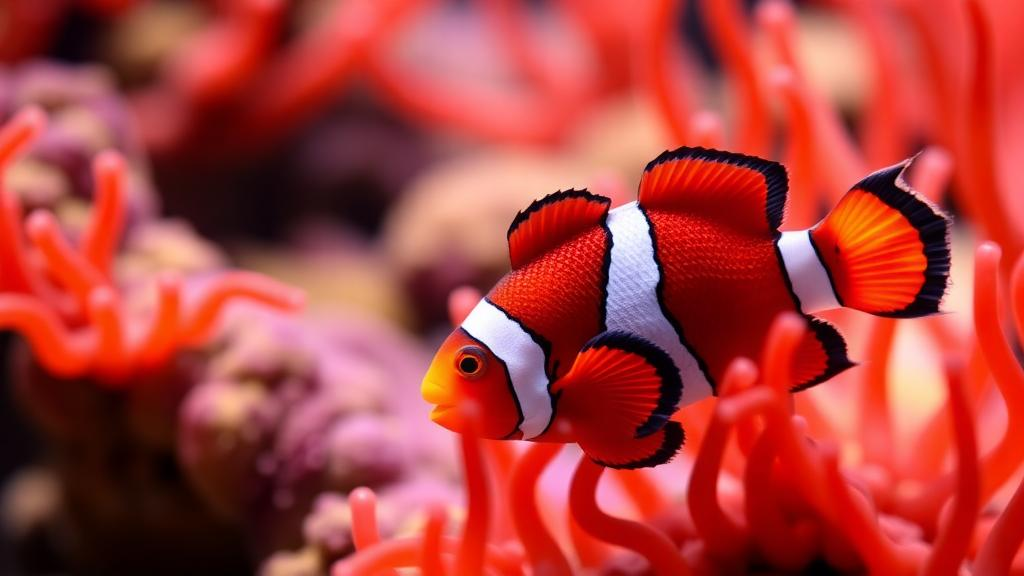
The striking orange-and-white bands of the false percula clownfish, Amphiprion ocellaris, are more than an evolutionary calling card on Indo-Pacific reefs; they are the single most valuable trait in a multi-billion-dollar marine ornamental fish trade. A new feeding trial from researchers at the Federal University of Santa Catarina in Brazil, published in the journal Blue Biotechnology, suggests that the source of the pigment used to boost that coloration matters. Juvenile clownfish fed a diet supplemented with natural astaxanthin extracted from the green microalga Haematococcus pluvialis ended a 60-day trial with significantly redder, more saturated coloration than fish given the same nominal dose of synthetic astaxanthin, even though both supplements improved color compared with a control diet.
The study addresses a persistent challenge in ornamental aquaculture. Fish cannot synthesize carotenoids, the family of pigments responsible for the reds, oranges, and yellows that make reef fish so commercially desirable, so captive animals depend entirely on dietary supply. In the wild, clownfish accumulate carotenoids through their prey; in captivity, formulated feeds must deliver them. Without adequate supplementation, captive-bred specimens often fade to paler versions of their wild counterparts, eroding their market value and, by extension, the economic case for farming rather than wild-capture, which remains a major pressure on reef ecosystems.
Astaxanthin, the ketocarotenoid that colors salmon flesh and flamingo plumage, is widely regarded as the most effective pigmenting compound for fish. It occurs naturally in microalgae, bacteria, and crustaceans, with Haematococcus pluvialis serving as the leading commercial source of the natural form. Synthetic astaxanthin, produced by chemical synthesis, dominates the salmon-feed market because it is cheaper. Beyond coloration, astaxanthin participates in a suite of biological functions: it protects tissues against photooxidation, prevents oxidation of polyunsaturated fatty acids, supports immune responses, and influences reproductive behavior and output. That breadth of activity makes the choice between natural and synthetic sources consequential for animal welfare as well as aesthetics.
The Brazilian team, led by Higor Hoffmann and including colleagues from the university’s Laboratory of Fish and Marine Ornamentals and Laboratory of Algae Cultivation, set out to compare the two sources head to head at low inclusion levels. They randomly assigned 180 five-month-old juvenile clownfish, averaging 0.70 grams in weight and 2.89 centimeters in length, among nine 90-liter blue fiberglass tanks, twenty fish per tank, with three tanks per treatment. The three diets were a commercial control feed, the same feed spiked with synthetic astaxanthin (Carophyll Pink 10%), and feed supplemented with natural astaxanthin from H. pluvialis (Naturose, containing 1.5% astaxanthin). Because the natural product is far less concentrated, the researchers added 1.2 grams per kilogram of the algal product versus 0.18 grams per kilogram of the synthetic one, both targeting an intended dietary astaxanthin concentration of 18 milligrams per kilogram. The pigment was first dissolved in soybean oil and sprayed onto the feed, which was then dried under forced ventilation and stored frozen.
Water quality was tightly controlled throughout the trial in a recirculating system supplied with ocean water from Mozambique Beach in Florianópolis, Brazil, filtered mechanically and biologically, sterilized with ultraviolet light, and conditioned with a foam fractionator. Salinity held at 34.15 parts per thousand, temperature at 26.5 degrees Celsius, dissolved oxygen at 7.13 milligrams per liter, and pH at 8.14, with ammonia and nitrite kept near 0.10 milligrams per liter. Fish were fed twice daily at 4% of tank biomass, and biometric measurements were taken on days 0, 15, 30, 45, and 60 under clove-oil anesthesia. Survival was a perfect 100% in every treatment, and overall growth performance did not differ significantly among diets by the end of the trial, although the natural-astaxanthin group did show significantly greater weight and length than the control at the day-30 measurement.
The real story unfolded in the color data. To quantify pigmentation objectively, the team photographed anesthetized fish individually against a white background under standardized lighting, four 18-watt 6500-kelvin compact fluorescent lamps in a closed room, with an 18% gray card for white-balance correction and yellow and red reference cards for calibration. They then analyzed five body regions, head, dorsal, ventral, pectoral fin, and caudal fin, plus the whole body, converting RGB values from the digital images into the HSB color model, which decomposes color into hue, saturation, and brightness in a way that approximates human perception. Hue, measured in degrees, indicates the authenticity of the color, with values near 0 or 360 degrees corresponding to red; saturation reflects color intensity relative to gray; and brightness runs from black to white. Because saturation and brightness are expressed as percentages, the researchers converted them to radians for parametric analysis.
The hue results were decisive. Fish on the natural-astaxanthin diet showed significant hue reductions, meaning a shift toward deeper red, in all five body regions and across the whole body, with decreases ranging from 25 to 29 degrees and a final whole-body value of 24.7 degrees. The ventral region responded fastest, with significant reddening appearing by day 30, and the head region reached its lowest recorded hue, 23.3 degrees, by day 45. Synthetic astaxanthin produced significant hue shifts in fewer regions and generally later in the trial; in the dorsal region, for example, a significant change appeared on day 45 but reverted to near-initial values by day 60. The authors attribute the early ventral response to the fat-soluble nature of natural astaxanthin and the higher lipid content of the ventral region, which favors pigment accumulation in the chromatophores there.
Saturation told a complementary story. By day 60, fish on the natural-astaxanthin diet displayed higher saturation values, between 81% and 93%, across nearly all skin regions, indicating more intense coloration with less dilution by gray. Notably, the natural group began fluctuating in saturation as early as day 15, while the other groups did not respond until day 45, and despite an initially lower value, the natural group finished with the highest saturation overall. Brightness declined significantly in the ventral and caudal fin regions and for the whole body in the natural group from day 45 onward, a pattern consistent with deeper, richer pigmentation. Chemical verification by HPLC-MS-MS confirmed that astaxanthin was successfully incorporated into the supplemented feeds, with measured concentrations of 16.53 milligrams per kilogram in the synthetic diet and 14.82 milligrams per kilogram in the natural diet, against 10.74 milligrams per kilogram in the control, a baseline presence the authors attribute to salmon meal in the commercial feed.
The findings align with earlier work showing that algal astaxanthin enhances clownfish pigmentation. Lee and colleagues previously reported marked reddening of A. ocellaris by the sixth week of supplementation with H. pluvialis extract at 200 and 400 milligrams per kilogram, considerably higher doses than those used here. Other studies have explored plant-derived alternatives, including carotenoids from gac fruit and bell pepper at 250 milligrams per kilogram, which improved growth and feed efficiency, and blends of paprika, turmeric, and chlorophyll oleoresins that boosted growth metrics. Researchers in Vietnam found that sweet potato and Enteromorpha carotenoids raised skin redness values above control levels. The Brazilian trial is distinctive in demonstrating a clear natural-versus-synthetic advantage at a comparatively modest inclusion level, suggesting that the esterified, protein-associated form of astaxanthin in algal biomass may be more bioavailable to clownfish than the free synthetic compound.
For the ornamental fish industry, the implications are practical and potentially transformative. Clownfish are among the most successfully captive-bred marine ornamentals, and the trade’s sustainability depends on farmed specimens that match or exceed the vibrancy of wild-caught fish. Because coloration is directly tied to market value, a feeding strategy that delivers redder, more saturated fish within a 60-day production cycle, using a renewable microalgal ingredient, strengthens both the economics of hatchery production and the conservation case against reef collection. The authors conclude that H. pluvialis-derived astaxanthin is a valuable tool for aquaculture, with the caveat that optimal dosage and timing still warrant refinement, since previous studies have reported inconsistent requirements. What is already clear is that when it comes to painting Nemo, the alga does it better.
Subject of Research: Effects of natural versus synthetic astaxanthin supplementation on the coloration, growth, and survival of juvenile clownfish Amphiprion ocellaris
Article Title: Natural or synthetic carotenoid: impacts of Haematococcus pluvialis-derived astaxanthin and synthetic astaxanthin on the diet of clownfish Amphiprion ocellaris
Article References: Hoffmann, H., Ozório, R. Á., Lopes, R. G., Owatari, M. S., Tsuzuki, M. Y., & Derner, R. B. (2025). Natural or synthetic carotenoid: impacts of Haematococcus pluvialis-derived astaxanthin and synthetic astaxanthin on the diet of clownfish Amphiprion ocellaris. Blue Biotechnology, 2(1), Article 17. https://doi.org/10.1186/s44315-025-00041-x
Image Credits: AI Generated
DOI: 10.1186/s44315-025-00041-x
Keywords: astaxanthin, Haematococcus pluvialis, clownfish, Amphiprion ocellaris, carotenoids, ornamental aquaculture, fish pigmentation, microalgae, HSB color model, aquaculture nutrition, marine ornamental fish trade, synthetic pigment
Cite Scienmag News
Daisy Hatcher. (September 30, 2026). Algae-Grown Astaxanthin Outshines Synthetic Pigment in Turning Clownfish a Deeper Red. Scienmag. https://scienmag.com/algae-grown-astaxanthin-outshines-synthetic-pigment-in-turning-clownfish-a-deeper-red/
Daisy Hatcher. "Algae-Grown Astaxanthin Outshines Synthetic Pigment in Turning Clownfish a Deeper Red." Scienmag, 30 September 2026, https://scienmag.com/algae-grown-astaxanthin-outshines-synthetic-pigment-in-turning-clownfish-a-deeper-red/. Accessed 16 October 2026.
Daisy Hatcher. "Algae-Grown Astaxanthin Outshines Synthetic Pigment in Turning Clownfish a Deeper Red." Scienmag. September 30, 2026. https://scienmag.com/algae-grown-astaxanthin-outshines-synthetic-pigment-in-turning-clownfish-a-deeper-red/


