


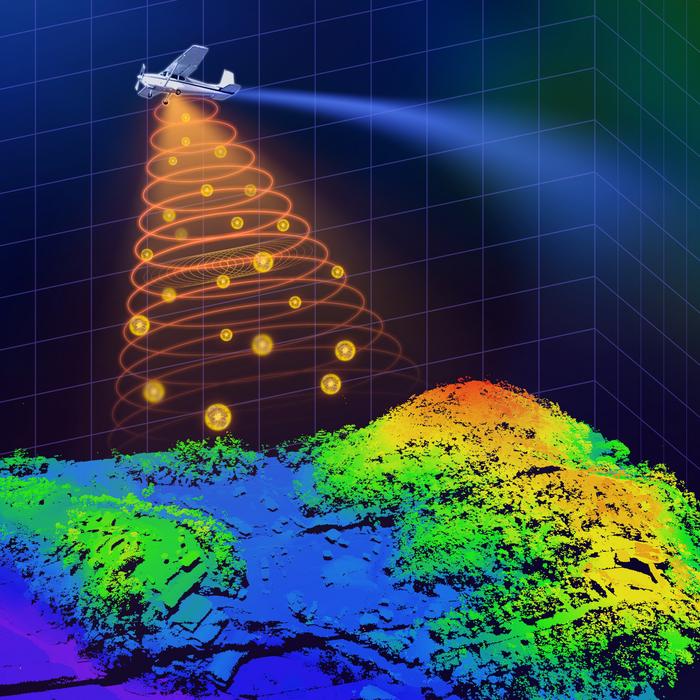
WASHINGTON — Researchers have developed a compact and lightweight single-photon airborne lidar system that can acquire high-resolution 3D images with a low-power laser. This advance could make single-photon lidar practical for air and space applications such as environmental monitoring, 3D terrain mapping and object identification.

Credit: Feihu Xu, University of Science and Technology of China
WASHINGTON — Researchers have developed a compact and lightweight single-photon airborne lidar system that can acquire high-resolution 3D images with a low-power laser. This advance could make single-photon lidar practical for air and space applications such as environmental monitoring, 3D terrain mapping and object identification.
Single-photon lidar uses single-photon detection techniques to measure the time it takes laser pulses to travel to objects and back. It is particularly useful for airborne applications because it enables highly accurate 3D mapping of terrain and objects even in challenging environments such as dense vegetation or urban areas.
“Using single-photon lidar technology on resource-limited drones or satellites requires shrinking the entire system and reducing its energy consumption,” said research team member Feihu Xu from University of Science and Technology of China. “We were able to incorporate recent technology developments into a system that, in comparison to other state-of-the-art airborne lidar systems, employs the lowest laser power and the smallest optical aperture while still maintaining good performance in terms of detection range and imaging resolution.”
In Optica, Optica Publishing Group’s journal for high-impact research, the researchers show that the system has the capability to achieve an imaging resolution that surpasses the diffraction limit of light when used with sub-pixel scanning and a new 3D deconvolution algorithm. They also demonstrate the system’s ability to capture high-resolution 3D images during daytime over large areas aboard a small plane.
“Ultimately, our work has the potential to enhance our understanding of the world around us and contribute to a more sustainable and informed future for all,” said Xu. “For example, our system could be deployed on drones or small satellites to monitor changes in forest landscapes, such as deforestation or other impacts on forest health. It could also be used after earthquakes to generate 3D terrain maps that could help assess the extent of damage and guide rescue teams, potentially saving lives.”
Shrinking single-photon lidar
The new airborne single-photon lidar system works by sending light pulses from a laser toward the ground. These pulses bounce off objects and are then captured by very sensitive detectors called single-photon avalanche diode (SPAD) arrays. These detectors provide enhanced sensitivity to single photons, enabling more efficient detection of the reflected laser pulses so that a lower-power laser could be used. To reduce the overall system size, the researchers used small telescopes with an optical aperture of 47 mm as the receiving optics.
Measuring the time-of-flight of the returned single photons makes it possible to calculate the time it takes for the light to travel to the ground and back. The detailed 3D images of the terrain can then be reconstructed from this information using computational imaging algorithms.
“A key part of the new system is the special scanning mirrors that perform continuous fine scanning, capturing sub-pixel information of the ground targets,” said Xu. “Also, a new photon-efficient computational algorithm extracts this sub-pixel information from a small number of raw photon detections, enabling the reconstruction of super-resolution 3D images despite the challenges posed by weak signals and strong solar noise.”
Ground and air testing
The researchers conducted a series of tests to validate the capabilities of the new system. A pre-flight ground test confirmed the effectiveness of the technique and showed that the system was able to perform lidar imaging with a resolution of 15 cm from 1.5 km away with default settings. Once they implemented sub-pixel scanning and 3D deconvolution, the researchers were able to demonstrate an effective resolution of 6 cm from the same distance away.
The investigators also conducted daytime experiments with the system aboard a small airplane over several weeks in Yiwu City, Zhejiang Province, China. These experiments successfully revealed detailed features of various landforms and objects, confirming the functionality and reliability of the system in real-world scenarios.
The team is now working to enhance the performance and integration of the system, with a long-term goal of installing it on a spaceborne platform such as a small satellite. The stability, durability and cost-effectiveness of the system also needs improving before it could be commercialized.
Paper: Y. Hong, S. Liu, Z.-P. Li, X. Huang, P. Jiang, Y. Xu, C. Wu, H. Zhou, Y.-C. Zhang, H.-L. Ren, Z.-H. Li, J. Jia, Q. Zhang, C. Li, F. Xu, J.-Y. Wang, J.-W. Pan, “Airborne single-photon LiDAR towards small-size and low-power payload,” 11, 5 (2024).
About Optica
Optica is an open-access journal dedicated to the rapid dissemination of high-impact peer-reviewed research across the entire spectrum of optics and photonics. Published monthly by Optica Publishing Group, the Journal provides a forum for pioneering research to be swiftly accessed by the international community, whether that research is theoretical or experimental, fundamental or applied. Optica maintains a distinguished editorial board of more than 60 associate editors from around the world and is overseen by Editor-in-Chief Prem Kumar, Northwestern University, USA. For more information, visit Optica.
About Optica Publishing Group (formerly OSA)
Optica Publishing Group is a division of Optica, Advancing Optics and Photonics Worldwide. It publishes the largest collection of peer-reviewed content in optics and photonics, including 18 prestigious journals, the society’s flagship member magazine, and papers from more than 835 conferences, including 6,500+ associated videos. With over 400,000 journal articles, conference papers and videos to search, discover and access, Optica Publishing Group represents the full range of research in the field from around the globe.
Journal
Optica
Article Title
Airborne single-photon LiDAR towards small-size and low-power payload
Article Publication Date
25-Apr-2024
Cite Scienmag News
Grant Pearson. (April 25, 2024). Airborne single-photon lidar system achieves high-resolution 3D imaging. Scienmag. https://scienmag.com/airborne-single-photon-lidar-system-achieves-high-resolution-3d-imaging/
Grant Pearson. "Airborne single-photon lidar system achieves high-resolution 3D imaging." Scienmag, 25 April 2024, https://scienmag.com/airborne-single-photon-lidar-system-achieves-high-resolution-3d-imaging/. Accessed 3 September 2026.
Grant Pearson. "Airborne single-photon lidar system achieves high-resolution 3D imaging." Scienmag. April 25, 2024. https://scienmag.com/airborne-single-photon-lidar-system-achieves-high-resolution-3d-imaging/

