


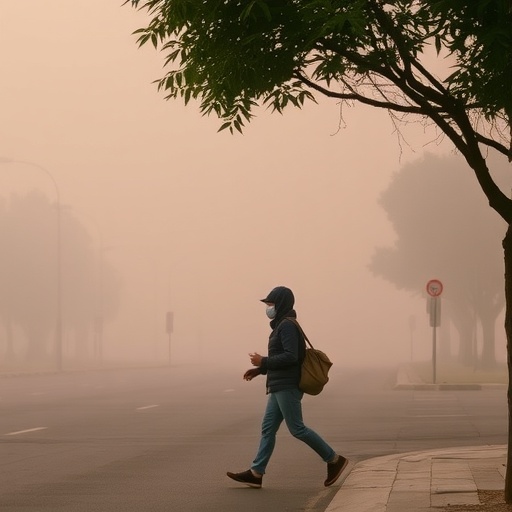
In recent years, the intricate relationship between air pollution and public health has garnered significant attention globally, yet its varying impact on health inequality across different demographic and socioeconomic groups remains insufficiently understood. A groundbreaking study by Yang, Li, Jiang, and colleagues sheds new light on this pressing issue, expertly dissecting how air pollution exacerbates health disparities within China, particularly focusing on vulnerable populations such as women, the elderly, and economically disadvantaged groups. Their research not only elucidates these nuanced dynamics but also explores how China’s innovative Cross-regional Medical Insurance Scheme plays a pivotal role in moderating these inequalities.
At the heart of this investigation lies a comprehensive heterogeneity analysis that spotlights the non-uniform effects of air pollution across different population segments. Employing a two-stage least squares (2SLS) instrumental variable approach, the researchers account for potential endogeneity biases often encountered in environmental health studies. This robust econometric method ensures that the observed correlations between air quality index (AQI) levels and health inequality truly reflect causal impacts rather than mere associations, thereby strengthening the validity of their findings.
One of the most striking revelations of the study concerns gender disparities in pollution-related health inequality. The interaction between AQI and gender yielded a significantly negative coefficient, signifying that air pollution amplifies health inequality for both men and women. However, the magnitude of this effect was notably greater among women. This finding underscores a crucial public health concern: women may face heightened biological or social vulnerabilities that amplify the adverse consequences of polluted environments, making them disproportionately susceptible to broader health inequalities exacerbated by degrading air quality.
Age represents another critical axis of disparity examined in the study. When the sample was partitioned into middle-aged individuals (45–59 years) and the elderly (60 years and above), the data revealed a more severe impact of air pollution on health inequality among the elderly. This age-related vulnerability likely arises from the accumulation of chronic conditions, reduced physiological resilience, and greater exposure to environmental toxins over time, all of which can magnify the detrimental effects of poor air quality and widen the health gap between different population groups.
Importantly, health status itself acts as a prevalent moderator of pollution-induced inequality. Individuals reporting poorer general health—self-rated as “fair,” “poor,” or “very poor”—demonstrated a significantly stronger interaction effect with air pollution exposure. This association signals a vicious cycle wherein those already burdened with compromised health suffer more acutely from environmental hazards, which in turn exacerbates existing disparities and undermines overall public health equity.
Beyond demographic factors, the study delves into socioeconomic statuses that modulate the pollution-health inequality nexus. By dissecting variables such as registered residence, income, and educational attainment, the authors illuminate entrenched social stratifications shaping unequal health outcomes. For instance, rural residents were disproportionately affected by air pollution-induced health disparities compared to urban counterparts. This rural-urban divide highlights the compounded disadvantage rural populations endure, likely attributable to limited healthcare access, poorer infrastructure, and greater environmental exposures.
Economic status further shapes the extent to which air pollution aggravates health inequalities. Using an income threshold based on average annual household income, the evidence pointed to a more pronounced effect among low-income households. This suggests that financial constraints hinder individuals’ abilities to mitigate pollution exposure and afford adequate healthcare, perpetuating a cycle of worsening health disparities exacerbated by environmental insult.
Educational attainment, as a social determinant of health, also influences this interplay. The study found a more significant negative interaction coefficient for individuals with lower levels of education, implying that limited health literacy or reduced employment opportunities may diminish the capacity to cope with and resist pollution-induced health risks. Conversely, those with higher education appeared somewhat shielded from the worst consequences, hinting at education’s protective function in health resilience.
Crucially, the study does not stop at identifying the problem; it innovatively examines a potential mechanism to alleviate pollution-induced health inequality through China’s Cross-regional Medical Insurance Scheme. By analyzing “place of medical insurance enrollment” as a moderating variable, the researchers demonstrate that individuals enrolled in medical insurance schemes in their inflow (migrant) regions suffer less health inequality from air pollution exposure than those relying on hometown-registered insurance. This suggests that healthcare accessibility, enhanced reimbursement policies, and reduced out-of-pocket expenses tied to localized insurance coverage counterbalance some of the adverse effects inflicted by environmental hazards.
These findings underscore the critical role of policy design in mitigating health inequalities, especially in the context of highly mobile populations such as internal migrants. By enabling migrants to access more effective healthcare in their current places of residence, the Cross-regional Medical Insurance Scheme alleviates healthcare disparities that would otherwise exacerbate pollution-driven health inequities. Timely medical intervention and financial risk protection facilitated by this scheme emerge as vital buffers against environmental health shocks.
Methodologically, the researchers’ use of 2SLS instrumental variables is notable for addressing the challenges of endogeneity—where pollution exposure may be correlated with unobserved confounding factors affecting health outcomes. This rigorous approach enhances confidence that the documented relationships indeed derive from causal effects rather than spurious correlations. Such methodology sets a benchmark for future environmental health inequality research seeking to disentangle complex exposure–outcome linkages.
Moreover, the comprehensive scope of this study, spanning the interplay of gender, age, health status, socioeconomic dimensions, and institutional factors, offers a holistic understanding of air pollution’s multifaceted impacts on health disparities. It paints a sobering picture of how environmental stressors compound existing social vulnerabilities, yet simultaneously provides a blueprint for targeted interventions through social policy reforms.
The implications of this research resonate far beyond China’s borders. As urbanization accelerates worldwide and air pollution remains a persistent global threat, the elucidation of population-specific susceptibilities and the efficacy of insurance-based mitigation strategies offer valuable lessons universally. Policymakers, healthcare providers, and environmental experts can draw upon these insights to design equitable health protection mechanisms that incorporate environmental justice considerations.
Furthermore, the study advocates for inclusive social insurance systems that adapt to migratory patterns and regional healthcare disparities—a crucial dimension in many developing nations experiencing rapid internal migration. By aligning health insurance schemes with individuals’ actual living environments rather than mere registration locales, governments can bolster health equity amidst environmental challenges.
In conclusion, this pioneering research by Yang and colleagues decisively links ambient air pollution to widening health inequalities among vulnerable population subgroups in China. It highlights the disproportionate burdens borne by women, the elderly, low-income, less-educated, and rural residents, while spotlighting the salutary moderating effect of Cross-regional Medical Insurance enrollment. This nuanced exploration, grounded in rigorous econometric analysis, offers critical guidance for policymakers aiming to curtail the health inequities intensified by environmental degradation.
As the world grapples with escalating environmental crises, understanding and addressing the heterogeneous impacts of pollution on health equity becomes ever more urgent. Studies such as this pave the way toward informed and inclusive solutions that safeguard the most at-risk populations, ensuring that economic development and environmental protection advance hand in hand with social justice and health equality.
Cite Scienmag News
Phoebe Ingram. (August 21, 2025). Air Pollution’s Impact on Migrant Health Inequality. Scienmag. https://scienmag.com/air-pollutions-impact-on-migrant-health-inequality/
Phoebe Ingram. "Air Pollution’s Impact on Migrant Health Inequality." Scienmag, 21 August 2025, https://scienmag.com/air-pollutions-impact-on-migrant-health-inequality/. Accessed 3 September 2026.
Phoebe Ingram. "Air Pollution’s Impact on Migrant Health Inequality." Scienmag. August 21, 2025. https://scienmag.com/air-pollutions-impact-on-migrant-health-inequality/


