

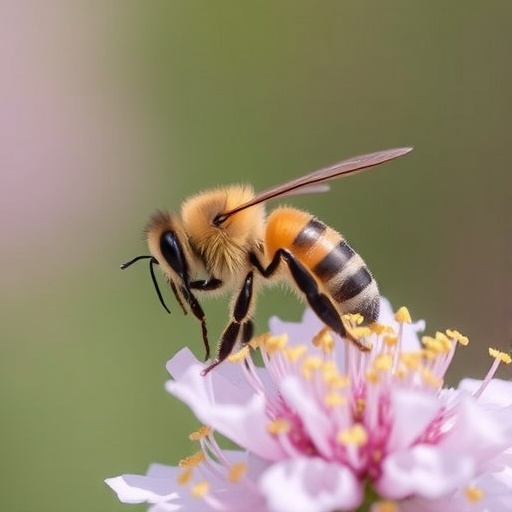
In recent years, environmental scientists and ecologists have raised alarms about the pervasive impact of air pollution on ecosystems worldwide. A new groundbreaking study published in Communications Earth & Environment reveals a profound and previously underestimated consequence of air pollution—its capacity to disrupt the olfactory perception of floral scents by honeybees. This disruption could have cascading effects not only on pollination dynamics but also on the broader health of ecosystems dependent on these vital pollinators. By employing a novel perceptual model, researchers demonstrate that airborne pollutants alter the chemical composition and consequently the detectability of floral scent signatures, ultimately impairing honeybees’ ability to recognize flowers crucial for their foraging behavior.
Honeybees rely heavily on their sophisticated olfactory systems to navigate the landscape of flowers and identify the nectar-rich species they must visit to sustain their colonies. Flowers emit complex mixtures of volatile organic compounds (VOCs) that serve as chemical cues, and these olfactory signals are finely tuned to honeybee receptors. However, when air pollution introduces a cocktail of reactive gases such as ozone, nitrogen oxides, and particulate matter, these beautiful botanical messages risk distortion or obfuscation. The study in question ventures beyond correlation and utilizes a perceptual model that predicts how pollution-induced chemical shifts affect honeybee scent recognition with remarkable precision.
The perceptual model integrates laboratory analyses of floral VOC emissions with atmospheric chemistry data to simulate how different pollution scenarios degrade or chemically alter these signals before reaching a bee’s antennae. Traditional studies have examined the chemical degradation of floral scents in polluted air, but this model effectively embeds the physiological aspect by mapping chemical changes onto known olfactory receptor responses in honeybees. This novel approach not only highlights the chemical transformations but also the sensory consequences, bridging a crucial gap between environmental chemistry and neuroethology.
One of the key findings is that pollutants such as ozone undergo rapid reactions with many VOCs emitted by flowers, causing the original scent profile to fragment into altered chemical products or to vanish altogether. These chemical transformations can strip away critical components of the floral scent bouquet, leaving honeybees with incomplete or misleading olfactory information. Since honeybees learn to associate specific floral scents with nutritional rewards, any distortion can lead to visitation errors, wasting foraging energy and reducing the efficiency of nectar and pollen collection.
The implications of these findings extend far beyond the individual bee’s experience. As honeybees are essential pollinators for a large fraction of agricultural crops and wild plants, disruptions in their foraging efficiency may lead to reduced seed set, diminished fruit yields, and ultimately, biodiversity loss in affected habitats. The perceptual model estimates that in moderately to heavily polluted environments, recognition failure rates could increase dramatically, posing a genuine threat to ecosystem stability and resilience.
From a technological standpoint, the research team utilized advanced chemical sensors and gas chromatography paired with mass spectrometry to identify and quantify VOCs emitted by several plant species commonly visited by honeybees. This empirical chemical data fed into atmospheric reaction models simulating typical pollution conditions found near urban and agricultural interfaces. By coupling these simulations with neurobiological data about honeybee olfactory receptor sensitivities, they constructed a comprehensive predictive framework capable of forecasting real-world impacts on bee olfaction.
Moreover, the model highlights an intriguing spatial dimension—floral scent recognition impairment is more intense in proximity to busy roadways and industrial zones where pollutant concentrations spike rapidly. Conversely, in rural or less polluted environments, the integrity of floral scent signals remains comparatively intact, underscoring the heterogeneity of air pollution’s ecological impacts. This spatial variability also informs conservation strategies by identifying geographical areas where mitigation efforts could be targeted to preserve pollination services.
The study also emphasizes temporal fluctuations, revealing that diurnal and seasonal variations in pollutant levels can differentially modulate the degradation of floral scents. For example, ozone concentrations typically peak during hot afternoons which corresponds paradoxically with peak foraging activity of honeybees. This temporal overlap intensifies the likelihood that foraging bees are encountering distorted floral olfactory cues, thereby exacerbating the problem during critical feeding intervals.
Scientifically, the implications of disrupted floral scent recognition on honeybee behavior prompted the researchers to speculate about potential adaptive mechanisms. Honeybees might partially compensate by relying more on visual cues or by flexibly adjusting their foraging patterns, but the extent and limits of such behavioral plasticity remain largely unexplored. This opens new avenues demanding interdisciplinary studies linking environmental chemistry, sensory biology, and behavioral ecology to fully understand pollinator resilience under pollutant stress.
The ecological stakes could be dire if air pollution continues unchecked. Honeybee colony health has already been threatened globally by multiple stressors such as pathogens, pesticides, habitat loss, and climate change. Adding compromised sensory perception exacerbates this multifactorial syndrome, potentially accelerating declines in pollinator populations. Given that over 75% of flowering plants worldwide require animal pollinators, these findings foreshadow destabilizing ripples through global food webs and agriculture-dependent economies.
Encouragingly, the study suggests that reducing emissions of key reactive pollutants could restore the integrity of floral scent signals and thus improve the foraging success of honeybees. Regulatory policies curbing industrial emissions and vehicular exhaust could have immediate benefits for pollinator ecosystems. Furthermore, urban planners and conservationists might consider integrating pollution sinks like increased vegetation buffers to protect critical pollination corridors, creating pockets of cleaner air that promote robust floral-bee interactions.
In addition to guiding policy, the perceptual modeling approach developed by Sprayberry, Girling, Ryalls, and colleagues has far-reaching scientific potential. It offers an innovative template for analyzing how other pollinator species—including moths, butterflies, and flies—might be impacted by air quality changes, as many of these species similarly rely on olfactory cues. Future research building upon this framework could also explore how plant species might evolve altered scent emission strategies to adapt to polluted environments, potentially triggering evolutionary feedback loops in plant-pollinator networks.
The research team’s integration of chemical ecology with sensory neuroscience exemplifies the power of cross-disciplinary approaches necessary to tackle complex environmental challenges. By translating chemical atmospheric phenomena into biological perceptual outcomes, the study pioneers a paradigm shift in understanding anthropogenic impacts on pollination ecology. This study serves as a vivid reminder that air pollution’s reach extends beyond visible smog or respiratory health, permeating the invisible realm of chemical communication essential for life on Earth.
In conclusion, the compelling findings from this perceptual model spotlight a critical yet overlooked pathway through which air pollution imperils honeybee populations and, by extension, global ecosystems reliant on effective pollination. As evidence mounts of the intimate links between atmospheric chemistry and biological sensory function, environmental policies must prioritize cleaner air to safeguard these indispensable natural systems. Honeybees, often symbolic of ecological health, now emerge as sensitive sentinels of chemical disruption—sentinels urging humanity towards cleaner, more sustainable coexistence with the environment.
Subject of Research:
Impacts of air pollution on honeybee floral scent recognition and foraging behavior through a perceptual model integrating atmospheric chemistry and honeybee olfactory biology.
Article Title:
A perceptual model indicates air pollution-induced shifts in honeybee floral-scent recognition.
Article References:
Sprayberry, J.D.H., Girling, R.D., Ryalls, J.M.W. et al. A perceptual model indicates air pollution-induced shifts in honeybee floral-scent recognition. Commun Earth Environ (2026). https://doi.org/10.1038/s43247-026-03351-z
Image Credits:
AI Generated


