


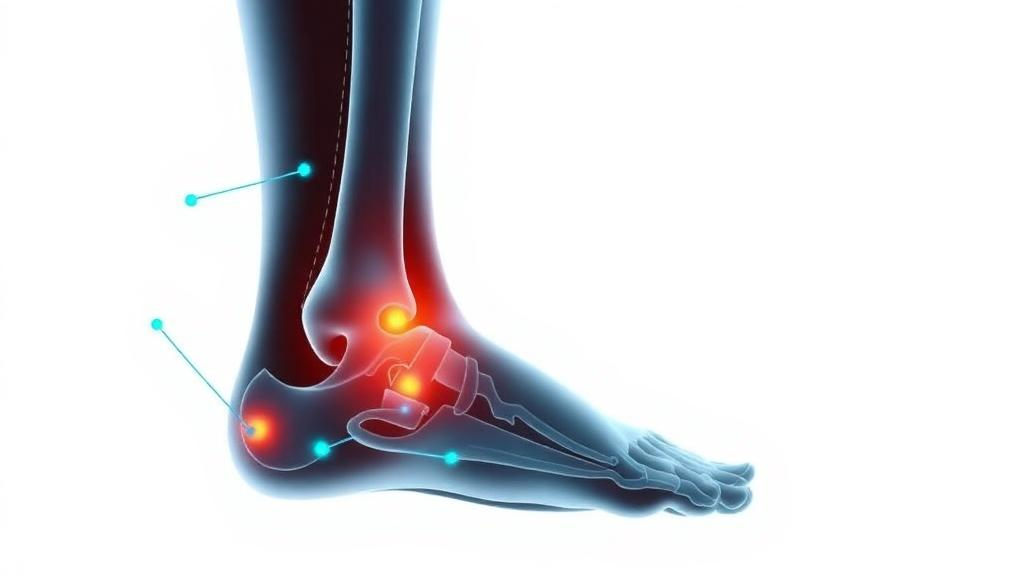
Ankle sprains are among the most common musculoskeletal injuries on the planet, and for a stubborn minority of patients they never truly heal. Roughly a quarter of people who sprain an ankle go on to develop chronic ankle instability, a condition defined by repeated episodes of the joint giving way, lingering mechanical laxity, and long-term functional impairment. Yet despite how widespread the problem is, clinicians still diagnose it largely the way they did decades ago: with manual tests such as the anterior drawer and talar tilt maneuvers, stress radiography, and subjective observation of gait. These methods show variable agreement between examiners and limited consistency across repeated measurements, leaving room for missed diagnoses and inconsistent classification. A new systematic review now suggests that artificial intelligence could change that picture dramatically, while also cautioning that the field is not yet ready for the clinic.
The review, published in Discover Artificial Intelligence and conducted according to PRISMA guidelines with prospective registration in PROSPERO, systematically searched PubMed, Scopus, Web of Science, and Google Scholar up to July 27, 2026. From 2,182 records identified, the researchers led by Parsa Samaei and colleagues at the University of Tehran ultimately included thirteen studies published between 2022 and 2026. Each study applied some form of artificial intelligence, from conventional machine learning to deep neural networks, to the diagnosis, classification, or subtype identification of ankle instability. The team then appraised the methodological quality and risk of bias of every included study using PROBAST + AI, a specialized assessment tool designed for prediction models in medicine.
The headline result is striking. Across the five studies that evaluated diagnostic performance, reported area under the receiver operating characteristic curve values ranged from 0.892 to 0.999, figures that approach the theoretical maximum for a diagnostic test. The strongest results came from imaging. Transfer learning models built on ultrasound images of the ankle, using architectures such as EfficientNet, ResNet-50, and MobileNetV2, achieved AUC values between 0.995 and 0.999 for diagnosing chronic lateral ankle instability. A transformer-based multilabel network called AnkleNet detected lateral and medial ligament injuries on magnetic resonance imaging with AUC values of 0.910 and 0.892 respectively, and notably improved the diagnostic performance of the clinicians who used it. A radiomics-based approach even detected subtle architectural changes in cartilage and subchondral bone that are invisible to conventional image reading, reaching an AUC of 0.921.
Perhaps most intriguing for everyday medicine, the review found that advanced imaging is not the only path to accurate AI diagnosis. One study equipped shoes with integrated sensors and used an XGBoost model trained on plantar pressure and inertial sensor data to identify individuals with chronic ankle instability, achieving 93.39 percent accuracy and an AUC of 0.959, while also predicting rehabilitation probability in ways that correlated with clinical recovery. Another deep learning system automatically assessed weight-bearing ankle radiographs, correlating strongly with expert clinician measurements of talar tilt and anterior talar translation. These results suggest that AI could eventually serve as a quantitative second reader, supporting rather than replacing clinical expertise.
Classification studies, which used biomechanical, neuromuscular, and clinical data rather than imaging, reported equally eye-catching numbers. A ConvLSTM model trained on gait data augmented with a dual generative adversarial network achieved 100 percent accuracy, albeit in a small laboratory sample of just thirteen participants. A graph neural network combined with attention reinforcement learning, dubbed GaitNet, reached 96 percent accuracy and an AUC of 1.00 on three-dimensional gait kinematics. A hybrid convolutional neural network and random forest model identified neuromuscular deficits from surface electromyography during unanticipated landing tasks with 96 percent accuracy and an F1-score of 0.95. Even conventional algorithms performed well: random forest reached an AUC of 0.967 using heel-rise kinematic variables, and support vector machines achieved AUC values above 0.80 using anthropometric and functional measurements in delivery workers.
One study pushed beyond diagnosis altogether. Using unsupervised k-means clustering, researchers identified five clinically meaningful subtypes of chronic ankle instability, hinting that what clinicians currently treat as a single condition may in fact be several distinct disorders with different mechanical and functional signatures. If confirmed, this could open the door to genuinely personalized rehabilitation, targeting interventions to the specific impairments that define each patient’s subtype rather than applying one-size-fits-all protocols.
But the review’s authors are careful to pour cold water on the temptation to declare victory. When they applied the PROBAST + AI tool, seven studies showed low overall risk of bias, five were judged high risk, and one was unclear. The concerns clustered in the analysis domain, covering model development, validation, sample size, and generalizability. Several studies achieved extremely high accuracy using small or highly selected datasets, a classic warning sign of overfitting, where a model memorizes the quirks of its training data rather than learning generalizable patterns. External validation, in which a model is tested on data from an entirely different institution or population, was rare. The authors emphasize that even a low risk-of-bias judgment simply means no major concerns were identified, not that a model is proven robust.
Heterogeneity compounds the problem. The thirteen studies differed in nearly every dimension imaginable: participant populations ranged from athletes to parcel delivery workers to retrospective imaging cohorts of 4,000 patients; input data spanned MRI, ultrasound, radiographs, gait kinematics, electromyography, wearable sensors, questionnaires, and anthropometric measurements; and the AI architectures ranged from logistic regression and naive Bayes to transformers, graph neural networks, and generative adversarial networks. Because each study reported different performance metrics on different tasks with different reference standards, the numbers cannot be directly compared, and no single algorithm can yet be crowned superior. The review also notes that its own search excluded IEEE Xplore, EMBASE, and the Cochrane Library, leaving open the possibility that relevant studies were missed.
What emerges is a field moving at remarkable speed but still in its adolescence. The authors conclude that AI-based approaches show substantial potential for supporting the diagnosis and classification of ankle instability across imaging, biomechanical, wearable-sensor, and clinical modalities, but that reported performance should be interpreted as preliminary rather than as evidence of established clinical effectiveness. Their prescription for the road ahead is clear: larger, multicenter studies with standardized reference standards, transparent reporting, rigorous external validation, and prospective clinical evaluation. Until then, the dazzling accuracy figures should be read as a promise of what AI might deliver for the millions of unstable ankles worldwide, not yet as a diagnosis you can expect to receive at your next appointment.
Subject of Research: Artificial intelligence for the diagnosis and classification of chronic ankle instability
Article Title: The role of artificial intelligence for the diagnosis and classification of ankle instability: a systematic review
Article References: Samaei, P., Ebrahimi, E., Molavi, M. R., & Ardakani, M. K. (2026). The role of artificial intelligence for the diagnosis and classification of ankle instability: a systematic review. Discover Artificial Intelligence, 6(1), Article 1306. https://doi.org/10.1007/s44163-026-02412-8
Image Credits: AI Generated
DOI: 10.1007/s44163-026-02412-8
Keywords: artificial intelligence, chronic ankle instability, machine learning, deep learning, diagnosis, classification, ankle sprain, systematic review, wearable sensors, medical imaging, biomechanics, risk of bias
Cite Scienmag News
Blake Davidson. (October 2, 2026). AI Shows Striking Accuracy in Diagnosing Chronic Ankle Instability, Review Finds. Scienmag. https://scienmag.com/ai-shows-striking-accuracy-in-diagnosing-chronic-ankle-instability-review-finds/
Blake Davidson. "AI Shows Striking Accuracy in Diagnosing Chronic Ankle Instability, Review Finds." Scienmag, 2 October 2026, https://scienmag.com/ai-shows-striking-accuracy-in-diagnosing-chronic-ankle-instability-review-finds/. Accessed 4 October 2026.
Blake Davidson. "AI Shows Striking Accuracy in Diagnosing Chronic Ankle Instability, Review Finds." Scienmag. October 2, 2026. https://scienmag.com/ai-shows-striking-accuracy-in-diagnosing-chronic-ankle-instability-review-finds/


