


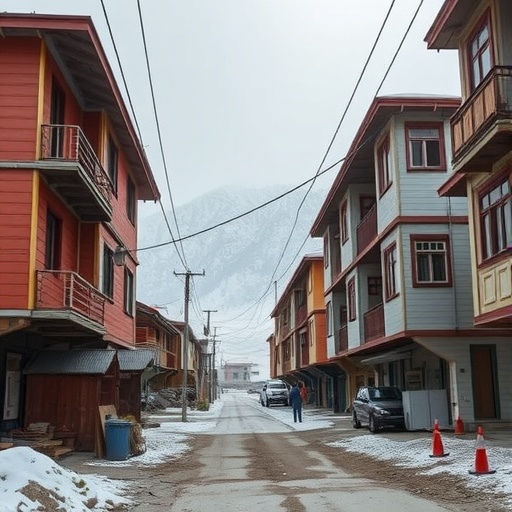
In the wake of the COVID-19 pandemic, global urban landscapes have experienced profound shifts, particularly in informal housing sectors where vulnerable populations reside. A groundbreaking study published in npj Urban Sustainability brings to light previously unseen delays in informal housing development in Mongolia, unveiled through sophisticated AI methodologies. This research not only highlights the complexities of post-pandemic urban recovery but also pioneers the usage of artificial intelligence in analyzing socio-spatial dynamics in rapidly changing environments.
The study focuses on “gers,” the traditional Mongolian ger dwellings that proliferate on the urban outskirts of Ulaanbaatar, the capital city. Gers symbolize more than housing; they reflect cultural heritage intertwined with the challenges posed by rapid urbanization and climate extremes. Amidst the pandemic, the expansion and improvement of these informal settlements have been notably slowed, a phenomenon meticulously quantified through advanced AI-driven image recognition technologies.
Leveraging satellite imagery and machine learning algorithms, the researchers developed an AI-based ger detection model capable of identifying informal housing clusters with remarkable precision. This technology harnessed multispectral satellite data combined with high-resolution optical images, allowing the differentiation of ger tents from other urban features with unprecedented accuracy. Such technical innovation marks a milestone in remote sensing applications for urban planning and socio-economic research.
The AI system utilized convolutional neural networks (CNN), a class of deep learning architectures particularly adept at image classification and object detection tasks. Through training on vast datasets labeled with ground-truthed locations of gers, the model learned to recognize subtle textural and spectral signatures unique to these informal dwellings. This methodological transparency and rigor in AI training ensured robustness against environmental variabilities like seasonal snow cover and atmospheric interference.
Post-pandemic lockdowns and economic downturns have constrained governmental and non-governmental organizations’ capacity to provide services and infrastructure upgrades in ger areas. The study’s longitudinal analysis covering pre-pandemic to current conditions reveals striking deceleration in housing upgrades and new construction within these communities. These delays compound longstanding issues such as inadequate sanitation, energy scarcity, and vulnerability to harsh winters that disproportionately affect residents.
From an urban sustainability perspective, Mongolia’s situation is a poignant case study of resilience and fragility co-existing. The ger districts, housing nearly 60% of Ulaanbaatar’s population, existed in a state of dynamic flux even before the pandemic. The AI-driven insights illuminate the pandemic’s disruptive role as a stressor exacerbating existing inequalities, impeding urban integration efforts, and threatening public health improvements.
Importantly, the research transcends conventional census and survey methodologies that often miss transient and informal settlements. The scalability and temporal frequency of satellite data allow near-real-time monitoring, empowering policymakers with actionable intelligence. This capability could transform urban governance by enabling targeted interventions and resource allocation even under crisis scenarios.
Furthermore, the technical sophistication of the study showcases interdisciplinary collaboration, melding computer science, urban studies, and social geography. It underscores a paradigm shift where AI tools not only analyze big data but also interpret socio-cultural phenomena grounded in place-based realities. Such integrative approaches are critical for addressing complex urban sustainability challenges in the Anthropocene.
While this AI application is technical, it carries profound humanitarian implications. The capacity to rapidly track informal housing dynamics can support emergency response, inform housing policies tailored to vulnerable populations, and promote inclusive urban development. In Mongolia’s ger districts, this means mitigating health risks amplified by overcrowded living and low access to public services, thereby fostering equitable growth.
Moreover, the study sets a precedent for similar analyses in other global cities grappling with informal settlements, from Asia to Latin America and Africa. The AI model’s adaptability to diverse environmental and urban contexts promises to democratize spatial intelligence, enabling more inclusive and informed urban planning worldwide.
Technological advancement in remote sensing combined with AI also opens pathways for longitudinal studies monitoring environmental impacts, such as urban heat island effects or pollution exposure in ger areas. Such data are vital for designing climate-resilient infrastructure and social programs, especially under rising global temperatures and more frequent extreme weather events.
The pandemic-induced delay documented in Mongolia’s informal housing progress serves as a cautionary tale about the vulnerability of marginalized urban communities to global crises. It reinforces the urgency for resilient, flexible urban systems buttressed by technological innovation and inclusive governance frameworks.
In conclusion, this pioneering research contribution pushes the frontier of urban sustainability studies by applying state-of-the-art AI technology to real-world social challenges. It offers a powerful lens into Mongolia’s ger settlements while setting a roadmap for harnessing AI in transformative urban policy and development. As the world recovers and rebuilds from the pandemic, tools like these are indispensable for creating cities that are not only smarter but fairer and more humane.
Cite Scienmag News
Kristina Jarvis. (September 30, 2025). AI Reveals Post-Pandemic Delay in Mongolian Housing. Scienmag. https://scienmag.com/ai-reveals-post-pandemic-delay-in-mongolian-housing/
Kristina Jarvis. "AI Reveals Post-Pandemic Delay in Mongolian Housing." Scienmag, 30 September 2025, https://scienmag.com/ai-reveals-post-pandemic-delay-in-mongolian-housing/. Accessed 3 September 2026.
Kristina Jarvis. "AI Reveals Post-Pandemic Delay in Mongolian Housing." Scienmag. September 30, 2025. https://scienmag.com/ai-reveals-post-pandemic-delay-in-mongolian-housing/


