


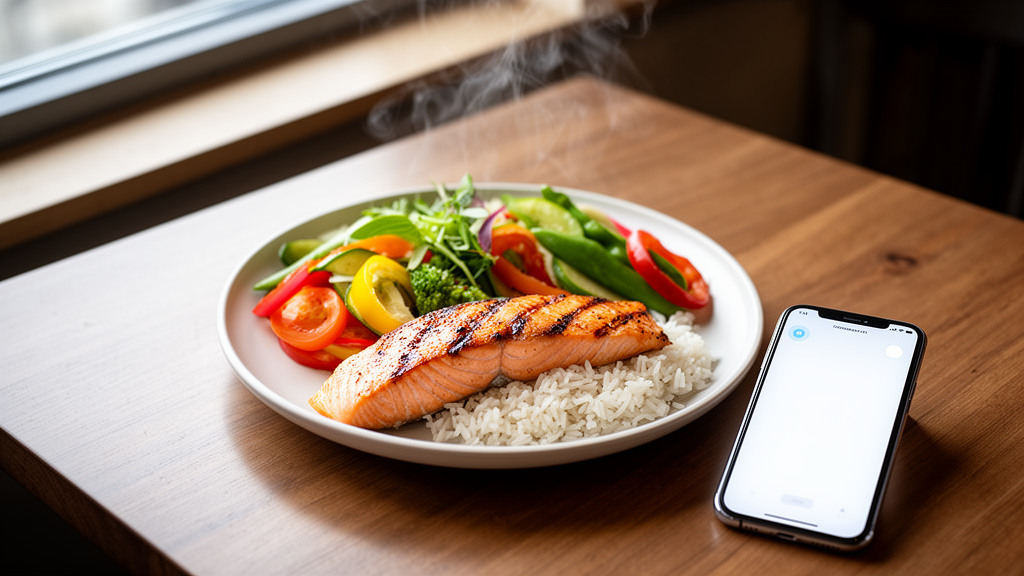
A photograph of a ready-to-eat meal may soon reveal far more than what meets the eye. Researchers at Bohai University in Jinzhou, China, working with a colleague at Hefei University of Technology, have built a Transformer-based multimodal deep learning framework that can assess both the flavor character and the nutritional quality of prepared meals using nothing but product images. The study, published in npj Science of Food, tackles one of the food industry’s most persistent bottlenecks: the slow, destructive, and expensive laboratory analyses traditionally required to verify that a packaged dish tastes good and delivers the nutrients printed on its label.
The premise is audacious. Flavor, after all, is a chemical phenomenon, governed by hundreds of volatile compounds that reach the nose and non-volatile molecules that land on the tongue. Nutritional content, meanwhile, is measured through wet chemistry: protein by Kjeldahl or combustion methods, fat by solvent extraction, carbohydrate by difference or enzymatic assay. None of these quantities would seem to be encoded in the pixels of a photograph. Yet the researchers reasoned that a meal’s appearance carries indirect but systematic information about its composition, from the browning of seared meat to the sheen of rendered fat to the visible proportion of sauce, vegetables, and grain in a tray.
To ground the model in chemical reality, the team first performed a rigorous flavor chemistry characterization of 32 ready-to-eat meal variants spanning pork-, chicken-, and beef-based products. Using headspace solid-phase microextraction coupled with gas chromatography-mass spectrometry, or HS-SPME/GC-MS, they identified 77 volatile flavor compounds across the product set. From these, they screened 22 key odor-active compounds using the odor activity value, a metric that divides a compound’s concentration by its sensory detection threshold; compounds with a value of one or higher are considered genuinely perceptible to human noses. Aldehydes and spice-derived terpenes emerged as the major contributors separating the products from one another, a chemically sensible finding since aldehydes typically arise from lipid oxidation and the Maillard reactions of cooking meat, while terpenes trace back to seasonings such as pepper, star anise, and citrus-derived spices.
This chemical ground truth matters because it anchors what the neural network ultimately learns. Rather than asking the model to guess abstract labels, the researchers tied the image data to measured flavor profiles and physicochemical nutrient indices, allowing the network to internalize the correlations between what a dish looks like and what it contains. The architecture at the heart of the system is the Transformer, the same attention-based design that revolutionized natural language processing. Transformers excel at weighing which parts of an input matter most in relation to every other part, and in a multimodal setting they can fuse heterogeneous streams of information, visual features drawn from images alongside structured chemical and physicochemical descriptors, into a single coherent representation.
The headline result is a classification accuracy of 91.5 percent in distinguishing the 32 meal variants from images alone. For a task that requires separating closely related dishes of the same protein base, that figure suggests the model is picking up on subtle visual cues rather than trivial differences. More demanding still were the regression targets: predicting actual macronutrient content. After an optimization step using a weighted-Huber loss, a robust objective that limits the influence of outlier samples and weights the training signal across classes, the model achieved determination coefficients of 0.86 for protein, 0.80 for fat, and 0.79 for carbohydrate. In practical terms, an R-squared near 0.8 means the image-based predictions explain roughly four-fifths of the variance observed in conventional physicochemical measurements, a level of agreement the authors describe as high consistency with laboratory reference values.
The consumer dimension of the study adds a commercial edge. In a panel of 100 participants, flavor attributes dominated purchase decisions, confirming the industry intuition that taste, not nutrition labels, drives what shoppers actually put in their baskets. Critically, the trained model was able to identify the core flavor descriptors of the products, effectively translating pixels into sensory language. That capability points toward a workflow in which a quality-control engineer photographs a finished dish and receives, within seconds, an estimate of its macronutrient profile and its expected flavor character, without opening a package or sending a sample to a lab.
The implications for centralized kitchens and ready-to-eat meal enterprises are considerable. Modern meal production operates at enormous scale, with single facilities turning out tens of thousands of portions daily. Batch-to-batch variation in raw materials, cooking time, and sauce distribution can shift both flavor and nutrition in ways that periodic lab sampling catches only after the fact. An image-based screening tool could function as a continuous, non-destructive checkpoint on the production line, flagging trays whose appearance deviates from the expected profile before they are sealed, shipped, and reviewed by consumers. Because the method requires only a camera and a trained model, its marginal cost per inspection is close to zero, in contrast to GC-MS runs that require expensive instrumentation, skilled operators, and consumable reagents.
The authors also sketch a consumer-facing trajectory for the framework. A smartphone application that estimates macronutrients and calories from a photo of one’s plate is not a new idea, but existing systems typically rely on generic food recognition and portion heuristics. A model trained on systematic flavor chemistry could go further, offering personalized meal recommendations that account for both nutritional needs and flavor preferences, the two axes the consumer panel showed jointly govern acceptance. For individuals managing diabetes, athletic training diets, or simply the daily question of what to eat, an AI that understands both what a dish contains and what it will taste like represents a meaningful step beyond calorie counting.
Still, the study’s scope invites caution. The model was trained and validated on 32 variants of pork-, chicken-, and beef-based ready-to-eat meals, a deliberately bounded product space. Generalizing to the sprawling diversity of global cuisine, with its vast range of plating styles, lighting conditions, and ingredient combinations, will require far larger and more varied datasets. Image-based prediction is also inherently indirect: the model infers chemistry from appearance, so it can be fooled by plating choices, sauces that conceal the food beneath, or lighting that alters perceived browning. The authors position the framework as an AI-assisted quality-control tool rather than a replacement for definitive laboratory analysis, a framing that acknowledges these limits while underscoring the practical value of rapid screening.
What makes the work conceptually significant is its demonstration that flavor, often treated as the least quantifiable of food attributes, can be folded into a multimodal learning pipeline alongside nutrition. By pairing rigorous HS-SPME/GC-MS characterization and odor activity analysis with modern deep learning, the researchers built a bridge between sensory chemistry and computer vision, two fields that rarely share a vocabulary. If subsequent studies extend the approach across broader food categories and real-world imaging conditions, the humble photograph could become a standard instrument of food science, one that judges a meal the way a hungry, discerning customer would: by how it looks, and by what that appearance promises about taste and nourishment.
Subject of Research: Transformer-based multimodal deep learning for image-based synchronous evaluation of flavor and nutritional quality in ready-to-eat meals
Article Title: Transformer-based multimodal deep learning and its application in flavor-nutrition synchronous evaluation
Article References: Qi, W., Ding, M., Zhang, Y., Wang, B., Shen, C., & Liu, D. (2026). Transformer-based multimodal deep learning and its application in flavor-nutrition synchronous evaluation. npj Science of Food. https://doi.org/10.1038/s41538-026-01186-8
Image Credits: AI Generated
DOI: 10.1038/s41538-026-01186-8
Keywords: deep learning, Transformer, multimodal AI, flavor chemistry, food nutrition, ready-to-eat meals, GC-MS, volatile compounds, odor activity value, food image recognition, quality control, macronutrient prediction
Cite Scienmag News
Daisy Hatcher. (October 8, 2026). AI Reads a Meal’s Photo to Judge Its Flavor and Nutrition. Scienmag. https://scienmag.com/ai-reads-a-meals-photo-to-judge-its-flavor-and-nutrition/
Daisy Hatcher. "AI Reads a Meal’s Photo to Judge Its Flavor and Nutrition." Scienmag, 8 October 2026, https://scienmag.com/ai-reads-a-meals-photo-to-judge-its-flavor-and-nutrition/. Accessed 8 October 2026.
Daisy Hatcher. "AI Reads a Meal’s Photo to Judge Its Flavor and Nutrition." Scienmag. October 8, 2026. https://scienmag.com/ai-reads-a-meals-photo-to-judge-its-flavor-and-nutrition/


