


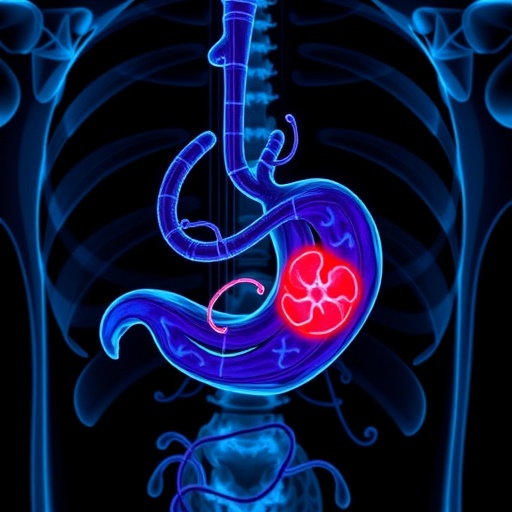
In a groundbreaking advance poised to redefine the clinical landscape of gastric cancer management, a team of researchers has unveiled a pioneering digital biopsy tool powered by deep learning algorithms designed to predict early recurrence in gastric cancer patients. This innovative approach signals a transformative shift in oncological diagnostics, leveraging artificial intelligence to extract nuanced biological insights that remain elusive to conventional pathological assessment.
Gastric cancer remains one of the deadliest malignancies worldwide, largely due to its often-late diagnosis and the high propensity for postoperative recurrence. Early identification of patients at elevated risk of relapse is critical for tailoring adjuvant therapies and improving survival outcomes. Traditional biopsy techniques, while instrumental, are limited by invasiveness and interpretative variability. The advent of a non-invasive digital biopsy method utilizing deep learning heralds a new era in cancer prognostication.
At the heart of this technological leap is a sophisticated neural network architecture trained on vast datasets of histopathological images sourced from gastric cancer patients. By ingesting digitized tissue slides, the model learns to discern complex morphological patterns and subtle features indicative of tumor aggressiveness and recurrence potential. Unlike human observers, these algorithms can integrate multidimensional data, transcending conventional visual analysis to predict biological behavior with unprecedented accuracy.
The digital biopsy does not require additional tissue sampling; instead, it reinterprets existing pathological imaging with computational precision. This paradigm allows for rapid, reproducible assessment without the logistical and ethical challenges of acquiring more invasive samples. Crucially, the model’s predictive capability is calibrated to identify recurrence risk within a clinically relevant early postoperative window, offering oncologists a vital prognostic tool for therapeutic decision-making.
Validation of the model involved rigorous retrospective and prospective clinical cohorts, illustrating its robustness and generalizability across diverse patient populations. The deep learning system consistently outperformed traditional staging metrics and established biomarkers, underscoring the potency of artificial intelligence in refining cancer prognosis. This robustness is attributable to the model’s ability to integrate both spatial tissue heterogeneity and texture-based features that human pathology evaluation often overlooks.
Underlying this success is the model’s architecture, which employs convolutional neural networks (CNNs) optimized for image recognition tasks. CNNs are adept at identifying hierarchical feature representations, capturing low-level edges and textures while contextualizing them within broader morphological frameworks. This hierarchical learning mimics aspects of human visual processing but with the scalability and objectivity of machine computation.
In addition to predicting early recurrence, the system offers interpretability features enabling clinicians to visualize which tissue regions contribute most significantly to risk predictions. This transparency enhances clinical trust and facilitates integrative decision-making, bridging the gap between black-box AI models and practical oncological application. By highlighting histological hallmarks linked to aggressive phenotypes, the tool also fuels ongoing research into gastric cancer biology.
The integration of this digital biopsy into routine clinical workflows promises multiple advantages. It can streamline patient stratification for adjuvant therapy trials, personalize follow-up protocols, and potentially reduce healthcare costs by focusing resources on patients with the highest need. Moreover, its scalability offers promise for deployment in resource-limited settings where expert pathological review is often scarce.
Researchers employed meticulous preprocessing steps to ensure data quality, including stain normalization and artifact removal, which are critical for model accuracy. These technical refinements guard against biases induced by slide preparation variability and enable the model to generalize across different laboratory conditions, an essential feature for real-world application.
Beyond its immediate clinical utility, this study exemplifies the expanding role of digital pathology combined with AI in oncology. The digital biopsy model could serve as a template for similar approaches in other cancer types, where early prediction of recurrence remains a daunting challenge. Extending these methodologies may ultimately facilitate a new generation of personalized oncology care predicated on multi-modal data fusion.
Despite the promise, several challenges remain before widespread adoption. Regulatory approval pathways must adapt to accommodate AI-based diagnostics, and prospective clinical trials are necessary to establish impact on patient outcomes definitively. Additionally, ethical considerations regarding data privacy, algorithmic fairness, and explainability will be paramount to ensuring equitable and responsible deployment.
The researchers foresee continual improvement of the model through incorporation of multi-omics data, including genomic and transcriptomic profiles, harmonizing molecular and morphological insights for even finer prognostic granularity. Such integrative frameworks could elucidate tumor evolution dynamics, resistance mechanisms, and potential therapeutic targets, further enhancing personalized medicine.
In sum, this deep learning-based digital biopsy represents a landmark convergence of pathology, artificial intelligence, and clinical oncology. By transforming static histological images into dynamic, predictive biomarkers, it promises to increase diagnostic precision, tailor treatments, and ultimately improve survival rates for gastric cancer patients worldwide. This innovation stands as a testament to the power of interdisciplinary collaboration in tackling complex medical challenges.
The publication of these findings in Nature Communications underscores the scientific rigor and transformative potential of the work. As the oncology community embraces this new tool, it sets the stage for a future where AI-driven diagnostics are integral to cancer care, offering hope and enhanced clinical pathways for countless patients facing this formidable disease.
Cite Scienmag News
Nathaniel Bowman. (April 15, 2026). AI Predicts Early Gastric Cancer Recurrence via Biopsy. Scienmag. https://scienmag.com/ai-predicts-early-gastric-cancer-recurrence-via-biopsy/
Nathaniel Bowman. "AI Predicts Early Gastric Cancer Recurrence via Biopsy." Scienmag, 15 April 2026, https://scienmag.com/ai-predicts-early-gastric-cancer-recurrence-via-biopsy/. Accessed 3 September 2026.
Nathaniel Bowman. "AI Predicts Early Gastric Cancer Recurrence via Biopsy." Scienmag. April 15, 2026. https://scienmag.com/ai-predicts-early-gastric-cancer-recurrence-via-biopsy/


