


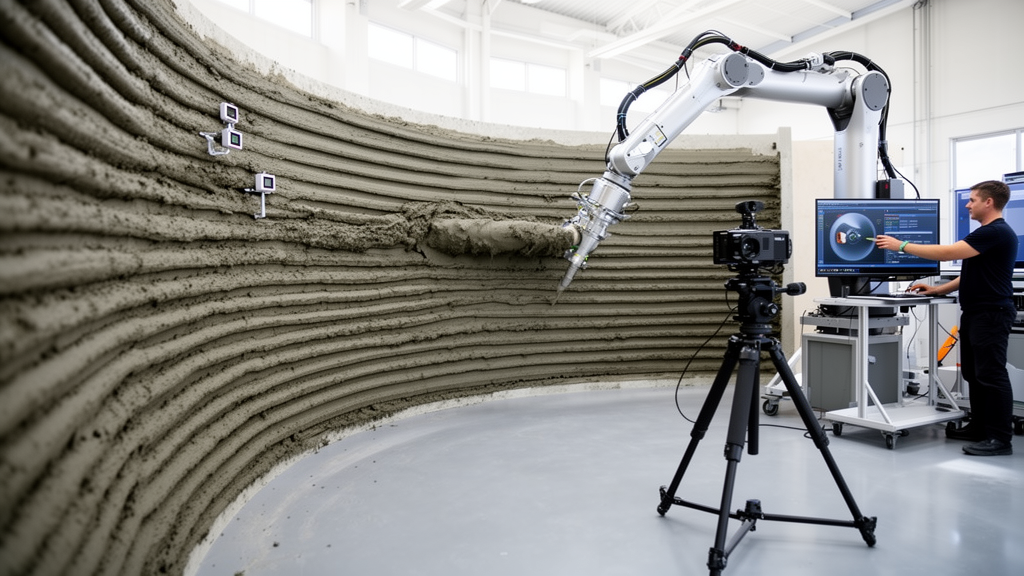
Three-dimensional printed concrete has long promised to free construction from formwork, cut labor demands, and unlock shapes no traditional builder could pour. But the technology has been held back by stubborn problems: printed layers create mechanical anisotropy, printing parameters interact in ways that defy real-time quality control, and the absence of standardized design frameworks has kept printed elements out of serious load-bearing applications. A new open-access review in the journal AI in Civil Engineering argues that artificial intelligence is now the thread capable of stitching these fragmented problems into a single, self-correcting system.
The paper, authored by Li Wang, Zupan Zhang, Yupeng Guo, Jinggang Xu, and Yahong Zhou and published on 8 July 2026, reviews how machine learning, computer vision, and generative design are transforming 3D printed concrete across three core domains: material formulation, printing process control, and structural design and evaluation. The authors describe a paradigm shift from an empirical, open-loop pipeline, in which each stage proceeds blindly from the last, toward a unified cyber-physical framework driven by bidirectional information feedback, where data from printing and structural assessment continuously flow back into material formulation.
To map the field, the team conducted a bibliometric analysis of the Web of Science Core Collection covering 2016 to 2025, using search terms combining artificial intelligence, machine learning, deep learning, computer vision, and neural networks with 3D concrete printing and robotic fabrication topics. After screening under PRISMA guidelines, 58 papers directly relevant to AI and 3D printed concrete were retained for analysis. The publication record tells its own story: research volume in the 3DPC field grew steadily over the decade, with a marked acceleration after 2020, and papers on AI applications in 3DPC surged to 24 in 2024 alone.
A keyword co-occurrence network built with VOSviewer revealed that the field clusters into three largely disconnected research domains: machine learning-based performance prediction, computer vision-based process control, and AI-driven structural design and evaluation. The authors argue this separation highlights a broader fragmentation, with material formulation, real-time control, and structural assessment operating as silos due to the lack of a unified AI integration framework. Their proposed remedy is the closed-loop architecture that structures the entire review.
At the material level, machine learning models are replacing trial-and-error mix design. Because the properties of printed concrete emerge from a complex interplay of mix proportions, fiber content, and process parameters, conventional empirical models fail to capture the highly nonlinear behavior. The review documents how algorithms such as Gaussian Process Regression, Random Forest, and gradient boosting methods predict properties like compressive strength and yield stress from mix and process data. In one highlighted study, Malik and colleagues found that Gaussian Process Regression achieved the best strength prediction performance with an R-squared above 0.91, a notable result because GPR performs robustly on small datasets and, unlike many neural approaches, yields probabilistic outputs that let engineers assess the reliability of predictions rather than trusting bare point estimates.
Interpretability has become a priority as well. Because black-box models make it difficult to judge which inputs matter, researchers have turned to explainable techniques. Using SHAP value analysis, Uddin and colleagues identified polypropylene fiber content, contributing 35.2 percent, and the water-to-binder ratio, contributing 28.7 percent, as the dominant factors governing rheological behavior, while Iqbal and colleagues confirmed that printing orientation, contributing 27.5 percent, decisively influences anisotropic strength. Beyond prediction, AI now enables multi-objective optimization and inverse design: coupling machine learning surrogates with algorithms such as NSGA-II to find Pareto-optimal mixes balancing strength, rheology, cost, and carbon footprint. One study combining NSGA-II with TOPSIS reduced the carbon footprint by 28 percent without compromising printing and mechanical properties, and a back-propagation neural network for inverse mix design achieved correlation coefficients above 0.97 on a dataset of 60 mixes.
During printing itself, time-dependent rheological shifts can induce filament deformation, layer misalignment, and tearing, defects that accumulate until dimensional accuracy collapses. The review describes how computer vision closes this gap through a perception-decision-execution loop. Deep learning architectures automatically quantify geometric anomalies and surface defects; semantic segmentation networks have been used to recognize and locate interlayer lines, and point cloud comparative analysis has quantified the error between designed and as-printed geometry. Moving from monitoring to active intervention, researchers have deployed lightweight networks such as MobileNetV1 on microcontrollers for low-latency autonomous defect repair, and an improved Inception-ResNet network to classify filament morphology while continuously regulating extrusion and accelerator injection rates. The authors caution, however, that a trade-off persists between pixel-level precision and inference latency, and that harsh field conditions, shifting natural light and dense cement dust, still degrade the robustness of vision systems.
The equipment itself is evolving from fixed actuators to intelligent mobile platforms. The review highlights a mobile robotic printing system whose three robotic arms cover a production area of roughly 16 by 22 meters, and the Platypus X12, a large off-rail, self-propelled printer from the Australian company Luyten whose telescoping structure expands to an operational envelope of 12 meters wide by 6 meters high and which autonomously compensates for uneven terrain. An AI-driven shotcrete robot integrating a TinyML model and machine vision autonomously identifies and repairs concrete defects up to a spray height of 3 meters, while a UAV platform has demonstrated bench-scale unsupported aerial printing. Multi-agent coordination extends these limits further: dual mobile manipulators have collaboratively printed beams, and the Aerial-AM framework deploys scalable UAV swarms with real-time predictive control to synchronize flight trajectories with material extrusion, though the authors note this aerial work remains preliminary.
At the structural level, AI-driven topology optimization and generative design are unlocking lightweight geometries that traditional construction cannot produce. One topology-optimized lattice beam consumed only 76.8 percent of the standard material volume while retaining 99.7 percent of its load-bearing capacity, and a bio-inspired generative algorithm modeled on mushroom fold structures generated self-supporting toolpaths that mitigated cantilever collapse risks by over 75 percent. AI also underpins performance evaluation at multiple scales, from convolutional neural networks predicting crack morphologies from microscopic pore images, to regression models estimating the ultimate bearing capacity of printed walls, to ensemble and probabilistic models assessing rebar-matrix bond strength with classification accuracy of 97.4 percent. In the field, a smart 3D-printed retaining wall on the A30 highway in the United Kingdom fuses embedded sensor telemetry with LiDAR-generated point clouds to maintain a dynamic digital twin that autonomously evaluates structural integrity.
Despite these achievements, the review is candid about the bottlenecks. Data heterogeneity across tabular mix records, time-series rheology signals, and machine-specific toolpath formats limits model transferability between printing hardware. Purely data-driven models remain physics-agnostic, violating physical laws during extrapolation, and most current physics-regularized models rely on soft loss penalties that trade accuracy against the computational burden of evaluating partial differential equations. Small fragmented datasets restrict generalization, and most frameworks offer deterministic rather than probabilistic outputs, precluding rigorous structural reliability assessment. The authors point toward physics-informed modeling, cross-layer coupling, digital twin interoperability, deep reinforcement learning for autonomous control, and ethical safeguards including explainable AI and human-in-the-loop supervision. By continuously feeding process execution and structural evaluation data back into material formulation, they argue, 3D printed concrete can mature into a fully self-adaptive and autonomous construction ecosystem.
Subject of Research: A review of artificial intelligence applications in 3D printed concrete technology across materials, equipment, and structures
Article Title: AI-powered 3D printed concrete technology: a new paradigm of intelligent construction integrating materials, equipment, and structures
Article References: Wang, L., Zhang, Z., Guo, Y., Xu, J., & Zhou, Y. (2026). AI-powered 3D printed concrete technology: a new paradigm of intelligent construction integrating materials, equipment, and structures. AI in Civil Engineering, 5(1), Article 19. https://doi.org/10.1007/s43503-026-00104-x
Image Credits: AI Generated
DOI: 10.1007/s43503-026-00104-x
Keywords: 3D printed concrete, artificial intelligence, machine learning, computer vision, topology optimization, digital twin, sustainable construction, physics-informed modeling, structural health monitoring, multi-objective optimization, robotic construction, AI-powered
Cite Scienmag News
Denise Maddox. (October 29, 2026). AI Moves 3D Printed Concrete From Open Loop to Closed Loop. Scienmag. https://scienmag.com/ai-moves-3d-printed-concrete-from-open-loop-to-closed-loop/
Denise Maddox. "AI Moves 3D Printed Concrete From Open Loop to Closed Loop." Scienmag, 29 October 2026, https://scienmag.com/ai-moves-3d-printed-concrete-from-open-loop-to-closed-loop/. Accessed 1 November 2026.
Denise Maddox. "AI Moves 3D Printed Concrete From Open Loop to Closed Loop." Scienmag. October 29, 2026. https://scienmag.com/ai-moves-3d-printed-concrete-from-open-loop-to-closed-loop/









