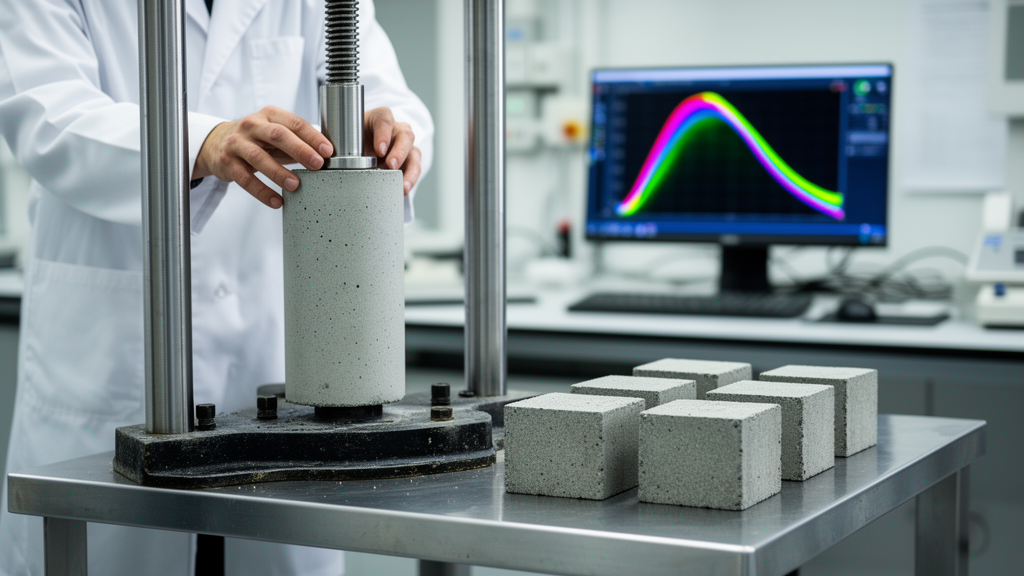
Engineers have long relied on crushing physical specimens of concrete in laboratories to learn how strong a proposed mix will be, a process that consumes raw materials, takes weeks of curing time, and remains vulnerable to human error. A new study published in AI in Civil Engineering proposes a faster alternative: a family of nine hybrid machine learning models that predict the compressive strength of concrete directly from its ingredient composition, with reported prediction errors below one percent on several benchmark datasets.
The work, authored by Sarat Chandra Nayak and Sanjib Kumar Nayak, builds on the Broad Learning System, or BLS, a flat, single-layer network architecture that avoids the deep stacks of hidden layers found in conventional deep neural networks. BLS transforms input data into feature nodes through random mapping, then refines those features with enhancement nodes, connecting everything to the output through a matrix-based least-squares calculation. Because output weights are solved with ridge regression rather than iterative backpropagation, training is fast, and the network supports incremental updates without full retraining. The trade-off is a well-known weakness: the input weights and biases are initialized randomly, and poor random draws can undermine the model’s generalization ability.
To fix that weakness, the researchers coupled BLS with nine metaheuristic optimization algorithms, producing what they call the MBLS framework. Five of these are metaphor-free methods: the three Rao algorithms, the Beat-Mean-Random (BMR) algorithm, and the Best-Worst-Random (BWM) algorithm. The other four, Chemical Reaction Optimization, the Fireworks algorithm, Jaya, and Teaching Learning-Based Optimization, are algorithm-specific but parameter-free. What unites them is that none requires manual tuning of control parameters beyond population size; only the population, the design space, and termination conditions must be set. The metaheuristics search the space of BLS weights, biases, feature node counts, enhancement node counts, shrinkage coefficients, and regularization coefficients, evolving toward an optimal configuration rather than fixing the structure in advance.
The team tested the nine hybrid models, alongside a multilayer perceptron artificial neural network (MLPANN) as a comparator, on four real-world datasets compiled from the literature. Dataset 2, originally collected by Lim and colleagues, holds 104 samples. Dataset 3, from Zhao and colleagues, includes 714 records of tensile strength, with range-valued features replaced by lower bounds and missing values filled by mean imputation. Dataset 4 comprises 676 mixture design samples of alkali-activated materials drawn from peer-reviewed journals. Performance was measured with four metrics: mean absolute percentage error, root mean square error, mean absolute error, and the coefficient of determination R2.
Before training, the authors augmented the data. Because machine learning models degrade when training samples are scarce, they generated interpolated virtual data points midway between adjacent records to augment the training data, then normalized inputs to the range zero to one. Each stochastic model was run ten times per training sample using a moving window approach, with about 80 percent of samples used for training and 20 percent for testing, and the mean error across runs was recorded. Simulations ran in MATLAB 2019b on a desktop with an Intel Core i7 processor, an NVIDIA GTX1650 GPU, and 16 gigabytes of RAM.
The standout result came from the BL-BMR model, which pairs BLS with the Beat-Mean-Random optimizer. On Dataset 1, it achieved a MAPE of 0.9205, RMSE of 2.0080, MAE of 2.8799, and an R2 of 0.9925, meaning it explained more than 99 percent of the variance in strength. On Dataset 2 it recorded a MAPE of just 0.0932 with R2 of 0.9957. On Dataset 3 it again ranked first with MAPE 0.9828 and R2 0.9894, and on Dataset 4 it posted MAPE 0.7485 and R2 0.9895. Across all four datasets, BL-BMR delivered the lowest average MAPE, RMSE, and MAE and the highest R2, with BL-BWR and BL-Rao2 consistently the next best performers. The MLPANN baseline fared worst, which the authors attribute to its hidden-layer architecture and backpropagation-based learning.
Relative to competing models, adopting BL-BMR forecasts yielded MAPE improvements ranging from 8 percent to 84.98 percent on Dataset 1, 57.50 percent to 78.55 percent on Dataset 2, 7.82 percent to 62.74 percent on Dataset 3, and 27.24 percent to 42.76 percent on Dataset 4. A relative worth metric, computed against the least accurate model, gave BL-BMR the highest value at 85.3941. Wilcoxon signed-rank tests and Diebold-Mariano tests of forecast accuracy confirmed that BL-BMR’s predictions differed significantly from those of every comparator, with Diebold-Mariano statistics falling outside the significance range of plus or minus 1.965.
Computational efficiency also favored the hybrid approach. BL-BMR recorded the lowest average execution times on all four datasets: 108.46 seconds, 44.30 seconds, 79.29 seconds, and 77.53 seconds respectively, with BL-BWR nearly identical. The authors credit the fast convergence of the BMR search, its simple mathematical operations, and the absence of hidden layers. The authors also note that no single model dominated every metric on every dataset, which is why they ranked algorithms per dataset before assigning overall positions.
The study is, according to its authors, the first to apply BLS to compressive strength prediction, and it demonstrates that pairing a flat, rapidly trainable network with parameter-free metaheuristics outperformed an MLPANN comparator on these benchmarks. The reported accuracy figures apply to the four datasets examined, all compiled from prior literature, and the models remain stochastic, so repeated runs can vary. The authors acknowledge limitations including the lack of sensitivity analysis across different random seeds and limited interpretability of the trained models. They suggest deterministic feature mapping, ensemble methods, explainable AI techniques, and generative adversarial network-based data augmentation as directions for future work, along with testing on other engineering prediction problems.
Subject of Research: Hybrid broad learning systems with metaheuristic optimization for predicting concrete compressive strength
Article Title: Metaheuristic-based broad learning systems for compressive strength prediction of concrete structures
Article References: Nayak, S. C., & Nayak, S. K. (2026). Metaheuristic-based broad learning systems for compressive strength prediction of concrete structures. AI in Civil Engineering, 5(1), Article 11. https://doi.org/10.1007/s43503-026-00093-x
Image Credits: AI Generated
DOI: 10.1007/s43503-026-00093-x
Keywords: concrete, compressive strength, broad learning system, metaheuristics, machine learning, BMR algorithm, neural networks, civil engineering, prediction models, data augmentation, Metaheuristic-based, broad
Cite Scienmag News
Denise Maddox. (October 30, 2026). AI Model Predicts Concrete Strength With Near-Perfect Accuracy Using Metaheuristic Optimization. Scienmag. https://scienmag.com/ai-model-predicts-concrete-strength-with-near-perfect-accuracy-using-metaheuristic-optimization/
Denise Maddox. "AI Model Predicts Concrete Strength With Near-Perfect Accuracy Using Metaheuristic Optimization." Scienmag, 30 October 2026, https://scienmag.com/ai-model-predicts-concrete-strength-with-near-perfect-accuracy-using-metaheuristic-optimization/. Accessed 30 October 2026.
Denise Maddox. "AI Model Predicts Concrete Strength With Near-Perfect Accuracy Using Metaheuristic Optimization." Scienmag. October 30, 2026. https://scienmag.com/ai-model-predicts-concrete-strength-with-near-perfect-accuracy-using-metaheuristic-optimization/