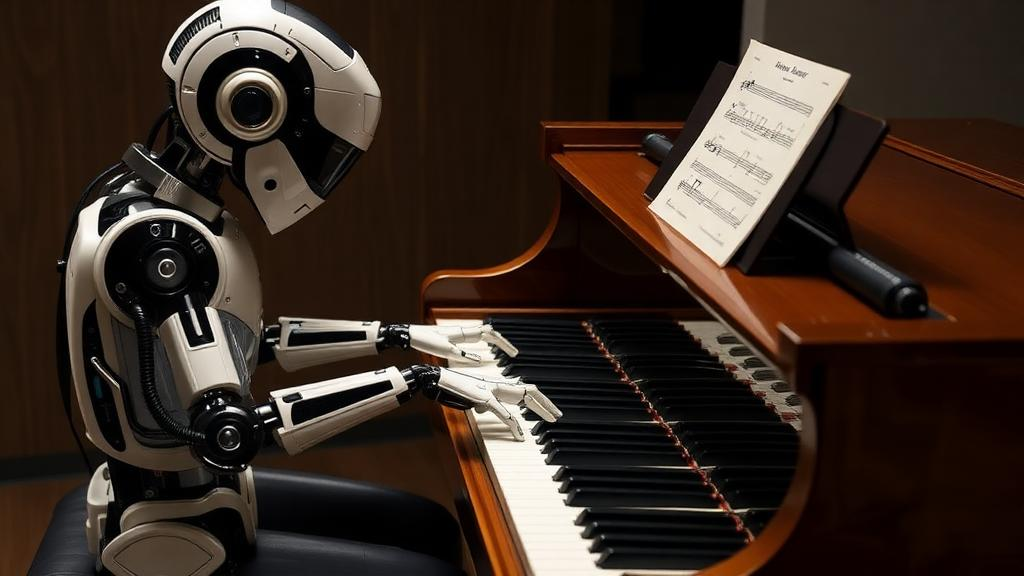
Choosing which finger presses which piano key sounds like a small detail, but it is one of the hardest problems in automated music performance. A single phrase can be fingered in dozens of plausible ways, and the difference between an awkward, jerky passage and a flowing, comfortable one often comes down to decisions made dozens of notes in advance. Now, a team of researchers in Chengdu, China, has built an artificial intelligence system that tackles this problem by fusing three ideas that have usually lived apart: multimodal sensing, a rule-constrained hidden Markov model, and reinforcement learning. The result, described in the journal Discover Artificial Intelligence, is a model that generates piano fingerings matching human annotations far more closely than existing methods, while producing playing paths that are measurably smoother and more comfortable.
The new framework, called Decision-constrained Multimodal Hidden Markov Reinforcement Learning, or DMHRL, was developed by Zhen Zhang of Chengdu Aeronautic Polytechnic University, together with Yaqi Huang of Chengdu Normal University and Hui Lv of Chengdu University of Technology. Their starting point was an observation about how the problem of automatic fingering has traditionally been split. Statistical models such as hidden Markov models are good at capturing local relationships between consecutive notes and fingers, but they judge each transition largely on its own merits. A fingering path that looks probable note by note may still be miserable to play across an entire phrase. Reinforcement learning, by contrast, excels at optimizing long-term cumulative rewards, but when let loose without constraints it happily proposes actions no human hand could execute, such as impossible finger crossings or spans that exceed any comfortable reach.
The insight behind DMHRL is to separate two questions that previous systems tended to blur: which fingerings are physically and biomechanically feasible, and which of the feasible options is actually preferable. To answer the first question, the model builds a decision-constrained hidden Markov model, or DC-HMM, that embeds explicit piano pedagogy rules directly into the state-transition probabilities. Four families of constraints govern the search. A finger-crossing rule rejects transitions in which one finger passes over another in a way that violates continuous movement patterns. A span rule checks whether the interval between adjacent notes exceeds the comfortable range of the current fingering. A chord rule separately evaluates multi-note combinations, and a hand-specific rule keeps left- and right-hand behavior distinct. Any candidate transition that violates a hard constraint is assigned a decision value of zero and simply vanishes from the path search before it can do any damage.
Crucially, the rules are not applied after the fact as a filter on finished output. They act during the Viterbi-style dynamic programming search itself, pruning infeasible branches as the model walks through the score. The rule table is indexed jointly by the previous note, the current note, the previous fingering, and the candidate fingering, so the gating decision is made with full local context. The researchers compiled these rules from standard piano fingering textbooks, prior automatic-fingering studies, and basic finger-movement principles, and verified them manually across different intervals and chord combinations. Importantly, the constraints encode only basic playability. Choices that are legal but differ in comfort are deliberately left untouched, reserved for the next stage of the pipeline.
That next stage is where reinforcement learning takes over. Q-learning, a classic value-based reinforcement learning algorithm, operates inside the feasible action space defined by the DC-HMM. At each decision point, the state consists of the multimodal observation for the current note plus the finger used on the previous note, so the agent always knows where the hand has just been. The reward function blends several comfort-related terms: the comfort of the finger span, the rationality of finger transitions, the continuity with the previous fingering, and a penalty for exceeding the comfort range. Because the maximum Q-value at each step is computed only over feasible actions, the policy can never drift back into territory the rules have already excluded, even during exploration. Training uses a constrained epsilon-greedy strategy, meaning even random exploration is restricted to playable fingerings.
The multimodal component gives both stages richer eyes than a score alone. The symbolic modality encodes pitch, onset time, duration, and velocity from MIDI note sequences, while the acoustic modality extracts short-time energy and envelope features from the actual piano audio. The two streams are aligned on a unified performance timeline, with acoustic frames aggregated within the intervals defined by MIDI onsets and offsets, and all continuous features standardized using training-set statistics. Under a conditional independence assumption, the joint observation probability factorizes into separate MIDI and audio terms given the fingering state. The symbolic stream carries the score structure; the acoustic stream contributes what the performance actually sounded like, including dynamics that never appear explicitly in the notation.
Trained and tested on the MAESTRO dataset of aligned MIDI and audio piano performances, with pieces divided into training, validation, and test sets to prevent leakage, DMHRL posted striking numbers. Fingering accuracy reached 88.7 percent, playing comfort scored 0.81, and the turning index, a measure of how often the fingering path zigzags, dropped to 28. Against four baselines, including a chord HMM, a pitch-difference matching model, a model-based reinforcement learning approach, and an autoregressive LSTM, the improvements were consistent across five independent runs and statistically significant at the 0.05 level. In a cross-dataset test on PianoVAM, a separate collection with independent fingering annotations, the model still achieved 85.9 percent accuracy and outperformed every baseline, suggesting the gains reflect genuine generalization rather than overfitting to one data distribution.
Ablation experiments revealed that each ingredient earns its place. Removing the decision-constrained HMM sent accuracy tumbling from 88.7 to 83.4 percent and pushed the turning index up to 35, confirming that rule-based pruning is what keeps the search in playable territory. Removing the reinforcement learning module cut comfort from 0.81 to 0.74, showing that the Q-learning stage is responsible for the global smoothness that statistical search alone cannot deliver. Feeding the model only MIDI yielded 79.2 percent accuracy, while audio alone managed just 75.6 percent, but combining both modalities lifted a basic HMM to 80.5 percent accuracy and 0.70 comfort, evidence that acoustic features supply dynamic information the symbolic notation cannot express.
The authors are candid about the limits. The rule table, however carefully compiled, can prematurely exclude expressive alternative fingerings in unusual passages such as rapid repeated notes or phrase-specific choices, and a reward function weighted too heavily toward comfort may push the agent toward conservative, unadventurous fingerings. The current experiments also cover offline optimization only; real-time interactive accompaniment would demand inference latency and responsiveness measurements the study did not perform, and technically demanding repertoire such as rapid runs, large leaps, and dense polyphony remains underrepresented in the test data. Future work, the team suggests, could introduce calibratable hand-shape parameters so that beginners and advanced players receive differently tailored candidate spaces, along with expert evaluation of whether the generated fingerings match real performance practice.
Even with those caveats, the architecture carries a lesson that extends well beyond the keyboard. Rather than stacking another neural module onto the pile, DMHRL assigns each decision level to the component best suited to it: multimodal features describe the state, hard rules define the space of legal moves, and reinforcement learning optimizes within that space over the long haul. The same division of labor could apply to any sequential decision problem where physical or regulatory constraints must be respected while still leaving room for learned preference, from robotic motion planning to surgical assistance. For now, though, the most immediate beneficiary may be the aspiring pianist, whose digital practice partner can finally suggest fingerings that a thoughtful teacher would recognize as their own.
Subject of Research: Automatic piano fingering optimization using multimodal hidden Markov models and reinforcement learning
Article Title: Fingering optimization method of an intelligent piano sparring system based on multimodal hidden Markov model and reinforcement learning
Article References: Zhang, Z., Huang, Y., & Lv, H. (2026). Fingering optimization method of an intelligent piano sparring system based on multimodal hidden Markov model and reinforcement learning. Discover Artificial Intelligence, 6(1), Article 1472. https://doi.org/10.1007/s44163-026-02364-z
Image Credits: AI Generated
DOI: 10.1007/s44163-026-02364-z
Keywords: piano fingering, reinforcement learning, Q-learning, hidden Markov model, multimodal AI, music informatics, MIDI, MAESTRO dataset, intelligent piano teaching, sequential decision-making, music technology, artificial intelligence
Cite Scienmag News
Blake Davidson. (October 13, 2026). AI Learns to Play Piano Like a Human by Combining Rules With Reinforcement Learning. Scienmag. https://scienmag.com/ai-learns-to-play-piano-like-a-human-by-combining-rules-with-reinforcement-learning/
Blake Davidson. "AI Learns to Play Piano Like a Human by Combining Rules With Reinforcement Learning." Scienmag, 13 October 2026, https://scienmag.com/ai-learns-to-play-piano-like-a-human-by-combining-rules-with-reinforcement-learning/. Accessed 13 October 2026.
Blake Davidson. "AI Learns to Play Piano Like a Human by Combining Rules With Reinforcement Learning." Scienmag. October 13, 2026. https://scienmag.com/ai-learns-to-play-piano-like-a-human-by-combining-rules-with-reinforcement-learning/