


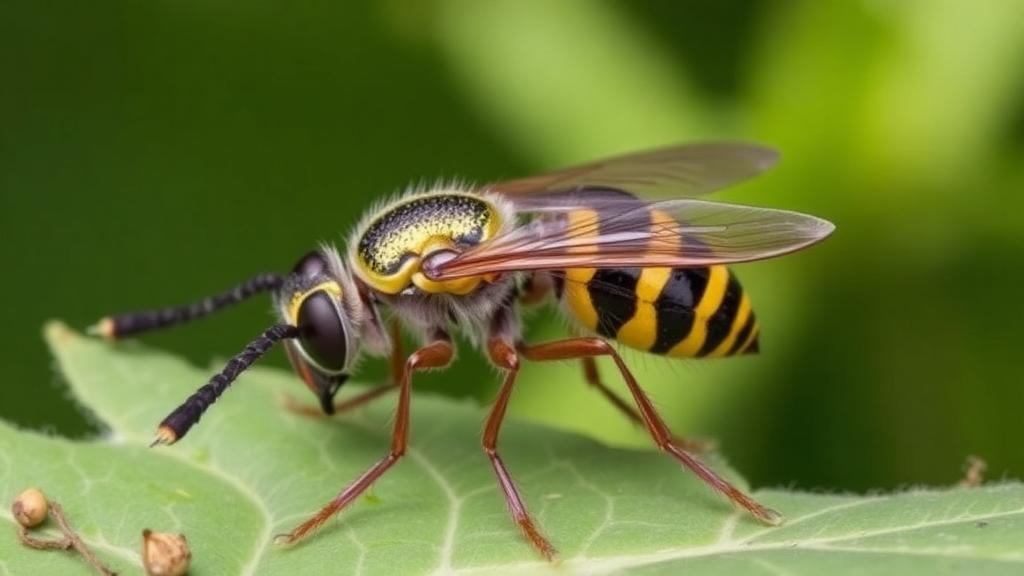
Fine-grained pest recognition has long been one of the most stubborn problems in agricultural artificial intelligence. A farmer or agronomist photographing an insect in the field is rarely rewarded with a clean, studio-style image. Instead, the camera captures the insect against tangled foliage, dappled light, soil, and other insects, all of which conspire to obscure the very features that distinguish one species from another. The challenge is compounded by the fact that many pest species look almost identical to the human eye, differing only in the pattern of wing veins, the shape of an antenna segment, or the spacing of spots along the abdomen. A new study published in Applied Intelligence introduces a vision–language framework called CLARiF, which tackles these difficulties by combining structured diagnostic captioning, mask-guided part extraction, bidirectional part–attribute fusion, and exemplar-informed re-ranking into a single recognition pipeline.
The research team, led by Qiuyu Li and Zhijie Xu of Xi’an Jiaotong-Liverpool University together with colleagues at the University of Liverpool and Zhengzhou University of Light Industry, framed the problem around five recurring obstacles: cluttered backgrounds, life-stage variation, subtle inter-class differences, long-tailed category distributions, and unsupported taxa that the model has never seen during training. Each of these obstacles can derail a conventional classifier. Life-stage variation means that the larva of one species may resemble the adult of another; long-tailed distributions mean that a handful of pest categories dominate the training data while dozens of rare species are represented by only a few images. Unsupported taxa pose an even deeper problem, because a closed-set classifier will confidently assign a label even when the insect in front of it belongs to a species entirely absent from its training set.
CLARiF’s first line of attack is structured diagnostic captioning. Rather than treating an image as an undifferentiated bundle of pixels, the framework generates textual descriptions that follow the logic an entomologist would use at a diagnostic key: body shape, coloration, markings, wing structure, and other morphological clues. This converts the recognition task into something closer to a cross-modal reasoning problem, in which the visual evidence and the verbal description of diagnostic traits must be brought into alignment. The approach draws on the recent wave of vision–language models, including architectures descended from CLIP, Flamingo, BLIP-2, LLaVA, and Qwen-VL, which have demonstrated that pairing images with natural language can dramatically improve generalization on tasks that require fine distinctions.
The second component, mask-guided part extraction, addresses the clutter problem directly. Using segmentation techniques in the lineage of the Segment Anything Model family, the framework isolates the insect from its surroundings before deeper analysis begins. This matters because a classifier that must simultaneously learn what the insect looks like and what the background looks like wastes capacity on irrelevant variation. By constraining attention to the segmented organism, and further to meaningful body parts within it, CLARiF ensures that the features driving a decision correspond to the anatomy of the pest rather than to the texture of a leaf or the angle of the sunlight.
The third element, bidirectional part–attribute fusion, is where the framework earns the alignment half of its name. Visual features extracted from specific body parts are fused with the attribute terms in the diagnostic captions in both directions: parts inform which attributes are present, and attributes guide which parts deserve scrutiny. This bidirectional flow allows the model to reason, in effect, that a particular spot pattern on the forewing supports one species hypothesis while the segment count on the antenna supports another. Such structured reasoning is precisely what separates fine-grained recognition from ordinary object classification, where a single holistic impression of the image is often sufficient.
The fourth component, exemplar-informed re-ranking, borrows an idea from retrieval-augmented systems. After the model produces an initial ranking of candidate species, the framework consults a gallery of reference exemplars and adjusts the ranking in light of the closest matches. This retrieval-informed fusion gives the system a form of case-based memory: even if the learned representations are imperfect, comparison against curated reference images can correct the final decision. The authors report that under comparable data-processing and fine-tuning settings, CLARiF outperformed independently reproduced vision–language baselines while retaining each model’s native language backbone, suggesting that the gains come from the framework rather than from any single underlying model.
The headline numbers are striking. On the official test split of IP102, the large-scale benchmark for insect pest recognition introduced by Wu and colleagues in 2019, CLARiF achieves an accuracy of 77.81 percent with a standard deviation of 0.18 across runs, and a macro-F1 score of 77.07 percent with a standard deviation of 0.21. The macro-F1 figure is particularly meaningful in this domain because it weights all classes equally, refusing to let abundant categories mask poor performance on rare ones. In a long-tailed setting where many species have few training examples, a high macro-F1 indicates that the framework is genuinely learning to distinguish the scarce and difficult categories, not merely riding the statistics of the common ones.
Perhaps the most consequential result concerns the open-set problem. Under a fixed held-out-species protocol, in which certain species were deliberately excluded from training and then presented to the model at test time, CLARiF achieved an area under the receiver operating characteristic curve of 88.62 percent for rejecting unsupported inputs. In practical terms, this means the system can often tell when it does not know, flagging an insect as outside its competence rather than fabricating a confident but wrong identification. For agricultural deployment, this property may matter more than raw accuracy: a misidentification of a quarantine pest as a harmless lookalike, or vice versa, can trigger unnecessary pesticide applications or allow an invasive species to spread undetected. A model that abstains when uncertain is a far safer instrument than one that always answers.
The evaluation was not confined to a single dataset. Alongside IP102, the study drew on the Forestry Pest Dataset and a curated control set referred to as IP102-Control, and the authors report that the data-processing pipeline, prompt templates, random seeds, held-out-species split files, gallery-construction scripts, and rejection-threshold configurations are documented in detail, with source code and processed exemplar metadata available from the corresponding author on reasonable request. This level of procedural transparency addresses a persistent weakness in the applied machine-learning literature, where comparisons between methods are often confounded by undisclosed differences in preprocessing, augmentation, or evaluation protocol. By reproducing the baselines themselves under identical settings, the team strengthened the claim that the observed improvements are attributable to the CLARiF design.
The broader significance of the work lies in what it suggests about the future of agricultural AI. Pest management is a cornerstone of global food security, and deep learning has already transformed tasks from disease detection on leaves to automated insect monitoring in greenhouses and pheromone traps. Yet most deployed systems remain brittle at the species level, where the decisions that matter are actually made. CLARiF demonstrates that the combination of language-grounded diagnostic reasoning, precise visual localization, and retrieval-based verification can push fine-grained recognition to a level of reliability that begins to approach expert practice, while the open-set rejection capability provides a guardrail against the overconfident errors that have historically undermined trust in automated identification. As vision–language models continue to improve, frameworks of this kind could become the analytical backbone of smartphone-based field diagnostics, extension services in regions without resident entomologists, and early-warning networks for invasive pests. The study, published in volume 56 of Applied Intelligence as article number 474, was supported by the SIP Leadership Talent Program, the Jiangsu Provincial Double Initiative Plan, and a Xi’an Jiaotong-Liverpool University research development grant, and the authors declare no competing interests.
Subject of Research: Vision–language-based fine-grained recognition of agricultural insect pests
Article Title: CLARiF: clue alignment and retrieval-informed fusion for fine-grained pest recognition
Article References: Li, Q., Pan, Y., Xiang, N., Zhang, H., Li, Z., Huang, X., & Xu, Z. (2026). CLARiF: clue alignment and retrieval-informed fusion for fine-grained pest recognition. Applied Intelligence, 56(15), Article 474. https://doi.org/10.1007/s10489-026-07522-5
Image Credits: AI Generated
DOI: 10.1007/s10489-026-07522-5
Keywords: pest recognition, vision-language model, fine-grained classification, IP102 benchmark, agricultural AI, open-set recognition, retrieval-augmented learning, image segmentation, macro-F1, entomology, deep learning, crop protection
Cite Scienmag News
Alan Morgan. (October 3, 2026). AI Framework Reads Insect Clues Like an Expert to Identify Crop Pests. Scienmag. https://scienmag.com/ai-framework-reads-insect-clues-like-an-expert-to-identify-crop-pests/
Alan Morgan. "AI Framework Reads Insect Clues Like an Expert to Identify Crop Pests." Scienmag, 3 October 2026, https://scienmag.com/ai-framework-reads-insect-clues-like-an-expert-to-identify-crop-pests/. Accessed 4 October 2026.
Alan Morgan. "AI Framework Reads Insect Clues Like an Expert to Identify Crop Pests." Scienmag. October 3, 2026. https://scienmag.com/ai-framework-reads-insect-clues-like-an-expert-to-identify-crop-pests/


