


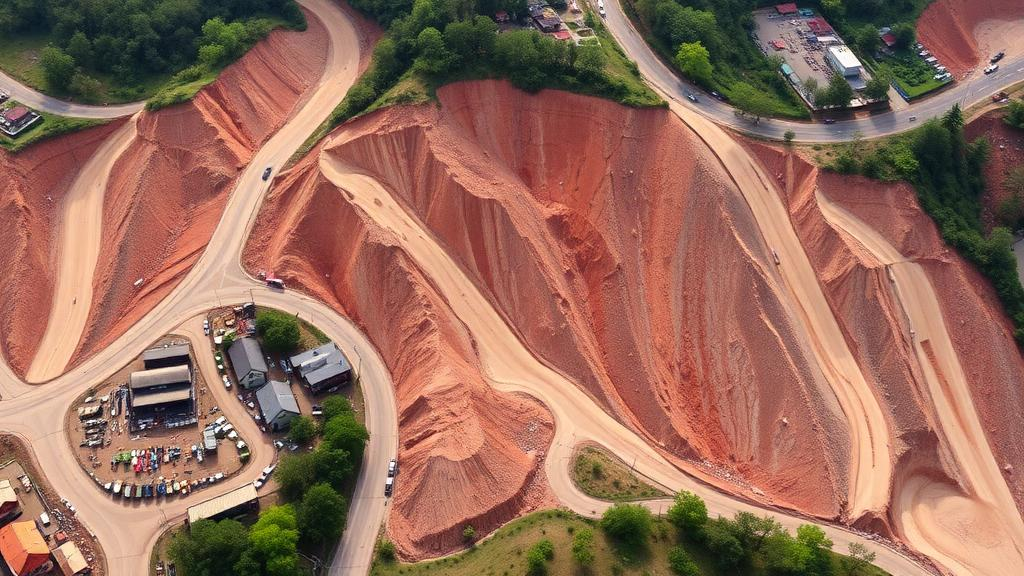
Landslides kill thousands of people every year and inflict direct economic losses exceeding four billion US dollars annually, yet one of the most basic questions in hazard assessment remains stubbornly hard to answer with confidence: how far will a failing slope travel? The answer, known as the runout distance, determines which villages, roads, and buildings sit in the path of destruction, and it underpins hazard maps, land-use planning, and engineering site selection. A new study published in Results in Engineering tackles this problem with an unusually large dataset and a machine learning framework designed to survive the messiness of real-world data, offering what its authors describe as a unified strategy for reliable runout prediction across radically different landslide types.
The research team, led by Yanglong Chen and Chaojun Ouyang of the Chinese Academy of Sciences, compiled a database of 32,714 landslide records drawn from public inventories around the world, including thousands of landslides triggered by the 2008 Wenchuan earthquake in China and the 2015 Gorkha earthquake in Nepal. The collection spans rainfall-triggered rock slopes in Hong Kong, hurricane-induced soil slides in Puerto Rico, coseismic failures in Greece and the Nepal Himalaya, and many other settings. Each record contains geometric descriptors such as landslide volume, source area, vertical drop height, slope angle, and various width measurements, along with the observed runout distance. The sheer scale of the database is itself a milestone, but its heterogeneity is what makes it scientifically interesting and computationally challenging.
That heterogeneity takes several forms. Different data sources cover different regions, report different subsets of variables, and describe vastly different numbers of events. Rainfall-triggered landslides account for 17,637 cases in the compiled dataset, earthquake-triggered events for 14,391, while landslides triggered by combined factors number only 67. Rock landslides dominate with 27,824 samples, compared with 4,533 soil landslides and just 285 mixed-material events. Because some inventories report volume but not slope angle, and others record source width but not total area, every possible combination of input factors corresponds to a different subset of usable samples. A model trained on one configuration may therefore be evaluated on data that differ systematically from the data behind another configuration, confounding any comparison of which factors truly matter.
The researchers argue that this is precisely where most previous machine learning studies of landslide runout have fallen short. Work has typically emphasized predictive accuracy for a single landslide type or region, treating model selection as a secondary concern. But different algorithms trained on the same data can latch onto different relationships, and when similarly performing models disagree about which factors drive runout, the popular SHAP interpretation technique, which attributes predictions to individual input variables, will produce different answers depending on which model happens to be chosen. In other words, factor importance inferred from a single model may reflect the quirks of that algorithm rather than any stable property of the underlying physics.
To break this dependence, the team built a selective ensemble framework. Six base learners representing distinct modeling paradigms were trained under identical preprocessing, factor configurations, and data splits: a multilayer perceptron, Random Forest, Support Vector Regression, XGBoost, and two attention-based deep learning architectures for tabular data, TabNet and FT-Transformer. Performance was assessed with five-fold cross-validation, and only models whose relative performance fell within five percent of the best learner, or three percent for very small sample groups, were admitted to the ensemble. The selected models were then combined using non-negative least squares, a constrained optimization that assigns each model a non-negative weight, preventing predictions from canceling one another and keeping every contributor’s influence directly interpretable. Crucially, the ensemble is retained only if its cross-validation performance exceeds that of the best individual model; otherwise the framework falls back to the single best learner. This combination of screening, constrained aggregation, and a validation-based fallback rule is what allows the method to reduce model-selection variability without blindly averaging everything together.
The results are striking. When the vertical drop height H was included among the predictors, the ensemble achieved coefficients of determination between roughly 0.65 and 0.98 across the seven landslide types analyzed, with earthquake-triggered rock landslides reaching an R-squared of 0.96533 on independent test sets and soil landslides 0.95341. For four of the seven types, optimal performance was achieved with only two input variables, height and volume, echoing a familiar lesson from empirical runout formulas: a small number of well-chosen geometric factors often outperforms a crowded feature list, especially when adding variables shrinks the usable sample size. The ensemble matched or exceeded the best individual model in most cases, and its cross-validation performance was never lower, confirming improved stability rather than merely marginal accuracy gains.
The framework was also used to quantify what happens when a key factor becomes unavailable. Vertical height is often difficult to estimate accurately before a landslide occurs, so the team compared models with and without it. The consequences varied dramatically by landslide type. Rainfall-triggered landslides suffered the largest performance collapse, with R-squared falling from about 0.944 to roughly 0.377 when height was removed and remaining factors re-screened. Earthquake-triggered landslides were far more resilient, dropping only from 0.965 to 0.914, because substitute variables such as source height could partially compensate. This sensitivity analysis turns an abstract question about factor importance into a practical guideline: for some landslide types, investing in better pre-event height estimates pays enormous dividends, while for others, existing topographic proxies are nearly sufficient.
The ensemble-level SHAP analysis then revealed how the same physical factors behave differently depending on the triggering mechanism and material. Vertical height emerged as the dominant or near-dominant factor in nearly every category, showing a consistent nonlinear signature: its contribution is negative at low values, rises rapidly as height increases, and then plateaus, indicating diminishing marginal returns on elevation difference. Volume, by contrast, behaved in a trigger-dependent way. For rainfall-triggered rock landslides its contribution generally decreased with increasing volume, while for earthquake-triggered rock landslides it increased, a contrast the authors interpret cautiously given the strong correlations among volume, source area, and source width in the rainfall subset. Slope angle showed the starkest divergence: its contribution declined with steeper angles for rainfall-triggered and soil landslides, consistent with the idea that steep rain-fed slopes store and infiltrate less water, but it turned sharply positive above roughly 50 degrees for earthquake-triggered rock slopes, where seismic shaking can destabilize near-vertical faces directly.
The authors are careful to frame these patterns as statistical associations learned by the models rather than proof of physical causation, noting that correlated predictors share attribution and that data-processing differences among source inventories introduce uncertainties that cannot be fully eliminated. They also acknowledge gaps: multiple factor-triggered landslides remain severely underrepresented, and type-specific variables such as rainfall intensity are inconsistently documented across databases. Even so, the study delivers a template that other hazard domains could adopt. By screening diverse learners under uniform conditions, combining only the competitive ones with transparent weights, and interpreting factors at the ensemble level, the framework converts an unruly, heterogeneous compilation of 32,714 landslides into a stable basis for deciding which variables matter, for which landslide types, and at what cost in data availability. For regional-scale risk assessment, where thousands of potential failures must be screened quickly and cheaply, that combination of robustness, interpretability, and modest data requirements may prove as consequential as any single accuracy record.
Subject of Research: Machine learning prediction of landslide runout distance using a multi-source heterogeneous dataset and a selective ensemble framework with SHAP-based factor evaluation
Article Title: A selective ensemble framework for reliable factor evaluation and landslide runout prediction under data heterogeneity
Article References: Chen, Y., Ouyang, C., Zhao, B., Yang, W., & Wang, F. (2026). A selective ensemble framework for reliable factor evaluation and landslide runout prediction under data heterogeneity. Results in Engineering, 32, Article 113218. https://doi.org/10.1016/j.rineng.2026.113218
Image Credits: AI Generated
DOI: 10.1016/j.rineng.2026.113218
Keywords: landslide runout, machine learning, selective ensemble, SHAP, data heterogeneity, hazard assessment, Wenchuan earthquake, Gorkha earthquake, XGBoost, Random Forest, vertical drop height, regional risk mapping
Cite Scienmag News
Denise Maddox. (October 1, 2026). AI ensemble tames messy landslide data to predict how far slopes will run. Scienmag. https://scienmag.com/ai-ensemble-tames-messy-landslide-data-to-predict-how-far-slopes-will-run/
Denise Maddox. "AI ensemble tames messy landslide data to predict how far slopes will run." Scienmag, 1 October 2026, https://scienmag.com/ai-ensemble-tames-messy-landslide-data-to-predict-how-far-slopes-will-run/. Accessed 4 October 2026.
Denise Maddox. "AI ensemble tames messy landslide data to predict how far slopes will run." Scienmag. October 1, 2026. https://scienmag.com/ai-ensemble-tames-messy-landslide-data-to-predict-how-far-slopes-will-run/


