


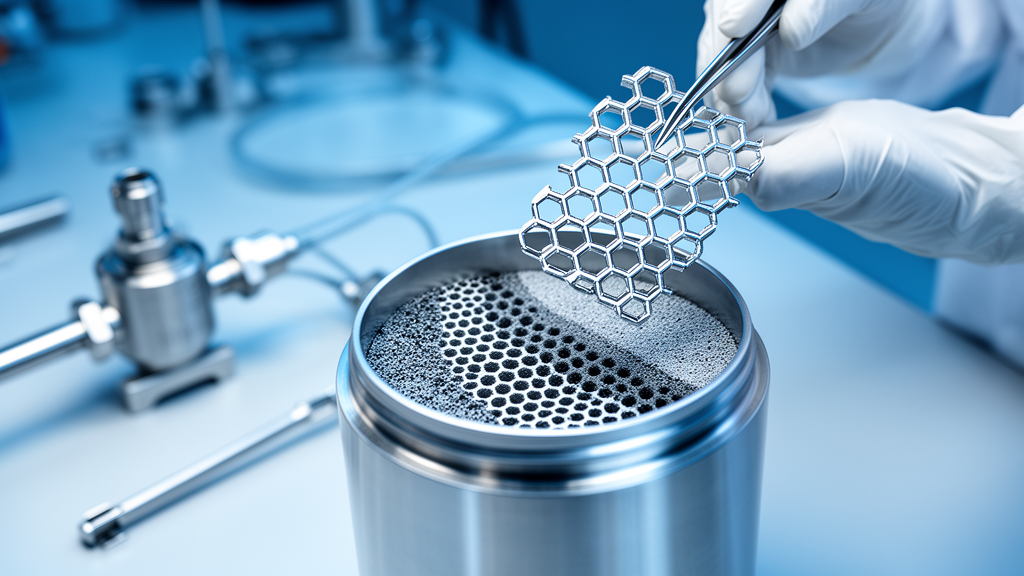
Hydrogen is often described as the fuel of the future, but getting it out of storage quickly remains one of the technology’s stubborn bottlenecks. A new study published in Frontiers in Energy Research shows how artificial intelligence, combined with rigorous computational fluid dynamics, can squeeze dramatically faster hydrogen discharge out of a well-known storage alloy. The work, led by Selman Djeffal of the National Polytechnic School of Constantine in Algeria and colleagues, demonstrates that the internal architecture of a metal-hydride reactor can be co-designed by an evolutionary algorithm to release hydrogen roughly 22 percent faster than the best uniform metal foam previously benchmarked, and up to 36 percent faster when the design envelope is widened.
The reactor in question stores hydrogen in LaNi5, a lanthanum-nickel alloy that absorbs hydrogen reversibly into its crystal lattice. Solid-state storage in metal hydrides is attractive because it packs hydrogen at high volumetric density, operates safely at moderate pressures, and avoids the cryogenic or high-pressure tanks required for gaseous hydrogen. But desorption, the process of releasing hydrogen from the hydride, is endothermic: it consumes heat. If heat cannot reach the reactive bed quickly enough, the reaction slows, part of the bed sits idle, and the reactor’s discharge rate suffers. Thermal management has long been identified as a major obstacle for practical hydride devices.
Previous work had established that inserting conductive metal foams into the hydride bed shortens the thermal path from the heated wall to the reactor core. Among fixed alternatives, a CuCr1Zr foam at 89 percent porosity gave the strongest desorption response, completing discharge in about 10 minutes. The new study asks a more ambitious question: what if the foam is not uniform at all, but instead graded radially, with a dense, highly conductive CuCr1Zr-rich region near the heated wall and a lighter, more permeable AlSi10Mg-rich composition toward the core? The researchers also coupled this structural grading with a transient operating schedule, using stronger heating and lower desorption pressure in the opening minutes before conditions relax to milder values.
To explore this continuous design space, the team developed PG-SADE-GHF, a physics-guided self-adaptive differential evolution framework for graded hybrid foam design. The method parameterizes the foam with smooth radial porosity profiles, spatial alloy allocation, and time-dependent heat-transfer and pressure schedules, all encoded in eight design variables. A self-adaptive differential evolution algorithm, which adjusts its mutation and crossover parameters based on successful trials, searches the space. In an equal-budget stress test, the adaptive variant achieved a lower final diagnostic objective in 29 of 30 paired runs compared with a fixed-parameter version, supporting its use for the search procedure.
Crucially, the study does not rely on a cheap surrogate model for its final claims. The original MATLAB surrogate predicted a desorption completion time of 7.95 minutes for its selected design. But when those exact coordinates were evaluated directly in OpenFOAM, a high-fidelity finite-volume CFD solver, the same design took 12.192 minutes. This 53 percent mismatch is retained transparently in the paper as a negative result, demonstrating that the CFD model was not tuned to recover the desired value. Instead, the researchers re-optimized the same eight variables using actual OpenFOAM evaluations within the original design bounds, arriving at a high-fidelity optimum of 7.817 minutes, only 1.68 percent from the original surrogate magnitude and 21.83 percent faster than the 10-minute uniform CuCr1Zr benchmark.
The team then performed an expanded-bound sensitivity study, widening the engineering envelope for heating intensity, pressure, and schedule duration. This separate extension reached 6.442 minutes, 35.58 percent faster than the uniform reference. Full 360-degree three-dimensional verification on a 196,608-cell mesh confirmed both results, with the expanded-bound wedge, standard full-3D, and high-resolution full-3D calculations all giving identical 6.442-minute completion times. Mesh and time-step independence checks showed maximum deviation of only 0.129 percent from the finest result, confirming that the reported performance is not an artifact of numerical resolution.
Beyond the reactor design itself, the study makes a methodological contribution to how AI-assisted engineering should handle the gap between cheap and expensive models. The researchers trained a CFD-corrected multifidelity model on the difference between surrogate predictions and OpenFOAM outcomes across 32 development designs. They then generated 12 additional Sobol/maximin challenge designs whose predictions were frozen and SHA-256 locked before their CFD outcomes were computed. On this locked held-out challenge, the original surrogate yielded a root-mean-square error of 3.354 minutes, while the CFD-corrected model achieved R-squared of 0.982, RMSE of 0.159 minutes, and 100 percent coverage of the nominal 95 percent prediction intervals. This corresponds to a 95.27 percent RMSE reduction, showing that sparse high-fidelity information can systematically correct low-fidelity bias.
The optimized coordinates reveal why the high-fidelity solution differs from the original surrogate point. OpenFOAM places more CuCr1Zr in the core-side transition, extends the conductive wall zone, uses stronger early heat transfer, and maintains a lower early outlet pressure for longer. These trends suggest a stronger need for heat delivery and desorption driving force than the reduced model estimated. A matched-condition decomposition also prevents over-attribution of the total speed-up to grading alone: within the original bounds, most of the gain comes from operating-schedule optimization, while the expanded design exhibits a larger independent architecture benefit.
The study is careful to distinguish its contribution from prior graded-foam work. Graded porosity itself is not new; previous studies reported roughly 11.5 to 20 percent improvements during hydrogen absorption with gradient-porosity foams. The novelty here is narrower and process-specific: desorption is endothermic and requires sustained heat input while hydrogen pressure is kept below equilibrium, so the design problem couples where conductive material is placed with when heat-transfer intensity and outlet pressure are applied. This simultaneous radial material allocation and transient scheduling, followed by transparent surrogate-to-CFD re-optimization, is the central contribution.
The researchers define a concrete experimental validation pathway rather than leaving future work unspecified. A first prototype should manufacture the conductive outer and more porous inner lattice regions as separately controlled additively manufactured inserts, with X-ray micro-CT and gravimetric measurements verifying porosity, strut dimensions, and pore connectivity. The assembled reactor should be instrumented with radial and axial thermocouples, pressure sensing, and hydrogen mass-flow measurement, with the primary comparison being measured desorption time against the same-bound OpenFOAM prediction. Critical uncertainties include foam-wall and foam-hydride contact resistance, manufactured pore size, alloy-interface behavior, and kinetic drift with cycling. The OpenFOAM model is a porous-continuum representation rather than a pore-resolved strut simulation, and the authors state these limitations explicitly. Experimental validation remains required before the predicted performance can be considered established.
Subject of Research: hydrogen storage
Article Title: Artificial intelligence-assisted design and CFD re-optimization of graded hybrid metal foams for faster hydrogen desorption in LaNi5 metal-hydride reactors
Article References: Djeffal, S., Bendriss, B., Chibani, A., Ghoul, A., Morakchi, M. R., & Rashid, F. L. (2026). Artificial intelligence-assisted design and CFD re-optimization of graded hybrid metal foams for faster hydrogen desorption in LaNi5 metal-hydride reactors. Frontiers in Energy Research, 14, Article 1956543. https://doi.org/10.3389/fenrg.2026.1956543
Image Credits: AI Generated
DOI: 10.3389/fenrg.2026.1956543
Keywords: hydrogen storage, LaNi5, metal hydride, metal foam, CFD, OpenFOAM, differential evolution, surrogate model, desorption, thermal management, additive manufacturing, multifidelity
Cite Scienmag News
Denise Maddox. (October 16, 2026). AI-Designed Graded Hybrid Metal Foams Cut Hydrogen Desorption Time in LaNi5 Reactors. Scienmag. https://scienmag.com/ai-designed-graded-hybrid-metal-foams-cut-hydrogen-desorption-time-in-lani5-reactors/
Denise Maddox. "AI-Designed Graded Hybrid Metal Foams Cut Hydrogen Desorption Time in LaNi5 Reactors." Scienmag, 16 October 2026, https://scienmag.com/ai-designed-graded-hybrid-metal-foams-cut-hydrogen-desorption-time-in-lani5-reactors/. Accessed 16 October 2026.
Denise Maddox. "AI-Designed Graded Hybrid Metal Foams Cut Hydrogen Desorption Time in LaNi5 Reactors." Scienmag. October 16, 2026. https://scienmag.com/ai-designed-graded-hybrid-metal-foams-cut-hydrogen-desorption-time-in-lani5-reactors/


