


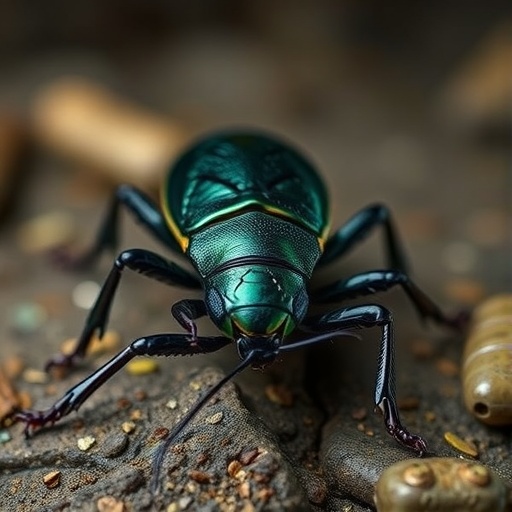
In a groundbreaking development at the intersection of biology and robotics, researchers from The University of Osaka, in collaboration with Diponegoro University, have unveiled an innovative bio-intelligent cyborg insect system that redefines the way living organisms can interface with artificial intelligence. This pioneering study introduces the concept of the Insect Synergy Circuit (ISC), a paradigm shift from traditional behavior-based insect control toward a more nuanced, internal-state-driven control mechanism that harnesses the insect’s physiological signals in real time.
For decades, cyborg insects have captivated the scientific community as intriguing bio-hybrid systems, blending the natural agility of living organisms with the precision of electronic devices for applications ranging from disaster search and rescue to environmental monitoring. However, existing systems have typically relied on simplistic control schemas that modulate behavior based on externally observable actions such as walking or stopping, often neglecting the insect’s internal biological states. This one-dimensional approach has limited the sophistication and adaptive capabilities of cyborg insect platforms.
The interdisciplinary team, led by Professor Keisuke Morishima at The University of Osaka’s Graduate School of Engineering, has advanced this field by engineering a wearable backpack specifically designed for Madagascar hissing cockroaches. Equipped with high-fidelity sensors, this device simultaneously tracks multiple physiological benchmarks—including heartbeat rhythms, low-frequency neural signal patterns, and detailed body motion metrics—producing a rich multimodal dataset that reflects not only the insect’s overt behavior but also its internal environmental perceptions and physiological conditions.
At the core of this innovation is a machine learning framework, developed using advanced Random Forest classifiers, which processes the integrated biological signals and motion data to infer the insect’s environment-associated internal states with remarkable accuracy. The system was rigorously tested under five distinct environmental stimuli: baseline natural conditions, ultraviolet light exposure, chemical agents, thermal stress, and food availability. Impressively, the classification model achieved an overall accuracy rate of 93%, distinguishing among these nuanced states with high fidelity—particularly excelling in recognizing natural and food-related environmental contexts.
This data-driven insight enabled the researchers to implement a closed-loop control system where artificial stimulation—such as subtle ultraviolet light pulses for directional turning or low-intensity vibrations to encourage forward movement—is applied judiciously based on the insect’s inferred physiological state. Notably, the ISC framework emphasizes minimizing invasive commands; stimulation is withheld during avoidance-related internal states, allowing the cockroach to exercise autonomous behavior when encountering noxious stimuli like chemicals or heat.
Experimental trials in complex multi-chamber mazes demonstrated the efficacy of this bio-hybrid control approach. Natural cockroaches intuitively gravitated towards food chambers and often failed to navigate the entire maze. In stark contrast, cyborg insects utilizing the ISC-guided closed-loop strategy exhibited enhanced navigational capabilities, successfully traversing the maze by harnessing cooperative exchanges between their internal biological signals and external AI-guided interventions. This indicativestrategy markedly surpasses conventional methods that often treat insects solely as reactive robotic platforms without regard for physiological feedback.
Professor Morishima articulated the profound implications of this work, emphasizing the shift from commanding to listening: “An insect is a living being with responses that vary broadly between individuals and moments. Traditional robotics impose rigid commands; our approach introduces a dynamic, responsive dialogue between AI and insect physiology.” This empathic paradigm fosters a more ethical and efficient interface in bio-hybrid systems, potentially reducing stress and enhancing performance by respecting the organism’s biological context.
Importantly, the researchers posit that the ISC framework extends well beyond cockroaches or even insects in general. Because the system integrates biological signal acquisition, behavioral data, and AI-driven interpretation, it lays the groundwork for scalable bio-intelligent systems that could encompass a diverse array of living organisms or complex sensor networks. Such systems might one day offer unprecedented precision in environmental sensing, therapeutic devices, or responsive wearable technologies that communicate intimately with human or animal physiological states.
The implications of this research ripple into future technologies where biological entities and AI no longer function as separate entities but as synergistic collaborators. The ISC’s pioneering bio-hybrid control strategy exemplifies a future of enhanced environmental sensing, adaptive robotics, and potentially new forms of inter-species communication mediated through physiological signals. This represents a foundational advance toward integrating living systems into intelligent control architectures that respect and harness life’s inherent complexity.
Beyond the technical triumphs, this research provokes philosophical reflection on the nature of control and coexistence between machines and biological life. The fine balance achieved by the ISC between intervention and autonomy challenges notions of power and command in robotics, suggesting more fluid, respectful modes of cooperation. It redefines cyborg technology not as domination over living creatures but as intimate partnership rooted in mutual responsiveness.
This landmark study, published in the ROBOMECH Journal, opens exciting avenues for the development of next-generation cyborg technologies. It exemplifies engineering excellence through the fusion of computational modeling, physiological signal processing, and ethical bio-interfacing, spearheading new frontiers in robotics that harmonize with biology rather than overriding it. The research team envisions a vibrant future where artificial intelligence listens, understands, and cooperates with living organisms to achieve collective goals that neither could accomplish alone.
As Professor Morishima asserts, “This is not the conclusion but the beginning. By tuning in to physiological signals from living systems, we lay the foundation for future communication and cooperation between artificial and biological systems.” The era of true bio-intelligent cyborg integration is dawning, promising transformative applications that could revolutionize fields from environmental science to medical technology and beyond.
Cite Scienmag News
Gavin Prescott. (May 28, 2026). AI Decodes Insect Body Signals to Navigate Cyborg Cockroaches. Scienmag. https://scienmag.com/ai-decodes-insect-body-signals-to-navigate-cyborg-cockroaches/
Gavin Prescott. "AI Decodes Insect Body Signals to Navigate Cyborg Cockroaches." Scienmag, 28 May 2026, https://scienmag.com/ai-decodes-insect-body-signals-to-navigate-cyborg-cockroaches/. Accessed 3 September 2026.
Gavin Prescott. "AI Decodes Insect Body Signals to Navigate Cyborg Cockroaches." Scienmag. May 28, 2026. https://scienmag.com/ai-decodes-insect-body-signals-to-navigate-cyborg-cockroaches/


