

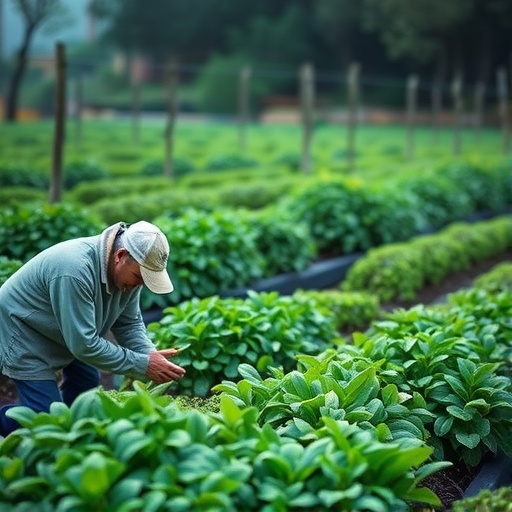
In recent years, the global agricultural sector has faced mounting challenges related to climate change, environmental degradation, and the urgent need for sustainable practices. Among the efforts to combat these issues, the adoption of green production technologies stands out as a pivotal strategy to promote environmental stewardship while ensuring food security. A groundbreaking study published in Scientific Reports in 2026 by She, Chen, and Sun offers compelling evidence on the role agricultural insurance plays in encouraging farmers to embrace these eco-friendly farming methods. Focusing on vegetable growers in China, this research uncovers intricate linkages between risk mitigation and sustainable agricultural innovation.
The agricultural landscape in China, a global leader in vegetable production, provides a rich backdrop for understanding how financial mechanisms such as insurance influence farming decisions. Vegetable cultivation in China is characterized by vulnerability to various natural risks—such as unpredictable weather patterns, pest outbreaks, and fluctuating market demands—that can severely impact farmer incomes. Given this uncertainty, insurance products have been introduced to shield farmers against potential losses. However, this study goes beyond the conventional understanding of insurance as mere financial protection, investigating its capacity to stimulate the adoption of environmentally friendly farming technologies.
Central to the study is the concept of green production technologies, which encompass practices designed to minimize environmental harm, optimize resource use, and reduce chemical inputs like pesticides and fertilizers. These technologies include integrated pest management, organic fertilizers, water-saving irrigation systems, and the use of disease-resistant crop varieties. The adoption of such methods is crucial in mitigating the negative externalities of conventional agriculture, such as soil degradation, groundwater contamination, and biodiversity loss.
The authors conducted detailed empirical analyses utilizing survey data collected from vegetable farmers across several provinces in China. The methodology integrated econometric models to assess how participation in agricultural insurance programs correlates with the likelihood of adopting green technologies. By controlling for confounding variables such as farm size, education level, access to markets, and government policies, the study presents a robust framework that isolates the impact of insurance from other influencing factors.
One of the seminal findings of the research is the positive and statistically significant relationship between access to agricultural insurance and farmers’ willingness to implement green production techniques. This suggests that insurance not only functions as a safety net but also reduces the perceived risks associated with transitioning from conventional to innovative farming practices. Farmers feel more secure experimenting with new methods when downside financial risks are effectively managed, facilitating a more proactive approach to sustainability.
The nuanced mechanisms behind this relationship are explored in the paper. For instance, insurance coverage enhances the financial resilience of farmers, increasing their capacity to invest in initially costly green infrastructures or inputs. Moreover, participation in insurance schemes often comes with technical assistance and knowledge dissemination, which raise awareness and understanding about green technologies. This double effect—risk coverage combined with education—creates an enabling environment for sustainable shifts in farming behavior.
Interestingly, the study delves into heterogeneity among farmers, revealing that smallholder vegetable growers benefit disproportionately from insurance in terms of green technology adoption. These farmers typically face higher vulnerability to economic shocks and lack capital reserves, making insurance a critical lever for fostering environmentally conscious farming. Large-scale farmers, while still positively affected, display a less marked response, possibly due to existing resource buffers.
Another critical dimension addressed is the potential for insurance schemes to be integrated with broader agricultural policy frameworks. The research highlights that when insurance is aligned with subsidies, extension services, and market regulations, the multiplier effect on green technology diffusion is considerable. Thus, policymakers are encouraged to design coordinated packages that link financial instruments with educational and infrastructural support to maximize impact.
Beyond the immediate economic and environmental benefits, the implications of this study extend to global sustainability goals, particularly the United Nations’ Sustainable Development Goals (SDGs). Enhancing the adoption of green production technologies aligns directly with SDG 2 (Zero Hunger), SDG 12 (Responsible Consumption and Production), and SDG 13 (Climate Action). Through effective risk management via insurance, farmers become active agents of change contributing to climate resilience and ecosystem health.
The research also carefully addresses potential challenges and limitations. Despite the positive role of insurance, the authors caution against overreliance on financial products without complementary measures. Issues such as insurance premium affordability, farmer trust in insurance providers, and the variability in coverage quality need to be tackled to sustain the upward trajectory of green technology adoption. Furthermore, there remains the risk of moral hazard where insurance may inadvertently encourage riskier behaviors that negate environmental benefits.
To overcome these challenges, the authors advocate for the incorporation of environmental criteria into insurance policy design. By linking pay-outs or premium reductions to the degree of green technology use, insurers can create incentives that reinforce sustainable practices. This innovative approach would create a virtuous cycle where ecological stewardship is financially rewarded, magnifying the positive impact on both farmer livelihoods and the environment.
From a technical perspective, the study’s econometric approach is notable for its rigorous robustness checks, including instrumental variable techniques to address potential endogeneity concerns. This methodological sophistication lends credibility to the causal interpretation of insurance’s impact on green technology adoption. The use of a large, geographically diverse sample further enhances the generalizability of findings within similar agroecological contexts.
Moreover, the comprehensive data collection included qualitative components such as farmer interviews and focus group discussions, complementing quantitative analyses. These qualitative insights unveil farmer motivations, perceived barriers, and experiential knowledge, adding depth to the understanding of how insurance shapes decision-making processes. Such mixed-method approaches represent a valuable template for future agricultural policy research.
As the global community increasingly prioritizes the transition to sustainable agriculture, this study provides critical evidence underscoring the strategic role of financial risk management tools. The integration of agricultural insurance with environmental innovation emerges as a powerful pathway to support farmer adaptation amid climate variability and market uncertainties. These findings not only inform China’s agricultural modernization policies but offer transferable lessons for other countries grappling with similar sustainability challenges.
In conclusion, the research by She, Chen, and Sun makes a significant contribution to agricultural economics, sustainability science, and rural development literature. It illuminates the multifaceted functions of agricultural insurance beyond risk compensation, highlighting its potential to catalyze green technology uptake. As nations strive to balance productivity with ecological integrity, such evidence-based insights are indispensable in crafting policies that safeguard both farmer livelihoods and the planet.
The time is ripe for stakeholders—governments, insurers, researchers, and farmers—to collaboratively harness the synergy between financial resilience and environmental innovation. Embracing agricultural insurance as a lever for sustainability could redefine the future trajectory of food production systems, ensuring they are robust, eco-friendly, and capable of feeding generations to come without compromising the health of natural resources.
Subject of Research: The impact of agricultural insurance on the adoption of green production technologies among vegetable farmers in China.
Article Title: Impact of agricultural insurance on farmers’ adoption of green production technologies: evidence from vegetable growers in China.
Article References: She, Z., Chen, Z. & Sun, L. Impact of agricultural insurance on farmers’ adoption of green production technologies: evidence from vegetable growers in China. Scientific Reports (2026). https://doi.org/10.1038/s41598-026-44981-9
Image Credits: AI Generated
DOI: 10.1038/s41598-026-44981-9
Keywords: agricultural insurance, green production technologies, sustainable agriculture, risk management, vegetable farmers, China, eco-friendly farming practices, climate resilience


