

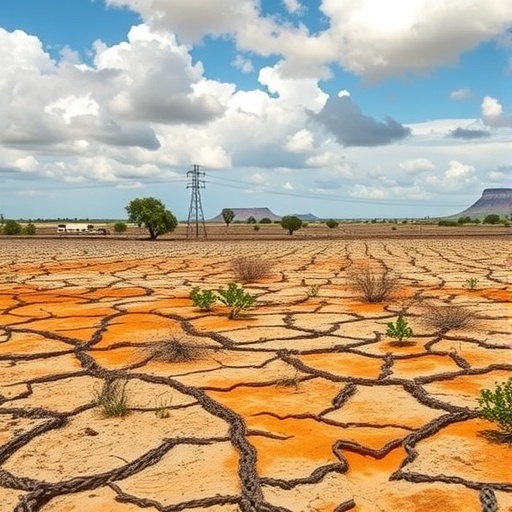
As global temperatures rise and climatic systems shift, the specter of intensified drought looms large across vast swathes of the Earth’s surface. Agricultural lands, the backbone of global food security, face unprecedented stress as water availability diminishes during critical growing periods. Recent pioneering research provides a clarifying lens on where these agricultural drought risks are converging most viciously under future climate scenarios. Using sophisticated climate reanalysis and state-of-the-art model simulations, a multidisciplinary team has charted emerging drought hotspots stretching across the tropics and into the Northern Hemisphere extratropics. Their findings reveal a nuanced portrait of intensifying drought regimes, shedding light on mechanisms and regional patterns that have eluded prior assessments focused solely on annual precipitation metrics.
Traditional drought assessments have often relied on annual, aggregated rainfall data, which can obscure crucial seasonal dynamics affecting crops’ water stress. Recognizing this limitation, the researchers innovatively concentrate on soil moisture conditions both at the inception of the growing season and throughout its duration. This approach offers a finer temporal resolution of moisture dynamics that better align with agricultural realities. Crucially, the study delves deeper than precipitation trends alone, integrating how soil moisture responds to shifts in evapotranspiration—a complex physiological and climatic balance controlling water loss from the land surface.
The land surface water balance hinges on multiple interacting factors, but evapotranspiration embodies a key process mediating how plants extract water and how much moisture evaporates directly from soils and vegetation. The study introduces a novel conceptual framework for classifying evapotranspiration drivers, highlighting a previously under-recognized regime dominated by plant root-zone water uptake limitations. This new state is pivotal; it signifies scenarios where plants exert maximum extraction from soil moisture, essentially stressing the boundaries of agricultural viability under drought conditions. Identifying this regime across regions enables a more mechanistic understanding of how climate stress translates into agricultural water deficits.
Geographically, the research unveils several zones that are morphing into future agricultural drought hotspots, with compelling evidence that these patterns are already emerging. Europe’s landscape, in particular, exhibits a pronounced trend toward drier growing seasons, coupled with southern Africa, northern South America, and western North America. These results are underpinned by robust observational data and model projections converging on similar directional signals, reinforcing confidence in the findings. The identification of such diverse hotspots underscores that drought threats are no longer confined to historically recognized arid regions but are now extending into traditionally temperate zones.
What makes these hotspots especially alarming is the convergence of multiple drought characteristics. Not only is the frequency of drought events set to rise, but the severity and intensity of these episodes are simultaneously escalating. This dual amplification compounds the threat to crop health and yields, as increasing drought occurrence alone would already stress agricultural systems. More severe droughts amplify stress physiological effects on plants, decrease groundwater recharge, and disrupt soil microbial communities vital for nutrient cycling, thereby magnifying potential yield losses and food supply shocks.
Interestingly, the study also confronts the apparent paradox where precipitation projections in some regions are conflicting or inconsistent. Despite this, drought trends remain firmly positive, attributable to enhanced evapotranspiration demand driven by rising temperatures. This decoupling of rainfall and drought risk provides critical insight into how future water stress scenarios must be approached. Relying solely on rainfall projections to predict drought vulnerability underestimates the hydrological reality shaped by temperature-induced moisture deficits and altered soil-plant water fluxes.
Focusing analyses on the growing season—a period when plants are most sensitive to water availability—allows the team to capture nuanced vulnerabilities that annual metrics miss. Growing season droughts carry direct implications for crop productivity and food security, contrasting with annual dry spells that might have less immediate agricultural impact. This seasonally refined view reveals drought hotspots in regions that conventional annual approaches have overlooked or underestimated, emphasizing the necessity of specialized temporal frameworks for agricultural drought risk assessment.
The implications extend beyond the well-recognized global south, historically the focus of drought vulnerability narratives. The study distinctly highlights extratropical regions within the Northern Hemisphere where agricultural drought risk is accelerating rapidly. This broader geographic scope challenges prevailing assumptions about the resilience of temperate agricultural zones and calls for reformulated adaptation strategies that address emerging vulnerabilities in areas previously considered more secure.
Policy and adaptation strategies must urgently integrate these new scientific insights to mitigate impending agricultural drought risks effectively. Investments in drought-resilient crops, improved irrigation practices, soil moisture conservation techniques, and regional water resource management tailored to the identified hotspots could buffer food systems against the projected stressors. The emerging hotspots pinpoint precise targets for such interventions, optimizing resource allocation in the face of tight financial and logistical constraints confronting global food and water governance.
The comprehensive methods employed in the study leverage cutting-edge climate reanalysis datasets and multi-model ensemble predictions across a suite of Shared Socioeconomic Pathways (SSPs), providing a robust framework that acknowledges varying future emission trajectories and socio-political developments. This incorporation of diverse scenario pathways enriches the credibility and applicability of the findings, ensuring that conclusions remain relevant under a range of plausible global futures. It further underscores the dynamic interplay between human activities, climate feedbacks, and agricultural water cycles.
Moreover, by introducing the classification of dominant evapotranspiration drivers, the work advances the scientific understanding of land-atmosphere interactions under drought stress. This conceptual innovation adds depth to hydrological modeling, enabling more precise diagnostics of drought mechanisms for integrated climate-agriculture impact assessments. Such advances refine predictive capacity, providing stakeholders with better tools for real-time drought monitoring and early warning systems.
The study’s revelation that drought risk intensification occurs even in the face of precipitation uncertainties reshapes ongoing dialogues about water security in a warming world. It compels the scientific community to reassess traditional rainfall-based drought indices and embrace comprehensive, moisture-balance approaches. These findings advocate for enhanced monitoring of soil moisture and evapotranspiration dynamics through both in situ and remote sensing platforms to track evolving drought conditions with higher fidelity.
In summary, this research marks a watershed moment in drought risk science, highlighting how emergent hotspots of agricultural drought are poised to reshape global food production landscapes under climate change. It bridges observational evidence with climate modeling sophistication while introducing new conceptual tools to unravel drought complexity. The identified trends and mechanisms furnish a critical knowledge base necessary for crafting resilient agricultural systems, safeguarding food supplies, and informing targeted adaptation policies worldwide.
As climate pressures mount, the imperative to integrate such advanced drought risk assessments into both regional and global agricultural planning escalates. This study offers an essential roadmap to anticipate, understand, and mitigate future drought threats, reinforcing the urgent call to action for stakeholders across governments, science, and agriculture sectors. The convergence of scientific insight with pragmatic adaptation pathways will be vital to sustain the planet’s food systems amid the intensifying drought regimes charted across diverse climatic zones.
Subject of Research: Emerging hotspots of agricultural drought under changing climate conditions and the mechanistic understanding of drought drivers affecting soil moisture and evapotranspiration during crop growing seasons.
Article Title: Emerging hotspots of agricultural drought under climate change
Article References:
Black, E., Wainwright, C., Allan, R.P. et al. Emerging hotspots of agricultural drought under climate change. Nat. Geosci. (2026). https://doi.org/10.1038/s41561-025-01898-8
DOI: https://doi.org/10.1038/s41561-025-01898-8


