

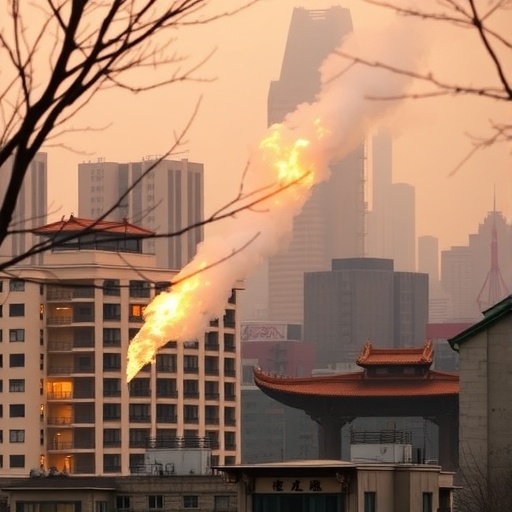
In recent years, the escalating levels of carbon dioxide emissions have raised significant concerns about the sustainability of urban environments worldwide. China, as one of the most rapidly urbanizing countries, offers a unique lens through which to analyze the intricate dynamics between demographic shifts and environmental impact. A groundbreaking study by Zhao, Y., Zhao, M., and Zhang, C., soon to be published in npj Urban Sustainability, investigates how the dual forces of aging populations and urbanization processes interact to influence CO2 emissions across Chinese cities. This empirical analysis dives deep into quantifying and understanding these relationships, providing valuable insights for policymakers and environmental scientists alike.
Urbanization has long been recognized as a primary driver of increased greenhouse gas emissions due to intensified energy consumption, transportation needs, and industrial activity concentrated in urban centers. However, this research highlights an underexplored angle: the role of aging demographics in moderating or amplifying these environmental pressures. China presents an ideal case study due to its historic rapid urban expansion combined with a significant shift toward an older population structure, a direct consequence of decades of population control policies and shifting fertility rates.
The methodology adopted by Zhao and colleagues involves a rigorous empirical approach. Utilizing comprehensive city-level data sets spanning multiple years, the research team applied advanced econometric models to disentangle the complex effects of urban growth and age composition on CO2 emissions. This approach enabled the researchers to isolate the effects of demographic variables from purely urban-centric factors, revealing nuanced patterns that challenge conventional wisdom.
One of the most compelling findings from the study is the evidence that aging populations may contribute to a reduction in per capita CO2 emissions. Older adults generally have lower mobility and energy demand profiles compared to younger cohorts, which traditionally drive commuting and consumption patterns associated with high emissions. This demographic trend potentially offsets some of the emission increases expected from expanding urban infrastructures.
Yet, the study also emphasizes that the impact of urbanization on emissions remains significantly positive, with each percentage increase in urban population share correlating with a substantial rise in city-wide CO2 levels. The densification of cities without adequate sustainable planning often leads to elevated emissions from transportation congestion, energy-intensive residential and commercial buildings, and industrial expansion. Therefore, while aging demographics introduce mitigating factors, the net effect still leans toward increased carbon footprints in growing urban areas.
The researchers carefully discuss how urban form and infrastructure carry enormous weight in shaping emission outcomes. Cities that have integrated green technology, sustainable public transit, and energy-efficient building designs can potentially leverage aging populations’ lower energy demands to achieve more sustainable urban ecosystems. However, in many Chinese cities, this kind of infrastructure has yet to reach maturity, leading to inefficient energy usage and persistent pollution challenges.
Moreover, this work elucidates the heterogeneous effects across different city tiers and regions. Megacities such as Beijing and Shanghai exhibit complex dynamics where aging demographics align with advanced industries and service economies, mitigating some emission sources but introducing new consumption patterns. Contrastingly, smaller, rapidly growing cities with aging populations but less-developed infrastructure tend to see a more straightforward positive correlation between urbanization and emissions.
The temporal dimension of the research is equally critical. As population aging continues over the next few decades, the relative strength of these demographic effects could increase, significantly shaping future emission trajectories. Policymakers are urged to consider these demographic shifts as vital parameters in their urban planning and environmental regulation frameworks, emphasizing the need for age-inclusive sustainability strategies.
Beyond mere statistical relationships, the study calls attention to the socio-economic underpinnings that connect aging, urbanization, and emission patterns. For instance, elderly populations often have different consumption needs, healthcare demands, and mobility patterns—all of which translate into unique energy use footprints. Understanding these behavioral aspects is essential for designing effective interventions that align with demographic realities.
Importantly, Zhao and co-authors acknowledge the limitations of their study, noting that while empirical models provide robust associations, causality cannot be fully established without further experimental or quasi-experimental research. They advocate for longitudinal and cross-disciplinary studies that integrate urban sociology, environmental science, and public health to flesh out the multifaceted interactions observed.
Their work also stimulates debate on how future urban sustainability efforts can be tailored. Urban planners and environmental policymakers might find it beneficial to focus on “age-friendly” urban designs that not only accommodate elderly residents but actively contribute to lowering emissions—such as promoting walkability, accessible public transport, and energy-efficient housing geared toward older adults.
The implications of this research extend beyond China, providing a valuable framework applicable to other rapidly urbanizing and aging societies globally. Countries facing similar demographic and urban growth scenarios can leverage these findings to preemptively adjust policies and urban infrastructure investments to curb emissions more effectively.
This paper exemplifies the growing recognition that demographic changes and urbanization trends cannot be treated as independent variables in sustainability discussions but rather as deeply intertwined factors that collectively shape environmental futures. The nuanced understanding it offers is invaluable for drafting integrative strategies that promote urban environments that are both livable and environmentally responsible.
As China continues its urban and demographic transformation throughout the 21st century, studies like this one provide critical guidance, highlighting paths toward sustainable city development by considering not only economic growth pressures but the evolving human landscape as well. In this way, Zhao and colleagues contribute an essential piece to the complex puzzle of urban sustainability in an era defined by climate change and demographic flux.
Subject of Research: The impact of population aging and urbanization on carbon dioxide emissions in Chinese cities.
Article Title: The impact of aging and urbanization on CO₂ emission in Chinese cities: an empirical analysis.
Article References:
Zhao, Y., Zhao, M. & Zhang, C. The impact of aging and urbanization on CO₂ emission in Chinese cities: an empirical analysis. npj Urban Sustain (2025). https://doi.org/10.1038/s42949-025-00316-7
Image Credits: AI Generated


