


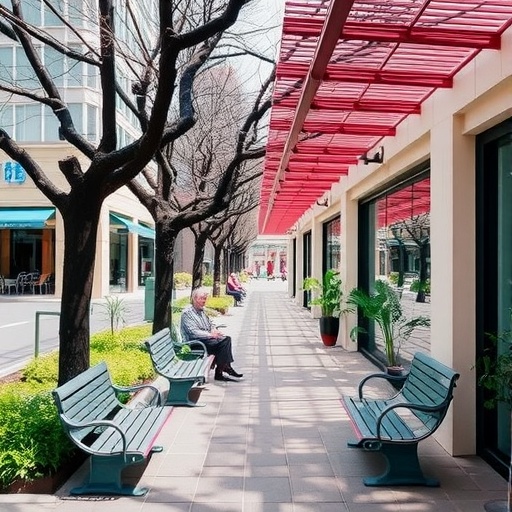
In the ever-evolving discourse on gerontology and urban planning, a recent study presents crucial insights into the lived experiences of older adults in China, focusing particularly on the intricate relationship between ageing-in-place and the utilization of neighbourhood outdoor spaces. The research foregrounds the physical and social dynamics that influence how older individuals interact with their immediate environments, shedding light on the nuanced demands of mobility, household composition, and community structure. This investigation takes on heightened relevance as urban populations worldwide confront the challenges wrought by demographic shifts and the imperative to design age-friendly spaces that foster autonomy and well-being.
A remarkable aspect of this study lies in its qualitative approach, prioritizing depth over scale. By intimately engaging with older adults’ perspectives, the researchers garner detailed understandings of how these individuals perceive and negotiate their built environments. This micro-level inquiry sharply contrasts with many large-scale quantitative studies that often overlook the personalized and context-dependent facets of ageing-in-place. The findings reveal differentiated patterns of outdoor space use that hinge substantially on mobility capabilities and the configurations of household units.
Understanding mobility as a pivotal factor, the study delineates clear behavioral distinctions between older adults who maintain good physical functioning and those confronting mobility limitations. Those with preserved mobility tend to access outdoor spaces not only for routine activities but also for social interaction and recreation, elements integral to sustaining mental and physical health. Conversely, limited mobility constrains such engagement, underscoring critical design considerations for making outdoor environments truly accessible. The environmental affordances—opportunities for action provided by the physical setting—must align with the functional capacities of older users to facilitate active ageing.
The investigation further explores how household composition influences the use and perception of neighbourhood spaces. Older adults living independently often exhibit distinct spatial usage patterns compared to those cohabiting with family members. Cohabitation with adult children, common in Chinese contexts, introduces complex dynamics where intergenerational interactions and shared responsibilities impact outdoor space utilization. This phenomenon raises intriguing questions about the social and environmental mechanisms that either promote or inhibit autonomy and well-being among older individuals.
Migration patterns of older adults moving to live with their adult children form another compelling facet of this research agenda. Such relocations, often driven by care needs or cultural expectations, evoke a reevaluation of how neighbourhood environments support ageing-in-place. The study underscores the necessity of targeted investigation into this subgroup to unravel their unique environmental interactions and requirements, which may differ considerably from those who have lived in the same community for extended periods.
The timing of data collection was synchronous with an age-friendly renovation of the work-unit community—a setting emblematic of older urban residential typologies in China. This serendipitous overlap allowed researchers to observe the interface between environmental modifications and user experiences directly. The renovations served not only as a backdrop but also enriched qualitative data, illuminating practical design challenges and successes in the realm of age-friendly urban retrofitting.
From a theoretical perspective, the study draws on the person-environment fit (P-E fit) framework to explicate the dynamic interplay between older adults and their surroundings. Achieving P-E fit is paramount for enabling ageing-in-place, where environmental attributes must be attuned to individual capabilities and preferences. This theoretical lens advances our understanding of how older individuals actively engage with and sometimes negotiate their neighbourhood landscapes to optimize daily functioning and subjective well-being.
Significantly, the study indicates pathways for expanding future research. A call is made for larger sample sizes to buttress the initial findings and to disentangle the complex relationships between social participation and outdoor space usage among older adults. Social isolation emerges as a critical variable meriting further exploration, particularly given its documented adverse health outcomes and potential mitigation through enhanced environmental design strategies.
Fostering the engagement of older residents remains a central theme throughout the study’s narrative. Age-friendly retrofitting initiatives must transcend mere physical accessibility to encompass social inclusivity and sensory stimulation, thereby cultivating vibrant communal spaces that resonate with the lived experiences of older adults. This comprehensive approach promises to enrich not only individual quality of life but also the social fabric of urban neighbourhoods.
The research outlined in this study advances the dialogue around sustainable urban ageing by presenting empirical evidence from a culturally and demographically specific context—China. Given the unprecedented scale of its ageing population, China’s policy and planning frameworks stand to benefit immensely from insights into how outdoor spaces are perceived and utilized. These findings could inform the design of nuanced, context-sensitive urban interventions that bolster ageing-in-place outcomes.
Moreover, the significance of outdoor spaces extends beyond the immediate physical benefits, encompassing psychosocial dimensions tied to identity, dignity, and community belonging. The study articulates how well-designed neighbourhood spaces can mitigate feelings of isolation, empower older residents through autonomy, and foster intergenerational connections, thereby reinforcing social cohesion in aging societies.
In the broader scope of urban planning and geronto-architecture, this research invites interdisciplinary collaboration. Architects, urban designers, public health experts, and social scientists must coalesce around the shared objective of creating built environments that are not only accessible but also emotionally and socially resonant for older adults. The embedded lessons from China may have universal applicability, especially as other countries confront similarly urgent ageing-related challenges.
Technology and innovation also surface as complementary avenues for enhancing P-E fit and outdoor space engagement. While not central to the current study, the integration of smart city concepts—such as adaptive lighting, sensor-based pathfinding, and inclusive recreational apparatus—could potentiate the usability and appeal of neighbourhood environments for older populations, an area ripe for future inquiry.
One cannot ignore the policy implications emanating from these insights. Urban renewal programs aiming at age-friendly transformations must prioritize participatory design processes that actively involve older residents. Their lived expertise regarding affordances and constraints within neighbourhoods is invaluable for crafting interventions that are both effective and embraced by the community.
Finally, this pioneering research lays foundational groundwork toward a more comprehensive understanding of ageing-in-place within rapidly changing urban contexts. By elucidating the factors that facilitate or inhibit older adults’ outdoor engagement, it illuminates pathways toward healthier, more resilient, and socially integrated urban living for ageing populations. This evolution represents not only a pressing necessity but an exciting frontier in the sustained quest to harmonize demographic realities with human-centered design.
Cite Scienmag News
Beatrice Stafford. (October 2, 2025). Ageing in Place: China’s Vital Neighbourhood Outdoor Spaces. Scienmag. https://scienmag.com/ageing-in-place-chinas-vital-neighbourhood-outdoor-spaces/
Beatrice Stafford. "Ageing in Place: China’s Vital Neighbourhood Outdoor Spaces." Scienmag, 2 October 2025, https://scienmag.com/ageing-in-place-chinas-vital-neighbourhood-outdoor-spaces/. Accessed 3 September 2026.
Beatrice Stafford. "Ageing in Place: China’s Vital Neighbourhood Outdoor Spaces." Scienmag. October 2, 2025. https://scienmag.com/ageing-in-place-chinas-vital-neighbourhood-outdoor-spaces/


