


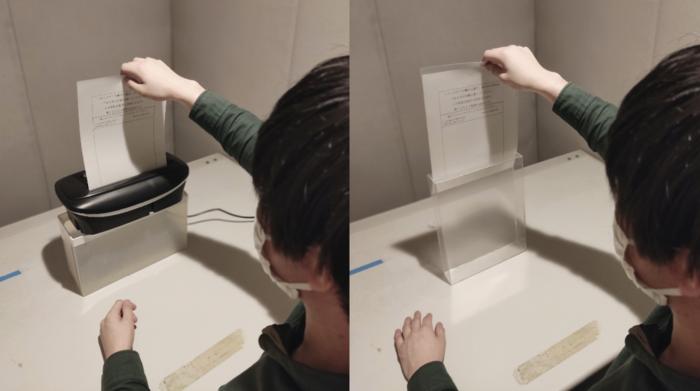
A research group in Japan has discovered that writing down one’s reaction to a negative incident on a piece of paper and then shredding it or throwing it away reduces feelings of anger.

Credit: Yuta Kanaya
A research group in Japan has discovered that writing down one’s reaction to a negative incident on a piece of paper and then shredding it or throwing it away reduces feelings of anger.
“We expected that our method would suppress anger to some extent,” lead researcher Nobuyuki Kawai said. “However, we were amazed that anger was eliminated almost entirely.”
This research is important because controlling anger at home and in the workplace can reduce negative consequences in our jobs and personal lives. Unfortunately, many anger management techniques proposed by specialists lack empirical research support. They can also be difficult to recall when angry.
The results of this study, published in Scientific Reports, are the culmination of years of previous research on the association between the written word and anger reduction. It builds on work showing how interactions with physical objects can control a person’s mood.
For their project, Kawai and his graduate student Yuta Kanaya, both at the Graduate School of Informatics, Nagoya University, asked participants to write brief opinions about important social problems, such as whether smoking in public should be outlawed. They then told them that a doctoral student at Nagoya University would evaluate their writing.
However, the doctoral students doing the evaluation were plants. Regardless of what the participants wrote, the evaluators scored them low on intelligence, interest, friendliness, logic, and rationality. To really drive home the point, the doctoral students also wrote the same insulting comment: “I cannot believe an educated person would think like this. I hope this person learns something while at the university”.
After handing out these negative comments, the researchers asked the participants to write their thoughts on the feedback, focusing on what triggered their emotions. Finally, one group of participants was told to either dispose of the paper they wrote in a trash can or keep it in a file on their desk. A second group was told to destroy the document in a shredder or put it in a plastic box.
The students were then asked to rate their anger after the insult and after either disposing of or keeping the paper. As expected, all participants reported a higher level of anger after receiving insulting comments. However, the anger levels of the individuals who discarded their paper in the trash can or shredded it returned to their initial state after disposing of the paper. Meanwhile, the participants who held on to a hard copy of the insult experienced only a small decrease in their overall anger.
Kawai imagines using his research to help businesspeople who find themselves in stressful situations. “This technique could be applied in the moment by writing down the source of anger as if taking a memo and then throwing it away when one feels angry in a business situation,” he explained.
Along with its practical benefits, this discovery may shed light on the origins of the Japanese cultural tradition known as hakidashisara (hakidashi refers to the purging or spitting out of something, and sara refers to a dish or plate) at the Hiyoshi shrine in Kiyosu, Aichi Prefecture, just outside of Nagoya. Hakidashisara is an annual festival where people smash small discs representing things that make them angry. Their findings may explain the feeling of relief that participants report after leaving the festival.
Journal
Scientific Reports
Article Title
Anger was gone with the paper on which the provocation was written
Article Publication Date
9-Apr-2024
Cite Scienmag News
Courtney Benton. (April 9, 2024). After being insulted, writing down your feelings on paper then getting rid of it reduces anger. Scienmag. https://scienmag.com/after-being-insulted-writing-down-your-feelings-on-paper-then-getting-rid-of-it-reduces-anger/
Courtney Benton. "After being insulted, writing down your feelings on paper then getting rid of it reduces anger." Scienmag, 9 April 2024, https://scienmag.com/after-being-insulted-writing-down-your-feelings-on-paper-then-getting-rid-of-it-reduces-anger/. Accessed 3 September 2026.
Courtney Benton. "After being insulted, writing down your feelings on paper then getting rid of it reduces anger." Scienmag. April 9, 2024. https://scienmag.com/after-being-insulted-writing-down-your-feelings-on-paper-then-getting-rid-of-it-reduces-anger/

