


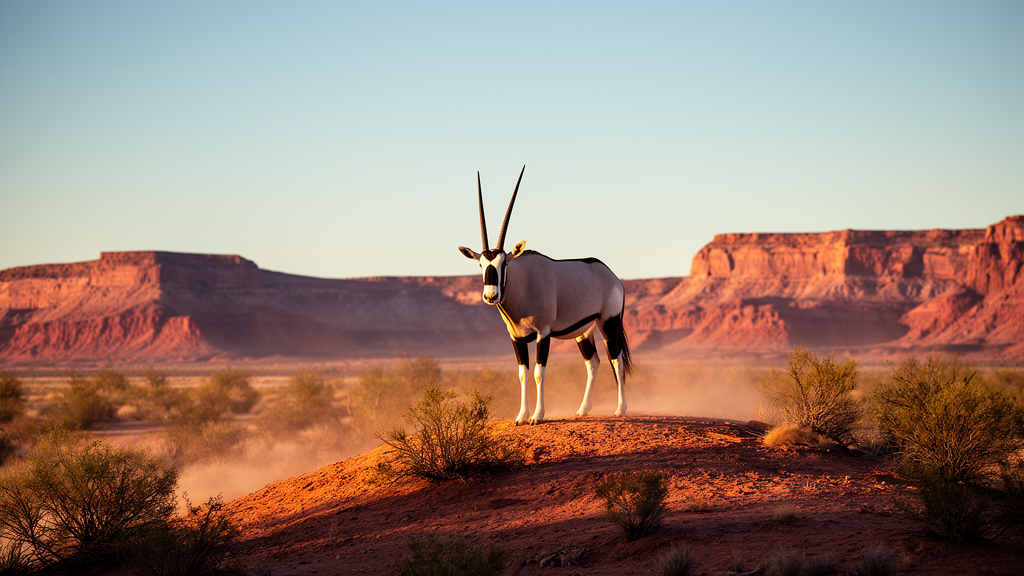
Deep in the Chihuahuan Desert of New Mexico, an African antelope with sword-like horns has been quietly writing one of the most remarkable invasion stories in North American wildlife. The gemsbok, a striking oryx native to the Kalahari Desert, was brought to the state in the 1960s and 1970s as a game animal for hunters. Half a century later, a new study from the University of Illinois Urbana-Champaign suggests that climate change could transform this localized introduction into a continental-scale range expansion, with suitable habitat stretching from the desert Southwest all the way to the Canadian border by the year 2100.
The research, published in the Journal of Mammalogy, used species distribution modeling to project where gemsbok could survive under future climate scenarios. The results are striking. Today, the animals occupy a relatively confined area of southern New Mexico, having expanded roughly 100 kilometers from their original introduction point. By the end of the century, however, the models show suitable habitat spilling well beyond state lines into Texas, Arizona, Utah, and California, and even reaching as far north as southern Washington and Montana. If the animals disperse into all of these spaces, the consequences for cattle ranching, native wildlife, and plant communities across the region could be profound.
What makes the projections credible is the way the team built them. Rather than relying solely on traditional wildlife surveys, the researchers turned to participant science. Photographs uploaded by ordinary people to platforms like iNaturalist flow into the Global Biodiversity Information Facility, a database that aggregates species occurrence records from around the world. From those records, lead author Nathan Alexander, who began the work as a doctoral student in the Department of Natural Resources and Environmental Sciences at Illinois and is now a postdoctoral scholar at Southern Illinois University, applied a statistical technique called Maxent to identify the environmental conditions that best explain where gemsbok live.
Maxent works by comparing the conditions at known occurrence points against the broader landscape, effectively asking which combination of climate and terrain variables best predicts the species’ presence. For every gemsbok sighting, the researchers examined factors including temperature seasonality, precipitation patterns, vegetation cover, terrain ruggedness, and human population density. Once they had established the species’ habitat preferences, they searched for matching environmental signatures across space and projected them forward in time under future climate scenarios. The approach revealed something ecologically important: many habitat patches that today exist as isolated pockets are expected to coalesce into larger, more contiguous blocks of suitable land as the climate warms.
That connectivity matters because isolated patches act as natural barriers to spread. Kieran Andreoni, who began the research as a master’s student at Illinois and now serves as conservation director at the Southern Plains Land Trust in Colorado, explained that when habitat patches are disconnected, dispersal barriers may prevent animals from reaching the next patch. But when those patches merge, opportunities for invasion multiply. The models show this pattern particularly strongly in western Texas, as well as western New Mexico, Arizona, and parts of California, including Death Valley, one of the hottest places on Earth.
The reason gemsbok are likely to thrive where other large mammals struggle lies in their extraordinary evolutionary heritage. Native to the Kalahari Desert in southern Africa, they are among the most drought-adapted large mammals on the planet. Bob Schooley, professor and head of the Department of Natural Resources and Environmental Sciences and a co-author of the study, noted that gemsbok can obtain all of their water from the plants they eat, meaning they do not need to drink at all. For an animal that can weigh 450 pounds, that level of water independence is exceptionally rare, and it positions the species as, in his words, the poster species for dealing with the kind of changes expected in the American Southwest.
Their advantages do not stop at physiology. When gemsbok were translocated from Africa, they left behind their natural predators, lions and hyenas. In their new range, southwestern predators such as coyotes and mountain lions kill far fewer gemsbok than their African counterparts would. The combination of superior arid-climate adaptation and relative freedom from predation creates a population with enormous potential for growth, particularly as warming and drying conditions increasingly stress the native species that share the landscape.
The most immediate ecological concern is competition for forage. Gemsbok herds eat many of the same plants as cattle and native ungulates such as pronghorn and bison, and as their numbers grow, they could substantially diminish food reserves for those species. Alexander added a further dimension to the problem: gemsbok can forage on lower-quality plant material than many native species. In drought years, when native animals may become stressed and nutrient deficient, gemsbok can shift to less nutritious vegetation and still persist. That asymmetry means the hardest years for native wildlife may be the easiest for the invaders.
The implications for ranching are equally stark. Schooley pointed out that desert rangelands are commonly used for cattle grazing, and during severe droughts ranchers pull their cattle off the land because there is nothing left for them to eat. No one pulls the gemsbok off. Given their ability to survive on low-quality forage, growing herds could severely damage the remaining grasslands precisely when those ecosystems are most vulnerable. There is also a disease dimension: gemsbok in the Southwest have tested positive for malignant catarrhal fever, bovine respiratory syncytial virus, and bovine para-influenza-3, all pathogens of concern to the cattle industry and potentially transmissible to native and domestic ungulates alike.
Managing the situation will not be simple. Gemsbok occupy a contested space in Southwestern land use: conservationists worry about native ecosystems, ranchers worry about forage and disease, and hunting operations value the animals as a trophy species that generates revenue. The Illinois researchers argue that navigating these competing interests will be tricky but critical if the region hopes to avoid the worst consequences of the spread. Their models provide a roadmap of where the expansion is most likely to occur, giving land managers a rare opportunity to act before isolated habitat patches coalesce into connected corridors. Whether that foresight translates into action may determine whether the gemsbok remains a curiosity of the New Mexican desert or becomes one of the defining invasive species of a warming North American West.
Subject of Research: Predicted climate-driven range expansion of introduced gemsbok (Oryx gazella) in the United States
Article Title: African gemsbok spreading in New Mexico: How far could they go under climate change?
Article References: African gemsbok spreading in New Mexico: How far could they go under climate change?. (n.d.). Original publication
Image Credits: AI Generated
DOI: Not provided
Keywords: gemsbok, oryx, invasive species, climate change, New Mexico, species distribution modeling, Maxent, drought adaptation, rangelands, wildlife management, Journal of Mammalogy, Southwest United States
Cite Scienmag News
Gavin Prescott. (October 9, 2026). African Antelope Set to Conquer the American Southwest as Climate Warms. Scienmag. https://scienmag.com/african-antelope-set-to-conquer-the-american-southwest-as-climate-warms/
Gavin Prescott. "African Antelope Set to Conquer the American Southwest as Climate Warms." Scienmag, 9 October 2026, https://scienmag.com/african-antelope-set-to-conquer-the-american-southwest-as-climate-warms/. Accessed 9 October 2026.
Gavin Prescott. "African Antelope Set to Conquer the American Southwest as Climate Warms." Scienmag. October 9, 2026. https://scienmag.com/african-antelope-set-to-conquer-the-american-southwest-as-climate-warms/


