


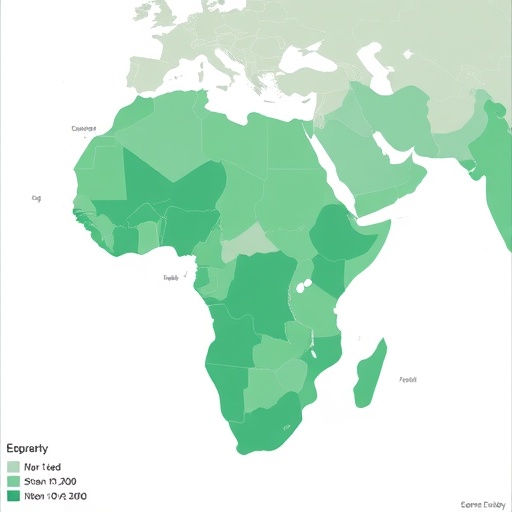
The burgeoning potential of green hydrogen as a cornerstone in the global decarbonization effort has ignited keen interest in mapping its economic viability across different geographies. A recent comprehensive investigation spearheaded by Egli, Schneider, Leonard, and colleagues zeroes in on Africa’s capacity to supply green hydrogen to Europe, emphasizing the intricate financial, infrastructural, and geopolitical parameters that define competitiveness. This analysis harnesses innovative modelling techniques to elucidate how the intersection of these parameters impacts the levelized cost of hydrogen (LCOH) and, ultimately, the feasibility of African green hydrogen as a sustainable energy export.
Focusing exclusively on African nations with Atlantic and Indian Ocean coastlines, the study deliberately excludes landlocked countries—owing to their lack of port infrastructure—and politically unstable regions identified by World Bank Governance Indicators. This refined scope isolates 31 countries, collectively responsible for 85% of the continent’s GDP, as the primary sample for evaluating green hydrogen’s export prospects. Notably, small island states are omitted due to spatial constraints that would inherently limit large-scale renewable energy deployment required for hydrogen production, underscoring the spatial and infrastructural impracticalities at play.
The dataset underpinning the study draws from the International Energy Agency’s extensive Hydrogen Database, featuring nearly two thousand projects worldwide. However, the researchers narrow their focus to 34 African projects committed to producing green hydrogen via electrolysis powered by wind or solar energy, all projected to commence operations by 2030. The temporal cut-off is critical for ensuring that analyses remain rooted in feasible and credible developments, avoiding the distortions introduced by speculative megaprojects envisioned beyond this horizon. Median production capacity among these projects stands at 60.6 kilotonnes of hydrogen annually, a metric which influences cost projections by capturing economies of scale and physical space demands intrinsic to electrolyser installations and associated renewables build-outs.
A pillar of the study revolves around the calculation of capital costs—specifically the weighted average cost of capital (WACC), often interchangeably used with cost of capital (COC). This financial metric encapsulates the aggregate expense of sourcing equity and debt financing for hydrogen infrastructure projects, adjusted for risk and market realities. Recognizing that African green hydrogen projects currently lack a track record and that financing sources may vary widely, the team devised four scenarios blending commercial and de-risked financing arrangements under low and high interest rate environments. This approach deftly captures the spectrum of investor risk appetites and macroeconomic conditions shaping project economics.
Detailed expert interviews conducted between February and August 2023 inform these scenarios, supplementing a rigorous literature review. These interviews unravel perceptions of financing feasibility from thirteen stakeholders familiar with African hydrogen projects, government policies, and international investment landscapes. Notably, these conversations reveal an acute sensitivity to political risk and technological maturity, both of which factor heavily into the risk premiums embedded in the cost of debt and equity. The team carefully quantifies these premiums, incorporating country-specific default spreads, equity risk premiums reflective of mature markets, and a technology premium to account for green hydrogen’s nascent status.
The study situates the risk-free rate—a baseline financial cost—within two contrasting frameworks: a historically low-interest environment reminiscent of post-financial crisis years, and a higher, contemporary interest rate regime reflective of market tightening as of mid-2023. These anchors offer a nuanced grasp of how macroeconomic fluctuations can sway the economics of hydrogen projects, especially given their capital intensity and long investment horizons. Across all models, debt is assumed to comprise 75% of project capital, a standard proportion for infrastructure financing, and lending margins account for lender caution in relatively volatile investment climates.
Differences emerge starkly when comparing commercial financing, where country risk factors prominently into premiums, versus de-risked scenarios in which Western European government guarantees underwrite part of the investment. Such guarantees, exemplified by Germany’s bilateral partnerships with African nations and joint hydrogen procurement schemes with the Netherlands, promise to unlock lower borrowing costs by attenuating sovereign and political risk anxieties. To realistically reflect residual risks, the model also introduces political risk insurance via the World Bank’s Multilateral Investment Guarantee Agency (MIGA), factoring in war and expropriation risks as part of de-risked case calculations.
From a modelling perspective, the GeoH2 optimization framework drives the core cost calculations. This spatially explicit tool divides each investing country into hexagonal cells, using detailed hourly renewable energy weather data to configure cost-optimal off-grid electrolyser facilities powered by wind and solar. The use of fine-grained geospatial resolution permits accurate assessments of energy generation potential, infrastructure requirements including water sourcing, and transportation costs to nearest ports. Importantly, water use is unrestricted in the model, though future enhancements might incorporate constraints to protect local resources.
Transportation logistics receive particular scrutiny, given the necessity of moving green hydrogen export volumes to European markets. Ammonia (NH₃) is modelled as the preferred carrier molecule, offering advantages in ease and cost of shipping over vast ocean distances compared to pure hydrogen gas. Drawing on shipping cost benchmarks—such as a reference cost of €0.39 per kilogram of hydrogen equivalent for 13,800 km—costs are linearly scaled to geodesic sea distances from African ports to Rotterdam. This produces a cost spread ranging from €0.09 to €0.44 per kilogram, corresponding to geographic proximities and transportation economies.
The researchers extend their comparative analysis to hydrogen production in the European Union, with Rotterdam serving as a proxy hub. Here, grid electricity at competitive prices, coupled with efficient heat supply assumptions, allow the calculation of LCOH benchmarks against which African export costs are weighed. Variations across financing scenarios are minimal in Europe due to the lower capital intensity of grid-based production, contrasting with the heavy capital investments in African renewable generation capacity and electrolysers. European LCOHs hover around €4.7 per kilogram, aligning well with projections from established energy consultancies and hydrogen market actors.
While the model excels in capturing many cost components, certain elements—such as port upgrade expenses and last-mile distribution within Europe—remain outside the scope due to data limitations and system complexity. Additionally, the analysis currently assumes static technology and cost parameters for renewables and electrolysers, deliberately excluding anticipated cost declines by 2030. These simplifications, while necessary, invite future studies to integrate dynamic cost learning effects to refine competitiveness projections further.
Collectively, this research synthesizes nuanced financial assumptions, granular spatial modelling, and real-world policy insights to present a multi-dimensional perspective on Africa’s emerging role in global green hydrogen markets. The results underscore that while African green hydrogen has technical and resource potential, its economic competitiveness hinges critically on financing structures and political risk mitigation. De-risking initiatives and international collaboration will likely be pivotal in scaling up capacity and enabling competitive market entry vis-à-vis established European production.
This holistic approach informs not only project developers and policymakers but also stakeholders along hydrogen value chains seeking to align investment priorities with climate ambitions. As green hydrogen surges onto the strategic energy stage, understanding the intertwined influence of capital costs, infrastructure readiness, and geopolitical frameworks will be vital to unlocking equitable and efficient energy transitions on the continent and beyond.
Mapping the cost competitiveness of African green hydrogen exports to Europe through detailed financial modelling and geospatial optimization.
Mapping the cost competitiveness of African green hydrogen imports to Europe
Egli, F., Schneider, F., Leonard, A. et al. Mapping the cost competitiveness of African green hydrogen imports to Europe. Nat Energy (2025). https://doi.org/10.1038/s41560-025-01768-y
Cite Scienmag News
Denise Maddox. (June 2, 2025). Africa-Europe Green Hydrogen Cost Competitiveness Mapped. Scienmag. https://scienmag.com/africa-europe-green-hydrogen-cost-competitiveness-mapped/
Denise Maddox. "Africa-Europe Green Hydrogen Cost Competitiveness Mapped." Scienmag, 2 June 2025, https://scienmag.com/africa-europe-green-hydrogen-cost-competitiveness-mapped/. Accessed 3 September 2026.
Denise Maddox. "Africa-Europe Green Hydrogen Cost Competitiveness Mapped." Scienmag. June 2, 2025. https://scienmag.com/africa-europe-green-hydrogen-cost-competitiveness-mapped/


