


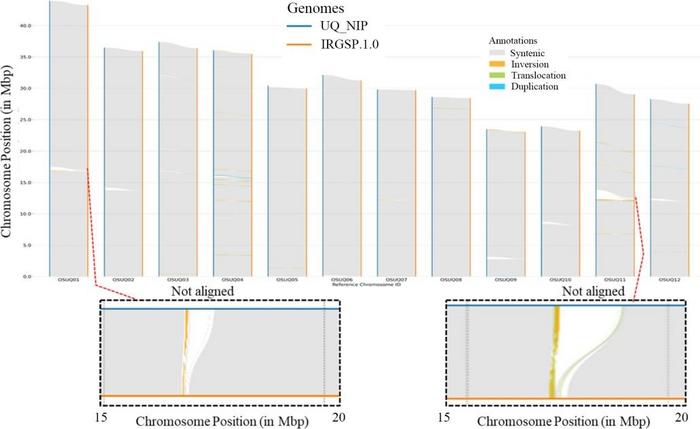
A research team has achieved a groundbreaking improvement in the haplotype-resolved genome sequence of the japonica rice cultivar Nipponbare. This enhancement reveals the identification and annotation of over 3,000 new genes, potentially offering significant advancements in crop improvement and breeding strategies.

Credit: The authors
A research team has achieved a groundbreaking improvement in the haplotype-resolved genome sequence of the japonica rice cultivar Nipponbare. This enhancement reveals the identification and annotation of over 3,000 new genes, potentially offering significant advancements in crop improvement and breeding strategies.
The japonica rice cultivar Nipponbare has been pivotal as a reference in rice genomics since its first sequencing over two decades ago, marking a significant breakthrough in plant genomics. Despite continuous improvements in sequencing technology, the Nipponbare genome assembly still contains unresolved gaps, primarily due to repetitive DNA sequence. Ongoing efforts and technological advances have enhanced genome assembly in other rice species and extended to telomere sequencing. However, achieving a fully haplotype-resolved assembly remains an unaddressed problem in rice genomic research, presenting a critical area for future study.
A study (DOI: 10.48130/tp-0024-0007) published in Tropical Plants on 03 April 2024, generates an improved haplotype resolved rice genome for a comprehensive telomere-to-telomere (T2T) improvement.
In this study, PacBio HiFi reads and Hi-C reads were utilized to generate a contig assembly with Hifiasm, resulting in a haplotype phased assembly. This assembly process yielded distinct contigs for nine of the chromosomes. In contrast, the assembly for the remaining three chromosomes involved two separate contigs for each. The assembled contigs were then hierarchically organized into 12 pseudo-chromosomes using the YaHS scaffolding tool, culminating in a T2T assembly that was larger and more complete than the previous IRGSP-1.0 reference. This refined assembly revealed the presence of 3,050 new genes, with more than 95% supported by transcript evidence, indicating a significant enhancement in the genome’s annotation and structural understanding. The findings highlight the immense potential of new sequencing technologies to expand and refine genomic data, substantially improving the genetic information of established genomes. The extended and more detailed genome, covering 99.3% of universal single-copy genes with an N50 of 30.7 Mb, provides a robust framework for further rice genetic studies and breeding programs. The comparative analysis also illuminated structural variants and additional non-aligning regions, enriching the understanding of genomic architecture and functionality.
According to the study’s lead researcher, Robert J. Henry, “This phased genome will be a useful resource for rice research.” Looking ahead, this team is focused on applying their advanced sequencing and assembly techniques to other rice varieties and closely related species.
In summary, this work not only underscores the rapid evolution of rice genomics technology but also emphasizes the critical need for ongoing advancements to accurately map complex genomes, thereby facilitating significant strides in agricultural genomics.
###
References
Original Source URL
Authors
Muhammad Abdullah1,2 , Agnelo Furtado1 , Ardashir Kharabian Masouleh1 , Pauline Okemo1,2 and Robert J. Henry1,2*
Affiliations
1 Queensland Alliance for Agriculture and Food Innovation, University of Queensland, Brisbane, QLD, 4067, Australia
2 ARC Centre for Plant Success in Nature and Agriculture, University of Queensland, Brisbane, QLD, 4067, Australia
About Tropical Plants
Tropical Plants (e-ISSN 2833-9851) is the official journal of Hainan University and published by Maximum Academic Press. Tropical Plants undergoes rigorous peer review and is published in open-access format to enable swift dissemination of research findings, facilitate exchange of academic knowledge and encourage academic discourse on innovative technologies and issues emerging in tropical plant research.
Journal
Tropical Plants
Method of Research
Experimental study
Subject of Research
Not applicable
Article Title
An improved haplotype resolved genome reveals more rice genes
Article Publication Date
3-Apr-2024
COI Statement
The authors declare that they have no competing interests.
Cite Scienmag News
Alan Morgan. (May 20, 2024). Advances in rice genome research offer insights and promising applications for agriculture. Scienmag. https://scienmag.com/advances-in-rice-genome-research-offer-insights-and-promising-applications-for-agriculture/
Alan Morgan. "Advances in rice genome research offer insights and promising applications for agriculture." Scienmag, 20 May 2024, https://scienmag.com/advances-in-rice-genome-research-offer-insights-and-promising-applications-for-agriculture/. Accessed 6 September 2026.
Alan Morgan. "Advances in rice genome research offer insights and promising applications for agriculture." Scienmag. May 20, 2024. https://scienmag.com/advances-in-rice-genome-research-offer-insights-and-promising-applications-for-agriculture/

