


Recent advancements in X-ray fluorescence (XRF) analysis have significantly enhanced our understanding of material composition, particularly in the realms of space exploration and advanced technological applications. This study delves into the comparative spectroscopic behaviors of copper and tungsten when subjected to different excitation sources, using cutting-edge detection methods that improve the resolution and accuracy of spectral measurements. The implications of this research are vast, not only shedding light on atomic phenomena but also bridging gaps in material science and astrophysics.
X-ray fluorescence analysis is crucial for elemental identification, a task that has gained recognition in the context of extraterrestrial exploration. Instruments designed for missions to Mars, the Moon, and asteroids rely heavily on XRF analysis for understanding the composition of these celestial bodies. Additionally, applications extend to advanced light sources and sophisticated techniques such as scanning electron microscopy, where the precise determination of elemental composition is paramount. This versatility is underpinned by the various excitation sources utilized, including X-ray, electron, proton, and alpha particle sources, each engendering distinct interaction mechanisms with materials.
Understanding these interaction mechanisms is fundamental to interpreting results accurately. The way photons and electrons interact with atoms showcases qualitative differences that affect energy transfer, selection rules, and the momentum conservation laws governing these interactions. Electrons, in particular, do not merely interact with outer-shell electrons; they have the propensity to penetrate deeper into the atomic structure. This leads to complex excitation patterns and varying transition probabilities, which can influence the intensity of emitted spectral lines during de-excitation processes. The intricate dance of excitation events highlights the necessity of advanced spectroscopic methodologies to extract nuanced spectral data.
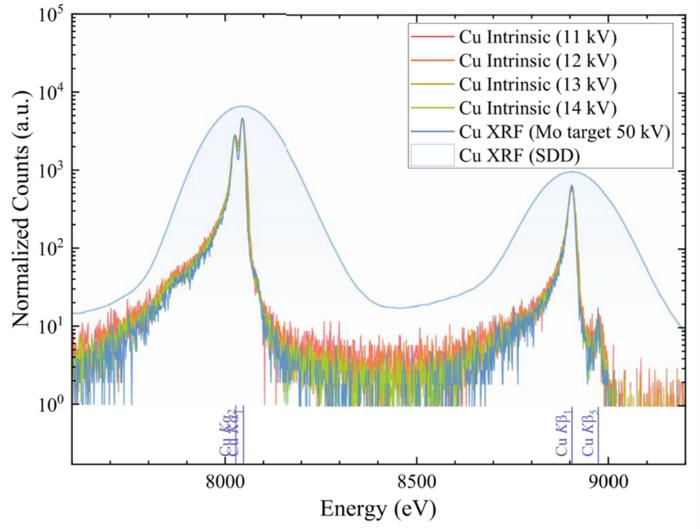
A notable challenge in practical applications arises when measuring spectral lines that are closely spaced, particularly the beta and gamma series lines. With energy separations often below 100 eV—sometimes as little as 10 eV—traditional detection methods such as silicon drift detectors (SDDs) prove inadequate. Their energy resolution, typically around 120 eV, creates significant overlap in spectral measurements, rendering it challenging to discern distinct features. To combat this, researchers have turned to superconducting transition-edge sensors (TES), which provide much higher energy resolution. These tools enable more effective measurement of nuanced spectral features, enhancing the capability to perform precise spectral analysis.
In the conducted study, the experimental protocols were finely tuned to optimize conditions for assessing the intrinsic spectra of copper and tungsten. Copper, characterized by its K-edge at 8.980 keV, required voltage settings ranging from 11 kV to 14 kV to excite its characteristic lines effectively. Conversely, tungsten demanded careful adjustment of its excitation parameters, with consideration given to its L-edge energies, necessitating voltage settings between 15 kV and 20 kV. The fine-tuning of these parameters underscores the meticulous approach taken in experiments, which included the use of molybdenum as an X-ray source. The K-edge energy of molybdenum, set at 50 keV, provided intense Kα line energies that were sufficient to excite the inner shell electrons of copper and tungsten.
The normalization process used for the analysis of copper’s Kα peaks reveals significant findings. Observations indicated that the intensities of Kβ lines remained consistent across both electron and photon excitation methods. This consistency suggests that the underlying atomic structure of copper manifested stability across differing excitation sources. Such results not only align with theoretical views regarding the behavior of the K shell but also reinforce the notion of uniform transitions that are less influenced by excitation type. In contrast, the analysis of tungsten presented a more complex scenario. While the Lα lines exhibited similar intensities across varied excitation sources, the Lβ lines manifested pronounced variations. This differential behavior can be attributed to the intricate subshell configurations of tungsten, showcasing the diverse influences of excitation on spectral outcomes.
As the implications of these findings unfold, they set the stage for future explorations in spectroscopic analysis and atomic dynamics. The research highlights a compelling pathway for refining analytical methodologies, opening new avenues for investigating a broader array of materials beyond copper and tungsten. The acquisition of an electron gun capable of operating within a 1 keV to 30 keV energy range demonstrates a forward-thinking approach to expanding the scope of experiments. Coupled with the development of a high-vacuum chamber, these advancements promise to facilitate in-depth studies of the Lβ line series across various elements, enhancing our understanding of atomic excitation dynamics.
Future experiments aim to incorporate alpha particle sources, specifically using americium-241, to provide a comparative analysis against electron-induced excitation. By juxtaposing these two methods, the research seeks to establish a comprehensive database of spectral characteristics that may enhance the capabilities of advanced instruments used in space science. Such initiatives have resonances that extend well beyond laboratory confines, aspiring to enrich our understanding of elemental behaviors in both terrestrial and extraterrestrial settings.
In conclusion, the comparative study of copper and tungsten under different excitation sources has revealed remarkable insights into their spectral responses. While copper displayed consistent intensity patterns, tungsten showcased a more complex interaction with varying excitation methods. As the research community braces for the next wave of advancements in spectroscopic techniques, the potential applications loom large, with implications that span across multiple disciplines—including material science, chemistry, and astrophysics. The findings of this study set forth a robust framework for future inquiries, empowering scientists to delve deeper into the rich tapestry of atomic behavior and its resultant effects on material properties.
Keywords
Cite Scienmag News
Denise Maddox. (June 2, 2025). Advancements in High Energy Resolution Fluorescence Spectroscopy Using Microcalorimeter-Based Dispersive X-Ray Sources: Implications for Scanning Electron Microscopy and Space Exploration. Scienmag. https://scienmag.com/advancements-in-high-energy-resolution-fluorescence-spectroscopy-using-microcalorimeter-based-dispersive-x-ray-sources-implications-for-scanning-electron-microscopy-and-space-exploration/
Denise Maddox. "Advancements in High Energy Resolution Fluorescence Spectroscopy Using Microcalorimeter-Based Dispersive X-Ray Sources: Implications for Scanning Electron Microscopy and Space Exploration." Scienmag, 2 June 2025, https://scienmag.com/advancements-in-high-energy-resolution-fluorescence-spectroscopy-using-microcalorimeter-based-dispersive-x-ray-sources-implications-for-scanning-electron-microscopy-and-space-exploration/. Accessed 3 September 2026.
Denise Maddox. "Advancements in High Energy Resolution Fluorescence Spectroscopy Using Microcalorimeter-Based Dispersive X-Ray Sources: Implications for Scanning Electron Microscopy and Space Exploration." Scienmag. June 2, 2025. https://scienmag.com/advancements-in-high-energy-resolution-fluorescence-spectroscopy-using-microcalorimeter-based-dispersive-x-ray-sources-implications-for-scanning-electron-microscopy-and-space-exploration/


