


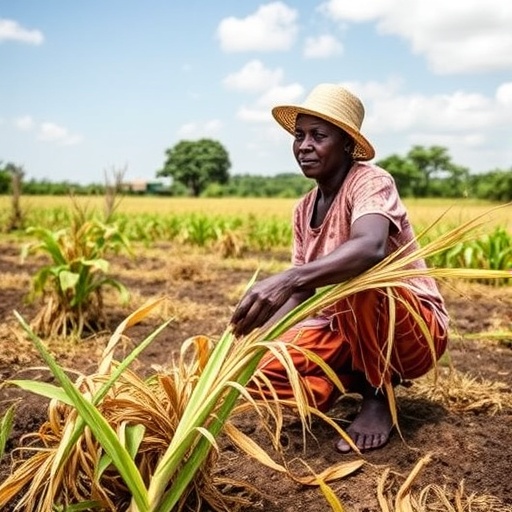
In recent years, the impact of climate change has become a pressing concern for agricultural communities around the globe, leading to drastic shifts in crop production, pest prevalence, and water availability. In Ghana, smallholder farmers increasingly face these challenges, which threaten their livelihoods and food security. A recent study conducted by Aduko, Kuorsoh, and Boasu sheds light on how climate change information can significantly influence farmers’ adaptation strategies, providing insight into the complex relationship between knowledge and practice.
This research highlights a crucial aspect often overlooked in discussions about climate change: the role of information dissemination in empowering farmers. The study indicates that farmers who are well-informed about climate change phenomena tend to adopt more effective and sustainable adaptation strategies. Access to accurate and timely climate information is essential for smallholder farmers making decisions about crop selection, planting schedules, and resource management. By understanding these dynamics, we can better support vulnerable populations in adapting to an increasingly volatile climate.
The study delves into the various sources of climate information available to Ghanaian farmers. From formal education to agricultural extension services, the authors identify several pathways through which farmers receive knowledge about climate change. It is noted that community engagements and localized knowledge systems also play an essential role in how farmers perceive and respond to climatic shifts. The integration of traditional knowledge with scientific insights appears to be a powerful combination that enhances farmers’ ability to devise practical solutions.
In exploring the climate adaptation strategies employed by farmers, the researchers categorize responses into distinct approaches. These include crop diversification, which allows farmers to spread risk across various crops, and improved water management practices, such as rainwater harvesting. These strategies demonstrate resilience in the face of adverse climatic conditions and signify a shift towards more sustainable farming practices. With the right information at their disposal, farmers are more likely to innovate and experiment, fostering a culture of resilience.
The authors of the study also emphasize the importance of tailoring climate information to local contexts. One-size-fits-all solutions are often ineffective in agricultural systems that are inherently diverse. The researchers advocate for localized climate forecasts and recommendations which consider the unique environmental and socio-economic conditions present in different regions of Ghana. By doing so, farmers can make informed decisions that are both contextually relevant and pragmatically actionable.
The use of technology in disseminating climate information cannot be overstated. Mobile applications and localized weather forecasting services are increasingly being utilized to reach farmers in remote areas. These innovations facilitate real-time access to climate data, allowing farmers to make informed decisions quickly. The study highlights instances where such technology has empowered farmers to adjust their practices according to immediate weather changes, thus minimizing risk and enhancing productivity.
While the potential for adaptation strategies is immense, the authors caution that access to climate information remains uneven across rural Ghana. Factors such as education level, economic status, and even gender can influence a farmer’s ability to access and utilize climate information effectively. As a result, the study calls for targeted interventions aimed at bridging these gaps. Engaging marginalized groups in climate dialogues and ensuring their access to crucial information could foster more equitable adaptation strategies.
Another critical finding of the research is the psychological aspect of information dissemination. Farmers’ perceptions and attitudes towards climate change largely dictate how they respond to available information. The study shows that increased awareness often correlates with a higher likelihood of adopting adaptation measures. Therefore, fostering a mindset that embraces climate resilience is as important as disseminating technical knowledge. Awareness campaigns that highlight success stories and encourage community participation can significantly influence farmers’ behavior.
Furthermore, institutional support is paramount in facilitating effective adaptation strategies among smallholder farmers. The study outlines the collaborative role of various stakeholders, including government agencies, non-governmental organizations, and local communities. Building strong partnerships among these entities can create a more robust support system, ensuring that farmers not only access information but also receive the necessary resources and tools to implement effective adaptation strategies.
In conclusion, the research performed by Aduko, Kuorsoh, and Boasu underscores the transformative power of climate change information in agricultural adaptation. By understanding the complexities of information dissemination, we can help empower farmers to confront the challenges posed by climate change. Future strategies should focus on enhancing accessibility, ensuring relevance, and fostering an adaptive mindset among farmers. As climate change continues to reshape agricultural landscapes, the insights gleaned from this research can serve as a blueprint for developing resilient agricultural practices that secure livelihoods and ensure food security in Ghana and beyond.
The implications of this study extend beyond Ghana, echoing the global need for targeted climate action in agricultural sectors. The essence of adaptation strategies lies not merely in technology and innovation but in the seamless integration of knowledge into practical responses. As farmers navigate the uncertainties of a changing climate, we must strive to equip them with the tools, insights, and support necessary for a sustainable agricultural future.
Cite Scienmag News
Alan Morgan. (January 19, 2026). Adapting to Climate Change: Insights for Ghana’s Smallholder Farmers. Scienmag. https://scienmag.com/adapting-to-climate-change-insights-for-ghanas-smallholder-farmers/
Alan Morgan. "Adapting to Climate Change: Insights for Ghana’s Smallholder Farmers." Scienmag, 19 January 2026, https://scienmag.com/adapting-to-climate-change-insights-for-ghanas-smallholder-farmers/. Accessed 3 September 2026.
Alan Morgan. "Adapting to Climate Change: Insights for Ghana’s Smallholder Farmers." Scienmag. January 19, 2026. https://scienmag.com/adapting-to-climate-change-insights-for-ghanas-smallholder-farmers/


