


The Cambrian fossil record indicates that most animal phyla had diversified and inhabited the Earth’s oceans approximately 518 million years ago. But even though chordates—the group that includes vertebrates like humans—were part of this early animal diversification, they make up a relatively small portion of fossils from more than 50 Cambrian sites worldwide.

Credit: Franz Anthony
The Cambrian fossil record indicates that most animal phyla had diversified and inhabited the Earth’s oceans approximately 518 million years ago. But even though chordates—the group that includes vertebrates like humans—were part of this early animal diversification, they make up a relatively small portion of fossils from more than 50 Cambrian sites worldwide.
In a new paper published in Royal Society Open Science, Harvard research scientist Rudy Lerosey-Aubril and associate professor Javier Ortega-Hernández present their surprising finding of a new species of chordate, and the first soft-bodied vertebrate to be discovered in the Drumian Marjum Formation of the American Great Basin.
This new fossil was part of a collection of Cambrian soft-bodied fossils deposited in the Museum of Natural History of Utah, a long term collaborator with researchers at Harvard.
The discovery of this new species, dubbed Nuucichthys rhynchocephalus, is a valuable contribution to early vertebrate evolution and biodiversity because of the dearth of these types of organisms in Cambrian fossil sites—including South China, the Northeastern United States, and British Columbia.
Nuucichthys is also one of only four species documenting the early evolutionary stage of vertebrate lineage and, as such, is one of humanity’s oldest relatives.
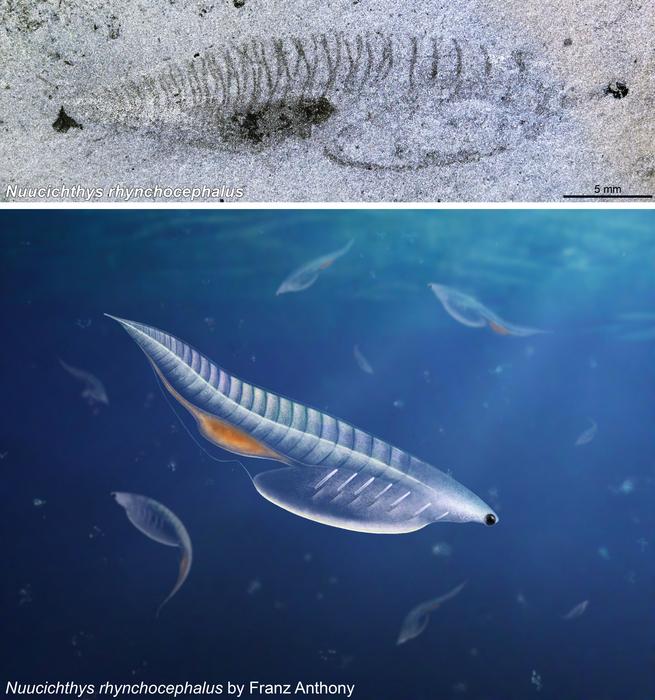
In their paper, Lerosey-Aubril and Ortega-Hernández describe Nuucichthys as having a finless torpedo-shaped body that includes a number of markers characteristic of vertebrates.
“Early vertebrates start to have big eyes and a series of muscle blocks that we call myotomes, and this is something we recognize very well in our fossil,” Lerosey-Aubril said.
The new species also confirms that, despite their overall similarities to larval fish—having a cavity that is a sort of rudimentary gill system—they were devoid of fins and therefore had limited swimming capabilities.
“But all of these characteristics clearly point to some vertebrate affinities,” Lerosey-Aubril said. “And because it’s very early in the evolution of the vertebrates, they don’t have bones yet—this is why these fossils are exceedingly rare.”
Lerosey-Aubril and Ortega-Hernández speculate that Nuucichthys likely lived high up in the water column of the ocean. Because of this, and because it possessed no biomineralized parts like bones or a shell, it was particularly prone to rapid post-mortem degradation and decay, which explains why they were fossilized so rarely.
“What’s interesting with this new species is that understanding how the morphology evolved from the invertebrate type to the vertebrate type is difficult without fossils, and this new fossil tells us a little bit about that,” Ortega-Hernández said.
The Drumian Marjum site where the new fossil was found has been intensively investigated since 2022 by an international group of paleontologists led by Lerosey-Aubril and Ortega-Hernández, and both believe that continuous collecting efforts at this site may result in the discovery of new specimens of Nuucichthys rhynchocephalus in the future.
Journal
Royal Society Open Science
Method of Research
Observational study
Subject of Research
Animals
Article Title
A long-headed Cambrian soft-bodied vertebrate from the American Great Basin region
Article Publication Date
24-Jul-2024
Cite Scienmag News
Drew Townsend. (July 25, 2024). A soft needle in an oceanic haystack. Scienmag. https://scienmag.com/a-soft-needle-in-an-oceanic-haystack/
Drew Townsend. "A soft needle in an oceanic haystack." Scienmag, 25 July 2024, https://scienmag.com/a-soft-needle-in-an-oceanic-haystack/. Accessed 3 September 2026.
Drew Townsend. "A soft needle in an oceanic haystack." Scienmag. July 25, 2024. https://scienmag.com/a-soft-needle-in-an-oceanic-haystack/

