


“Resistance training can reverse certain aspects of skeletal muscle aging.”

Credit: 2024 Roberts et al.
“Resistance training can reverse certain aspects of skeletal muscle aging.”
BUFFALO, NY- May 1, 2024 – A new research paper was published in Aging (listed by MEDLINE/PubMed as “Aging (Albany NY)” and “Aging-US” by Web of Science) Volume 16, Issue 8, entitled, “A novel deep proteomic approach in human skeletal muscle unveils distinct molecular signatures affected by aging and resistance training.”
The skeletal muscle proteome alterations to aging and resistance training have been reported in prior studies. However, conventional proteomics in skeletal muscle typically yields wide protein abundance ranges that mask the detection of lowly expressed proteins.
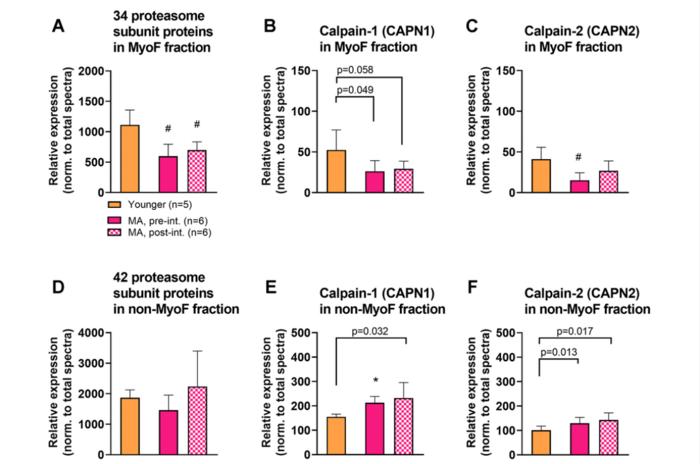
In this new study, researchers Michael D. Roberts, Bradley A. Ruple, Joshua S. Godwin, Mason C. McIntosh, Shao-Yung Chen, Nicholas J. Kontos, Anthony Agyin-Birikorang, Max Michel, Daniel L. Plotkin, Madison L. Mattingly, Brooks Mobley, Tim N. Ziegenfuss, Andrew D. Fruge, and Andreas N. Kavazis from Auburn University, Seer, Inc., and The Center for Applied Health Sciences adopted a novel deep proteomics approach whereby myofibril (MyoF) and non-MyoF fractions were separately subjected to protein corona nanoparticle complex formation prior to digestion and Liquid Chromatography Mass Spectrometry (LC-MS).
“Specifically, we investigated MyoF and non-MyoF proteomic profiles of the vastus lateralis muscle of younger (Y, 22±2 years old; n=5) and middle-aged participants (MA, 56±8 years old; n=6). Additionally, MA muscle was analyzed following eight weeks of resistance training (RT, 2d/week).”
Across all participants, the number of non-MyoF proteins detected averaged to be 5,645±266 (range: 4,888–5,987) and the number of MyoF proteins detected averaged to be 2,611±326 (range: 1,944–3,101). Differences in the non-MyoF (8.4%) and MyoF (2.5%) proteomes were evident between age cohorts, and most differentially expressed non-MyoF proteins (447/543) were more enriched in MA versus Y. Biological processes in the non-MyoF fraction were predicted to be operative in MA versus Y including increased cellular stress, mRNA splicing, translation elongation, and ubiquitin-mediated proteolysis. RT in MA participants only altered ~0.3% of MyoF and ~1.0% of non-MyoF proteomes.
“In summary, aging and RT predominantly affect non-contractile proteins in skeletal muscle. Additionally, marginal proteome adaptations with RT suggest more rigorous training may stimulate more robust effects or that RT, regardless of age, subtly alters basal state skeletal muscle protein abundances.”
Read the full paper: DOI: https://doi.org/10.18632/aging.205751
Corresponding Author: Michael D. Roberts
Corresponding Email: mdr0024@auburn.edu
Click here to sign up for free Altmetric alerts about this article.
About Aging:
Aging publishes research papers in all fields of aging research including but not limited, aging from yeast to mammals, cellular senescence, age-related diseases such as cancer and Alzheimer’s diseases and their prevention and treatment, anti-aging strategies and drug development and especially the role of signal transduction pathways such as mTOR in aging and potential approaches to modulate these signaling pathways to extend lifespan. The journal aims to promote treatment of age-related diseases by slowing down aging, validation of anti-aging drugs by treating age-related diseases, prevention of cancer by inhibiting aging. Cancer and COVID-19 are age-related diseases.
Aging is indexed by PubMed/Medline (abbreviated as “Aging (Albany NY)”), PubMed Central, Web of Science: Science Citation Index Expanded (abbreviated as “Aging‐US” and listed in the Cell Biology and Geriatrics & Gerontology categories), Scopus (abbreviated as “Aging” and listed in the Cell Biology and Aging categories), Biological Abstracts, BIOSIS Previews, EMBASE, META (Chan Zuckerberg Initiative) (2018-2022), and Dimensions (Digital Science).
Please visit our website at www.Aging-US.com and connect with us:
- X, formerly Twitter
- YouTube
- Spotify, and available wherever you listen to podcasts
Click here to subscribe to Aging publication updates.
For media inquiries, please contact media@impactjournals.com.
Aging (Aging-US) Journal Office
6666 E. Quaker Str., Suite 1B
Orchard Park, NY 14127
Phone: 1-800-922-0957, option 1
###
Journal
Aging-US
Method of Research
Observational study
Subject of Research
People
Article Title
A novel deep proteomic approach in human skeletal muscle unveils distinct molecular signatures affected by aging and resistance training
Article Publication Date
19-Apr-2024
Cite Scienmag News
Beatrice Stafford. (May 1, 2024). A novel deep proteomic approach unveils molecular signatures affected by aging and resistance training. Scienmag. https://scienmag.com/a-novel-deep-proteomic-approach-unveils-molecular-signatures-affected-by-aging-and-resistance-training/
Beatrice Stafford. "A novel deep proteomic approach unveils molecular signatures affected by aging and resistance training." Scienmag, 1 May 2024, https://scienmag.com/a-novel-deep-proteomic-approach-unveils-molecular-signatures-affected-by-aging-and-resistance-training/. Accessed 3 September 2026.
Beatrice Stafford. "A novel deep proteomic approach unveils molecular signatures affected by aging and resistance training." Scienmag. May 1, 2024. https://scienmag.com/a-novel-deep-proteomic-approach-unveils-molecular-signatures-affected-by-aging-and-resistance-training/

