


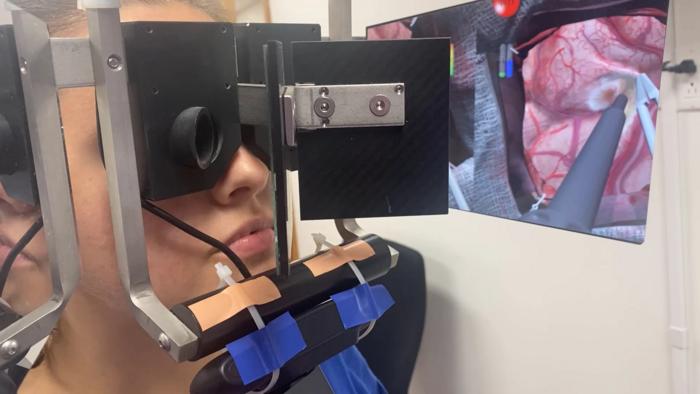
Neurosurgery is perhaps one of the most demanding professions in healthcare. Surgeons spend long hours performing operations where expert performance means the difference between a good and bad patient outcome. While operative injuries are rare, when they occur, they can have serious, and lifelong consequences.

Credit: The Neuro
Neurosurgery is perhaps one of the most demanding professions in healthcare. Surgeons spend long hours performing operations where expert performance means the difference between a good and bad patient outcome. While operative injuries are rare, when they occur, they can have serious, and lifelong consequences.
Researchers at the Neurosurgical Simulation and Artificial Intelligence Learning Centre at The Neuro (Montreal Neurological Institute-Hospital) of McGill University are striving to improve brain surgery training by designing real-time, intelligent tutors powered by AI. These systems are designed to mimic the role of human surgical instructors in brain surgical training. Intelligent tutors help the learner acquire excellent operative skills by continuously assessing hand movements during simulated brain procedures and providing personalized verbal feedback…
Educating the next generation of neurosurgeons is a long, expensive, and complex process. AI and simulation hold the potential to make the learning process easier while maintaining or enhancing the quality of graduating neurosurgeons’ skills.
Their most recent study was the first randomized controlled trial comparing AI intelligent tutor instruction with human expert human instruction during simulated surgery. They divided 97 medical trainees into three groups, either receiving real-time AI feedback, in-person expert instruction or no real-time feedback.
The trainees who received AI instruction performed significantly better than those who received expert instruction and no real-time instruction. The study found that expert instruction alone led to poorer surgical learning outcomes. By employing their extensive expertise and the new opportunities provided by AI, surgical educators can provide new possibilities for learners to reach their potential as excellent surgeons.
“This study suggests the future of instruction in the operating room may involve human educators utilizing the capacity of AI to further enhance learner surgical skills acquisition,” says Dr. Rolando Del Maestro, Director, Neurosurgical Simulation and Artificial Intelligence Learning Centre
The study, entitled “RealTime multifaceted artificial intelligence vs InPerson instruction in teaching surgical technical skills: a randomized controlled trial”, was published in Nature Scientific Reports on July 2, 2024.
Journal
Scientific Reports
Method of Research
Experimental study
Subject of Research
People
Article Title
Real‑Time multifaceted artificial intelligence vs In‑Person instruction in teaching surgical technical skills: a randomized controlled trial
Article Publication Date
2-Jul-2024
COI Statement
The authors declare no competing interests.
Cite Scienmag News
Cassandra Pierce. (September 4, 2024). A new role for intelligent tutors powered by AI in brain surgery? Scienmag. https://scienmag.com/a-new-role-for-intelligent-tutors-powered-by-ai-in-brain-surgery/
Cassandra Pierce. "A new role for intelligent tutors powered by AI in brain surgery?" Scienmag, 4 September 2024, https://scienmag.com/a-new-role-for-intelligent-tutors-powered-by-ai-in-brain-surgery/. Accessed 4 September 2026.
Cassandra Pierce. "A new role for intelligent tutors powered by AI in brain surgery?" Scienmag. September 4, 2024. https://scienmag.com/a-new-role-for-intelligent-tutors-powered-by-ai-in-brain-surgery/

