

Thursday, September 3, 2026
Science
No Result
View All Result
  • Login
  • HOME
  • SCIENCE NEWS
  • CONTACT US
  • HOME
  • SCIENCE NEWS
  • CONTACT US
No Result
View All Result
Scienmag
No Result
View All Result
Home Science News Technology and Engineering

A new, low-cost, high-efficiency photonic integrated circuit

May 8, 2024
in Technology and Engineering
Denise Maddox
By Denise Maddox Scienmag Editorial Profile - Mechanical Engineering
Reading Time: 3 mins read
0
A new, low-cost, high-efficiency photonic integrated circuit
67
SHARES
607
VIEWS
Share on FacebookShare on Twitter
ADVERTISEMENT

The rapid advancement in photonic integrated circuits (PICs), whichcombine multiple optical devices and functionalities on a single chip, has revolutionized optical communications and computing systems.

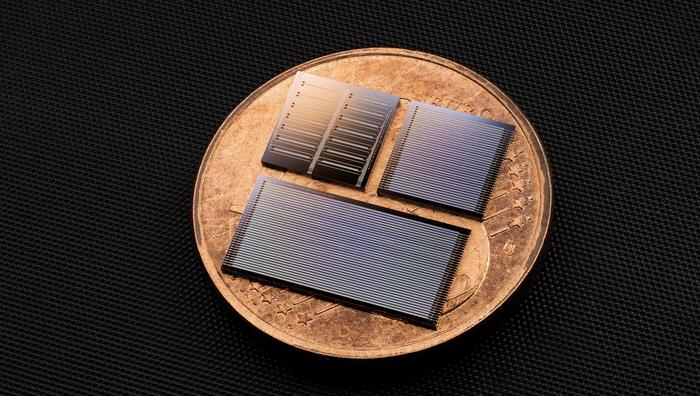
Lithium tantalate photonic integrated circuits.

Credit: Tobias Kippenberg (EPFL)

The rapid advancement in photonic integrated circuits (PICs), whichcombine multiple optical devices and functionalities on a single chip, has revolutionized optical communications and computing systems.

For decades, silicon-based PICs have dominated the field due to their cost-effectiveness and through their integration with existing semiconductor manufacturing technologies, despite their limitations with regard to their electro-optical modulation bandwidth. Nevertheless, silicon-on-insulator optical transceiver chips were successfully commercialized, driving information traffic through millions of glass fibers in modern datacenters.

Recently, the lithium niobate-on-insulator wafer platform has emerged as a superior material for photonic integrated electro-optical modulators due to its strong Pockels coefficient, which is essential for high-speed optical modulation. Nonetheless, high costs and complex production requirements, have kept lithium niobate from being adopted more widely, limiting its commercial integration.

Lithium tantalate (LiTaO3), a close relative of lithium niobate, promises to overcome these barriers. It features similar excellent electro-optic qualities but has an advantage over lithium niobate in scalability and cost, as it is already being widely used in 5G radiofrequency filters by telecom industries.

Now scientists led by Professor Tobias J. Kippenberg at EPFL and Professor Xin Ou at the Shanghai Institute of Microsystem and Information Technology (SIMIT) have created a new PIC platform based on lithium tantalate. The PIC leverages the material’s inherent advantages and can transform the field by making high-quality PICs more economically viable. The breakthrough is published in Nature.

The researchers developed a wafer-bonding method for lithium tantalate, whichis compatible with silicon-on-insulator production lines. They then masked the thin-film lithium tantalate wafer with diamond-like carbon and proceeded to etch optical waveguides, modulators, and ultra-high quality factor microresonators.

The etching was achieved by combining deep ultraviolet (DUV) photolithography and dry-etching techniques, developed initially for lithium niobate and then carefully adapted to etch the harder and more inert lithium tantalate. This adaptation involved optimizing the etch parameters to minimize optical losses, a crucial factor in achieving high performance in photonic circuits.

With this approach, the team was able to fabricate high-efficiency lithium tantalate PICs with an optical loss rate of just 5.6 dB/m at telecom wavelength. Another highlight is the electro-optic Mach-Zehnder modulator (MZM), a device widely used in today’s high-speed optical fiber communication. The lithium tantalate MZM offers a half-wave voltage-length product of 1.9 V cm and an electro-optical  bandwidth reaching 40 GHz.

“While maintaining highly efficient electro-optical performance, we also generated soliton microcomb on this platform,” says Chengli Wang, the study’s first author. “These soliton microcombs feature a large number of coherent frequencies and, when combined with electro-optic modulation capabilities, are particularly suitable for applications such as parallel coherent LiDAR and photonic computing.”

The lithium tantalate PIC’s reduced birefringence (the dependence of refractive index on light polarization and propagation direction) allows dense circuit configurations and ensures broad operational capabilities across all telecommunication bands. The work paves the way for scalable, cost-effective manufacturing of advanced electro-optical PICs.


Journal

Nature

DOI

10.1038/s41586-024-07369-1

Article Title

Lithium tantalate photonic integrated circuits for volume manufacturing.

Article Publication Date

8-May-2024

Subject of Research: Technology and Engineering

Article Title: A new, low-cost, high-efficiency photonic integrated circuit

Article References: Original research article

Image Credits: AI Generated

DOI: Not provided

Keywords: Not provided

Cite Scienmag News

Denise Maddox. (May 8, 2024). A new, low-cost, high-efficiency photonic integrated circuit. Scienmag. https://scienmag.com/a-new-low-cost-high-efficiency-photonic-integrated-circuit/

Denise Maddox. "A new, low-cost, high-efficiency photonic integrated circuit." Scienmag, 8 May 2024, https://scienmag.com/a-new-low-cost-high-efficiency-photonic-integrated-circuit/. Accessed 3 September 2026.

Denise Maddox. "A new, low-cost, high-efficiency photonic integrated circuit." Scienmag. May 8, 2024. https://scienmag.com/a-new-low-cost-high-efficiency-photonic-integrated-circuit/

Share27Tweet17
Previous Post

Keck Medicine of USC earns ‘LGBTQ+ Healthcare Equality Leader’ 2024 designation

Next Post

Roadmap to a carbon-neutral refinery by 2050

Related Posts

pyFDM 1.2: Python library simplifies uncertainty decision analysis for researchers
Technology and Engineering

pyFDM 1.2: Python library simplifies uncertainty decision analysis for researchers

September 3, 2026
Biodegradable Nanofiber Filters Hit N95 Performance Without Electrostatic Charges
Technology and Engineering

Biodegradable Nanofiber Filters Hit N95 Performance Without Electrostatic Charges

September 3, 2026
Fuzzy attention-based encoder-decoder improves skin lesion segmentation accuracy
Technology and Engineering

Fuzzy attention-based encoder-decoder improves skin lesion segmentation accuracy

September 3, 2026
Federated multimodal approach boosts malware classification across non-IID data
Technology and Engineering

Federated multimodal approach boosts malware classification across non-IID data

September 3, 2026
CNN-Based Game Theory Approach Improves Similar Image Retrieval
Technology and Engineering

CNN-Based Game Theory Approach Improves Similar Image Retrieval

September 3, 2026
New framework optimizes dynamic task allocation across edge-fog-cloud crowdsensing systems
Technology and Engineering

New framework optimizes dynamic task allocation across edge-fog-cloud crowdsensing systems

September 3, 2026
Next Post
Roadmap to a carbon-neutral refinery by 2050

Roadmap to a carbon-neutral refinery by 2050

  • Mothers who receive childcare support from maternal grandparents show more optimized

    Mothers who receive childcare support from maternal grandparents show more parental warmth, finds NTU Singapore study

    27656 shares
    Share 11059 Tweet 6912
  • University of Seville Breaks 120-Year-Old Mystery, Revises a Key Einstein Concept

    1061 shares
    Share 424 Tweet 265
  • Bee body mass, pathogens and local climate influence heat tolerance

    682 shares
    Share 273 Tweet 171
  • Researchers record first-ever images and data of a shark experiencing a boat strike

    546 shares
    Share 218 Tweet 137
  • Groundbreaking Clinical Trial Reveals Lubiprostone Enhances Kidney Function

    531 shares
    Share 212 Tweet 133
Science

Embark on a thrilling journey of discovery with Scienmag.com—your ultimate source for cutting-edge breakthroughs. Immerse yourself in a world where curiosity knows no limits and tomorrow’s possibilities become today’s reality!

RECENT NEWS

  • Tests May Underestimate Cognitive Skills of Deaf Young Adults
  • Yeast strains differ in dough gas cell stability and bread crumb structure
  • Multimodal AI system tracks shrimp growth and guides smart feeding decisions
  • Waste Palm Seed Extract Yields Powerful Supercapacitor Electrode Material

Categories

  • Agriculture
  • Anthropology
  • Archaeology
  • Athmospheric
  • Biology
  • Biotechnology
  • Blog
  • Bussines
  • Cancer
  • Chemistry
  • Climate
  • Earth Science
  • Editorial Policy
  • Marine
  • Mathematics
  • Medicine
  • Pediatry
  • Policy
  • Psychology & Psychiatry
  • Science Education
  • Social Science
  • Space
  • Technology and Engineering

Subscribe to Blog via Email

Enter your email address to subscribe to this blog and receive notifications of new posts by email.

Join 5,151 other subscribers

© 2025 Scienmag - Science Magazine

Welcome Back!

Login to your account below

Forgotten Password?

Retrieve your password

Please enter your username or email address to reset your password.

Log In
No Result
View All Result
  • HOME
  • SCIENCE NEWS
  • CONTACT US

© 2025 Scienmag - Science Magazine

Discover more from Science

Subscribe now to keep reading and get access to the full archive.

Continue reading