


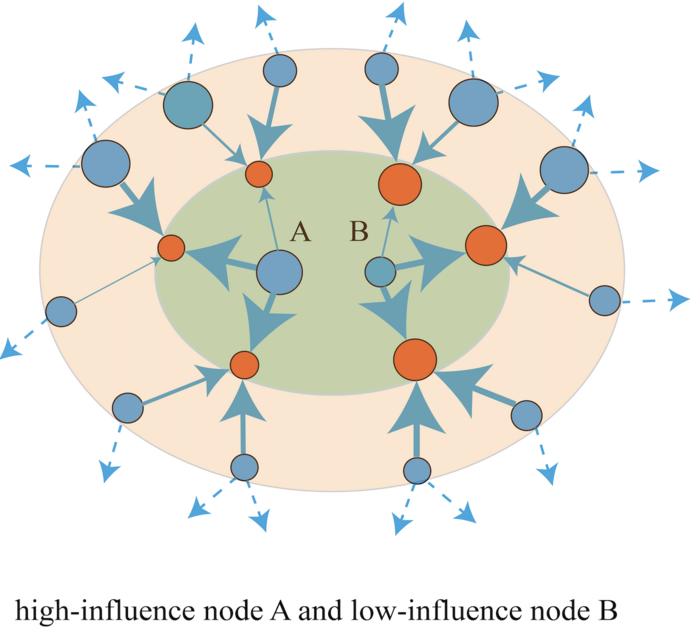
Understanding how information flows in social networks is critical to counteracting dangerous misinformation, promoting the spreading of news, and designing healthy online social environments. Scholars have long realized the role of information superspreaders – namely, users with the capability to rapidly spread messages and ideas to many others. A long-standing research tradition identifies the superspreaders through their position in the social network. This research, led by Prof. Linyuan Lü (University of Electronic Science and Technology of China) and Dr. Manuel S. Mariani (University of Zurich), challenges this long-standing paradigm. It shows that how users’ behavioral traits (i.e., how they tend to behave) provide more accurate early indicators of their spreading ability than where they sit in the social network.

Credit: ©Science China Press
Understanding how information flows in social networks is critical to counteracting dangerous misinformation, promoting the spreading of news, and designing healthy online social environments. Scholars have long realized the role of information superspreaders – namely, users with the capability to rapidly spread messages and ideas to many others. A long-standing research tradition identifies the superspreaders through their position in the social network. This research, led by Prof. Linyuan Lü (University of Electronic Science and Technology of China) and Dr. Manuel S. Mariani (University of Zurich), challenges this long-standing paradigm. It shows that how users’ behavioral traits (i.e., how they tend to behave) provide more accurate early indicators of their spreading ability than where they sit in the social network.
The authors departed from traditional network approaches by starting from a model for how information flows from individual to individual. Motivated by previous empirical findings, the model assumes that the probability that a message is transmitted from a source to a target user is determined by both the source’s influence (namely, a parameter that captures her likelihood to transmit information to others) and the target’s susceptibility to influence. The users’ influence and susceptibility parameters are not known a priori. However, the authors derived a pair of coupled equations that connect the users’ influence and susceptibility with the structure of the underlying propagation network, which enables their computation on massive behavioral datasets.
Through these equations, the authors could measure the influence and susceptibility scores of millions of users in Weibo and Twitter, which improves our understanding of information superspreaders in two ways. First, the results by the authors challenge the paradigm that the network hubs – i.e., the users with many followers – are the most effective information spreaders. They show that, instead, the influence and susceptibility scores of the users provide more accurate predictors of being a superspreader than the users’ number of followers. Second, the superspreaders are characterized by more high-contagion links (i.e. the product between their influence and their audiences’ susceptibilities tends to be large), and they tend to influence more influential users. This suggests that explaining the superspreaders requires the integration of network structures and individual-level behavioral characteristics.
These findings could open new directions in social network research. Within the realm of information spreading, the simplifying assumptions of the propagation model might be gradually relaxed. More refined models may include topic diversity, algorithmic influences, memory effects, all of which could lead to different equations for the users’ influence and susceptibility scores. The influence and susceptibility scores may also vary by topic, which could eventually lead to a multidimensional characterization of the users and their spreading capabilities.
On a more general note, the paradigm proposed by this study could also have implications for interventions aimed at large-scale behavioral change. Traditionally, these activities focus on persuading the social hubs to early adopt a new product or behavior. The authors’ findings suggest that a more effective approach might rely on identifying high-contagion links that connect highly-influential and highly-susceptible potential adopters. To this end, additional research is needed to adapt the algorithm to the spreading of behaviors, which will likely require different sets of equations compared to those obtained for information spreading. Field experiments will be needed to validate the resulting insights. Eventually, these efforts could reveal how to best integrate individuals’ position in their social networks with how they typically behave to design interventions for behavioral change, which is key for organizations and policymakers.
Journal
National Science Review
Cite Scienmag News
Courtney Benton. (April 9, 2024). A new algorithm to predict information superspreaders in social media. Scienmag. https://scienmag.com/a-new-algorithm-to-predict-information-superspreaders-in-social-media/
Courtney Benton. "A new algorithm to predict information superspreaders in social media." Scienmag, 9 April 2024, https://scienmag.com/a-new-algorithm-to-predict-information-superspreaders-in-social-media/. Accessed 4 September 2026.
Courtney Benton. "A new algorithm to predict information superspreaders in social media." Scienmag. April 9, 2024. https://scienmag.com/a-new-algorithm-to-predict-information-superspreaders-in-social-media/

