

Sunday, May 24, 2026
Science
No Result
View All Result
  • Login
  • HOME
  • SCIENCE NEWS
  • CONTACT US
  • HOME
  • SCIENCE NEWS
  • CONTACT US
No Result
View All Result
Scienmag
No Result
View All Result
Home Science News Technology and Engineering

A new advanced framework to assess the impact of invasive plants on ecosystems

August 15, 2024
in Technology and Engineering
Reading Time: 3 mins read
0
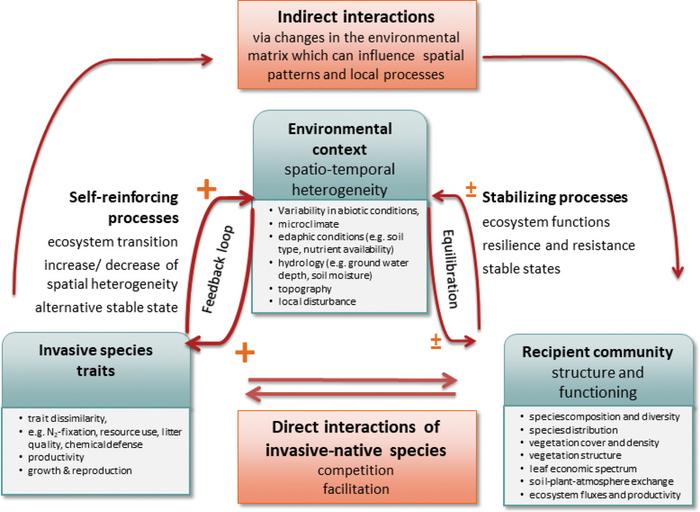
Mechanisms determine plant invasion impact.
67
SHARES
607
VIEWS
Share on FacebookShare on Twitter
ADVERTISEMENT

Researchers from the University of Freiburg and Justus Liebig University Giessen have developed a framework to better assess the impact of invasive plant species on ecosystems.

Mechanisms determine plant invasion impact.

Credit: Werner et al.

Researchers from the University of Freiburg and Justus Liebig University Giessen have developed a framework to better assess the impact of invasive plant species on ecosystems.

Outlined in a study published in the open-access journal NeoBiota, the framework combines new technologies and techniques to learn and predict how invasive plants alter ecosystems over time and in different environments.

Invasive plant species threaten biodiversity and ecosystem health worldwide. However, predicting the exact impact of these invasions is challenging due to the complexity of interactions between invading species, native communities, and impacted ecosystems.

The new framework addresses this challenge by integrating several advancements:

Environmental mapping: Progress in remote sensing and ecological monitoring allow researchers to capture detailed information about the environmental conditions of invaded areas. Drones, satellites, and advanced sensory networks can be used to create detailed ecosystem maps, which show how invasive species interact with their environment.

Functional tracers: These are specific indicators that reflect changes in ecosystem functions caused by invasive species. For example, nitrogen isotopes can be used to track the impact of nitrogen-fixing invasive plants on ecosystems.

Spatio-temporal modelling: By combining environmental data with new modelling techniques, such as AI, researchers can create detailed models showing the spread and impact of invasive species on ecosystems over time. Such models can predict how changes in environmental conditions, such as climate change, might influence an invasive species’ success.

Beyond scientific analysis, novel technologies also facilitate communication of ecological impacts, as the authors demonstrate in an animated 3D-video visualisation.

“The framework we’ve introduced offers researchers deeper insights into how invasive plant species interact with their environments, enabling more targeted management to lessen their ecological impact. We advocate for stronger collaboration between ecologists and technical experts to refine and expand these methods,” the authors emphasise.

“Going forward, further research and integration of the wide range of recent methods and tools are needed to enhance the framework’s effectiveness,” they conclude.

Original source

Werner C, Hellmann C, Große-Stoltenberg A (2024) An integrative framework to assess the spatio-temporal impact of plant invasion on ecosystem functioning. NeoBiota 94: 225-242. \

Researcher profiles

Prof. Dr. Christiane Werner:

Dr. André Große-Stoltenberg:


Journal

NeoBiota

DOI

10.3897/neobiota.94.126714

Article Title

An integrative framework to assess the spatio-temporal impact of plant invasion on ecosystem functioning

Article Publication Date

7-Aug-2024

Share27Tweet17
Previous Post

URI-led study holds promise for advancing modular quantum information processing

Next Post

‘Legos for wireless research’: Rice-led university consortium tackles the future of wireless with $4.5M NSF award

Related Posts

Comparing Robust Intelligent Controls for 3-DOF Robots — Technology and Engineering
Technology and Engineering

Comparing Robust Intelligent Controls for 3-DOF Robots

May 24, 2026
Predicting Flashover on Polluted Insulators with CNN-LSTM — Technology and Engineering
Technology and Engineering

Predicting Flashover on Polluted Insulators with CNN-LSTM

May 24, 2026
Sepsis from C. difficile Infection Has Comparable Mortality — Technology and Engineering
Technology and Engineering

Sepsis from C. difficile Infection Has Comparable Mortality

May 24, 2026
Mortality Trends in Dallas Very Preterm Neonates, 1977–2024 — Technology and Engineering
Technology and Engineering

Mortality Trends in Dallas Very Preterm Neonates, 1977–2024

May 24, 2026
Nanofiber Self-Adhesive Electrode with PEDOT, Polyurethane — Technology and Engineering
Technology and Engineering

Nanofiber Self-Adhesive Electrode with PEDOT, Polyurethane

May 24, 2026
Pediatric Weight Management: Insights from Primary Care Providers — Technology and Engineering
Technology and Engineering

Pediatric Weight Management: Insights from Primary Care Providers

May 24, 2026
Next Post
Ashutosh Sabharwal

‘Legos for wireless research’: Rice-led university consortium tackles the future of wireless with $4.5M NSF award

  • Mothers who receive childcare support from maternal grandparents show more parental warmth, finds NTU Singapore study

    Mothers who receive childcare support from maternal grandparents show more parental warmth, finds NTU Singapore study

    27649 shares
    Share 11056 Tweet 6910
  • University of Seville Breaks 120-Year-Old Mystery, Revises a Key Einstein Concept

    1052 shares
    Share 421 Tweet 263
  • Bee body mass, pathogens and local climate influence heat tolerance

    680 shares
    Share 272 Tweet 170
  • Researchers record first-ever images and data of a shark experiencing a boat strike

    543 shares
    Share 217 Tweet 136
  • Groundbreaking Clinical Trial Reveals Lubiprostone Enhances Kidney Function

    529 shares
    Share 212 Tweet 132
Science

Embark on a thrilling journey of discovery with Scienmag.com—your ultimate source for cutting-edge breakthroughs. Immerse yourself in a world where curiosity knows no limits and tomorrow’s possibilities become today’s reality!

RECENT NEWS

  • Comparing Robust Intelligent Controls for 3-DOF Robots
  • Predicting Flashover on Polluted Insulators with CNN-LSTM
  • New Framework Enhances Survey Response Quality Assessment
  • Synechococcus Leads Ocean’s Picocyanobacteria Sediment Record

Categories

  • Agriculture
  • Anthropology
  • Archaeology
  • Athmospheric
  • Biology
  • Biotechnology
  • Blog
  • Bussines
  • Cancer
  • Chemistry
  • Climate
  • Earth Science
  • Editorial Policy
  • Marine
  • Mathematics
  • Medicine
  • Pediatry
  • Policy
  • Psychology & Psychiatry
  • Science Education
  • Social Science
  • Space
  • Technology and Engineering

Subscribe to Blog via Email

Enter your email address to subscribe to this blog and receive notifications of new posts by email.

Join 5,146 other subscribers

© 2025 Scienmag - Science Magazine

Welcome Back!

Login to your account below

Forgotten Password?

Retrieve your password

Please enter your username or email address to reset your password.

Log In
No Result
View All Result
  • HOME
  • SCIENCE NEWS
  • CONTACT US

© 2025 Scienmag - Science Magazine

Discover more from Science

Subscribe now to keep reading and get access to the full archive.

Continue reading
