

Sunday, September 6, 2026
Science
No Result
View All Result
  • Login
  • HOME
  • SCIENCE NEWS
  • CONTACT US
  • HOME
  • SCIENCE NEWS
  • CONTACT US
No Result
View All Result
Scienmag
No Result
View All Result
Home Science News Chemistry

A fragment of human brain, mapped

May 9, 2024
in Chemistry
Cassandra Pierce
By Cassandra Pierce Scienmag Editorial Profile - Systems Neuroscience
Reading Time: 3 mins read
0
A fragment of human brain, mapped
67
SHARES
606
VIEWS
Share on FacebookShare on Twitter
ADVERTISEMENT

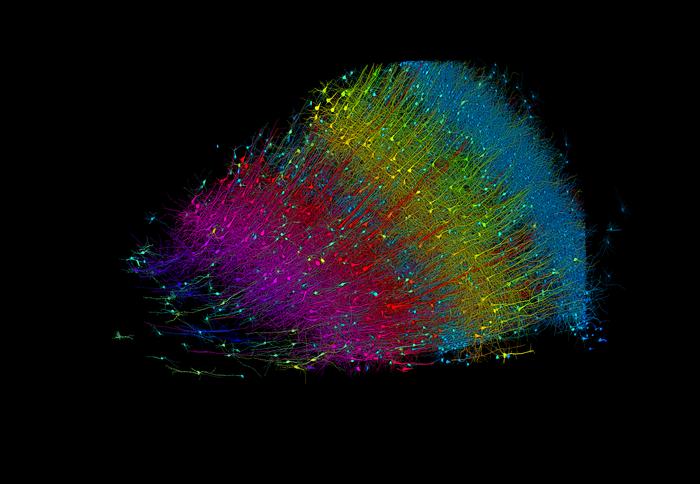
A cubic millimeter of brain tissue may not sound like much. But considering that tiny square contains 57,000 cells, 230 millimeters of blood vessels, and 150 million synapses, all amounting to 1,400 terabytes of data, Harvard and Google researchers have just accomplished something enormous.   

Excitatory neurons

Credit: Google Research and Lichtman Lab

A cubic millimeter of brain tissue may not sound like much. But considering that tiny square contains 57,000 cells, 230 millimeters of blood vessels, and 150 million synapses, all amounting to 1,400 terabytes of data, Harvard and Google researchers have just accomplished something enormous.   

A Harvard team led by Jeff Lichtman, the Jeremy R. Knowles Professor of Molecular and Cellular Biology and newly appointed dean of science, has co-created with Google researchers the largest synaptic-resolution, 3D reconstruction of a piece of human brain to date, showing in vivid detail each cell and its web of neural connections in a piece of human temporal cortex about half the size of a rice grain.

The feat, published in Science, is the latest in a nearly 10-year collaboration with scientists at Google Research, who combine Lichtman’s electron microscopy imaging with AI algorithms to color-code and reconstruct the extremely complex wiring of mammal brains. The paper’s three co-first authors are former Harvard postdoctoral researcher Alexander Shapson-Coe; Michał Januszewski of Google Research, and Harvard postdoctoral researcher Daniel Berger.

The collaboration’s ultimate goal, supported by the National Institutes of Health BRAIN Initiative, is to create a high-resolution map of a whole mouse brain’s neural wiring, which would entail about 1,000 times the amount of data they just produced from the 1-cubic-millimeter fragment of human cortex.  

“The word ‘fragment’ is ironic,” Lichtman said. “A terabyte is, for most people, gigantic, yet a fragment of a human brain – just a miniscule, teeny-weeny little bit of human brain – is still thousands of terabytes.”  

The latest map in Science contains never-before-seen details of brain structure, including a rare but powerful set of axons connected by up to 50 synapses. The team also noted oddities in the tissue, such as a small number of axons that formed extensive whorls. Since their sample was taken from a patient with epilepsy, they’re unsure if such unusual formations are pathological or simply rare.

Lichtman’s field is “connectomics,” which, analogous to genomics, seeks to create comprehensive catalogues of brain structure, down to individual cells and wiring. Such completed maps would light the way toward new insights into brain function and disease, about which scientists still know very little.

Google’s state-of-the-art AI algorithms allow for reconstruction and mapping of brain tissue in three dimensions. The team has also developed a suite of publicly available tools researchers can use to examine and annotate the connectome.

“Given the enormous investment put into this project, it was important to present the results in a way that anybody else can now go and benefit from them,” said Google Research collaborator Viren Jain.

Next the team will tackle the mouse hippocampal formation, which is important to neuroscience for its role in memory and neurological disease.


Journal

Science

DOI

10.1126/science.adk4858

Method of Research

Data/statistical analysis

Subject of Research

Cells

Article Title

A petavoxel fragment of human cerebral cortex reconstructed at nanoscale resolution

Article Publication Date

10-May-2024

Subject of Research: Chemistry

Article Title: A fragment of human brain, mapped

Article References: Original research article

Image Credits: AI Generated

DOI: Not provided

Keywords: Not provided

Cite Scienmag News

Cassandra Pierce. (May 9, 2024). A fragment of human brain, mapped. Scienmag. https://scienmag.com/a-fragment-of-human-brain-mapped/

Cassandra Pierce. "A fragment of human brain, mapped." Scienmag, 9 May 2024, https://scienmag.com/a-fragment-of-human-brain-mapped/. Accessed 6 September 2026.

Cassandra Pierce. "A fragment of human brain, mapped." Scienmag. May 9, 2024. https://scienmag.com/a-fragment-of-human-brain-mapped/

Share27Tweet17
Previous Post

Presenting a safer, low-cost, and low-energy whole-body magnetic resonance imaging device

Next Post

Transformation of ocean management is underway, study finds

Related Posts

Dissolved inorganic carbon disrupts mineral-bound organic matter in soils
Chemistry

Dissolved inorganic carbon disrupts mineral-bound organic matter in soils

September 6, 2026
Mn2O3-Co3O4 Nanocomposite Enables Visible-Light Degradation and Electrochemical Detection of Trimethoprim
Chemistry

Mn2O3-Co3O4 Nanocomposite Enables Visible-Light Degradation and Electrochemical Detection of Trimethoprim

September 6, 2026
Anthocyanin-enriched starch-chitosan films show promise for smart packaging
Chemistry

Anthocyanin-enriched starch-chitosan films show promise for smart packaging

September 6, 2026
Microextraction method traces tea polycyclic aromatic hydrocarbons with green assessment
Chemistry

Microextraction method traces tea polycyclic aromatic hydrocarbons with green assessment

September 6, 2026
Computational study reveals how ketoprofen interacts with biomolecules
Chemistry

Computational study reveals how ketoprofen interacts with biomolecules

September 5, 2026
Graphene research reveals evidence of unconventional superconductivity
Chemistry

Graphene research reveals evidence of unconventional superconductivity

September 5, 2026
Next Post
Transformation of ocean management is underway, study finds

Transformation of ocean management is underway, study finds

  • Mothers who receive childcare support from maternal grandparents show more optimized

    Mothers who receive childcare support from maternal grandparents show more parental warmth, finds NTU Singapore study

    27656 shares
    Share 11059 Tweet 6912
  • University of Seville Breaks 120-Year-Old Mystery, Revises a Key Einstein Concept

    1061 shares
    Share 424 Tweet 265
  • Bee body mass, pathogens and local climate influence heat tolerance

    682 shares
    Share 273 Tweet 171
  • Researchers record first-ever images and data of a shark experiencing a boat strike

    546 shares
    Share 218 Tweet 137
  • Groundbreaking Clinical Trial Reveals Lubiprostone Enhances Kidney Function

    531 shares
    Share 212 Tweet 133
Science

Embark on a thrilling journey of discovery with Scienmag.com—your ultimate source for cutting-edge breakthroughs. Immerse yourself in a world where curiosity knows no limits and tomorrow’s possibilities become today’s reality!

RECENT NEWS

  • Trial-unique Stroop task reveals context-specific control in memory-guided attention
  • New SAVE survey measures family accommodation in children with selective mutism
  • Designing animal research interfaces through a biocentric approach
  • Bacterial Laccase on Rice Straw Biochar Efficiently Degrades Toxic Pesticide Deltamethrin

Categories

  • Agriculture
  • Anthropology
  • Archaeology
  • Athmospheric
  • Biology
  • Biotechnology
  • Blog
  • Bussines
  • Cancer
  • Chemistry
  • Climate
  • Earth Science
  • Editorial Policy
  • Marine
  • Mathematics
  • Medicine
  • Pediatry
  • Policy
  • Psychology & Psychiatry
  • Science Education
  • Social Science
  • Space
  • Technology and Engineering

Subscribe to Blog via Email

Enter your email address to subscribe to this blog and receive notifications of new posts by email.

Join 5,151 other subscribers

© 2025 Scienmag - Science Magazine

Welcome Back!

Login to your account below

Forgotten Password?

Retrieve your password

Please enter your username or email address to reset your password.

Log In
No Result
View All Result
  • HOME
  • SCIENCE NEWS
  • CONTACT US

© 2025 Scienmag - Science Magazine

Discover more from Science

Subscribe now to keep reading and get access to the full archive.

Continue reading