


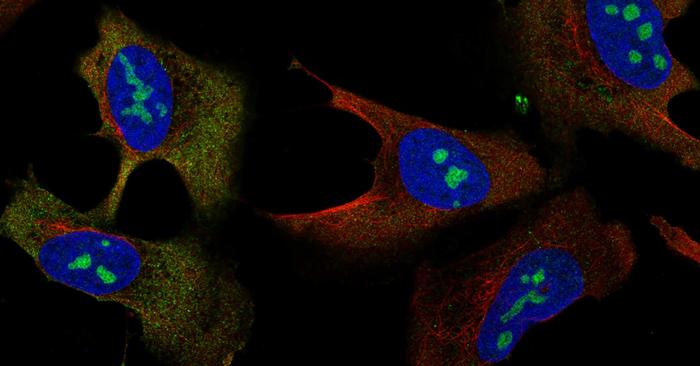
Scientists from UC San Diego, in collaboration with prestigious institutions like Stanford University, Harvard Medical School, and the University of British Columbia, have made significant strides in our understanding of human cell biology by creating a groundbreaking, comprehensive, and interactive map of U2OS cells. This study, which is on track to be published in Nature on April 9, 2025, sheds light on the complex architecture of human cells, revealing intricate interactions and previously unknown functions of various proteins, including a lesser-known protein called C18orf21.
For centuries, researchers have sought to explore the inner workings of the human cell, a quest that began with the invention of the microscope over 400 years ago. However, despite extensive research, many details regarding the functions and relationships of cellular proteins remained elusive. None of the established cell types had a proper, detailed catalog of their components and how these parts interact to perform essential biological functions. Leah Schaffer, a postdoctoral research scholar at UC San Diego School of Medicine, articulated the challenge facing cell biology: “We know each of the proteins that exist in our cells, but how they fit together to then carry out the function of a cell still remains largely unknown across cell types.”
The U2OS cells, which are often used in cancer research due to their association with pediatric bone tumors, were meticulously mapped using a combination of advanced high-resolution imaging techniques and sophisticated protein interaction analysis. By employing affinity purification methods, the researchers were able to isolate individual proteins, meticulously documenting their interactions with each other. This systematic approach allowed them to generate an intricate map of the subcellular architecture and protein assemblies present within the U2OS cell model.
As the researchers analyzed over 20,000 images tagged with fluorescent markers from the Human Protein Atlas, they uncovered an astonishing discovery. The collaborative effort resulted in the identification of 275 distinct protein assemblies of various sizes, highlighting the complexity of the internal organization of U2OS cells. Not only did this investigation reveal new functions of established proteins, but it also dramatically shifted the paradigm in how scientists interpret protein functionality within the cell.
One pivotal finding from the study was the identification of 975 previously uncharacterized functions of proteins. Notably, the study investigated C18orf21, a recently discovered protein whose involvement with cellular processes had been a mystery prior to this study. The researchers found that C18orf21 is likely engaged in RNA processing, thus broadening the understanding of its role within the cell’s programming. Furthermore, the known DPP9 protein, traditionally associated with proteolytic activity, was implicated in a new role concerning interferon signaling, a crucial pathway for immune responses against infections.
In an innovative twist, the researchers harnessed the capabilities of artificial intelligence to bolster their findings. By utilizing GPT-4, a sophisticated large language model, they accelerated the analysis process, querying the AI about the functions of individual proteins. Clara Hu, a first author on the study, reported how this method significantly reduced the time needed for cataloging protein interactions and their roles, thus enhancing the depth of insight they could obtain from the existing scientific literature.
The AI’s contributions didn’t merely stop at speeding up data analysis; it also played a role in consolidating information regarding protein assemblies, proposing thematic designs and nomenclature for the newly identified clusters of protein interactions. This creation of a user-friendly cell map, much akin to exploring a geographical map online, represents a considerable advancement in bioinformatics, allowing researchers to visually navigate cellular components with unprecedented resolution.
In terms of practical implications, the research team aimed their efforts at deciphering mechanisms behind various diseases, notably childhood cancers. By pinpointing mutated proteins within their interactive cell map, the researchers discovered 21 protein assemblies often altered in childhood cancer cases. This work culminated in the identification of 102 mutated proteins closely linked to cancer development. This finding highlights an important shift in how cancer research should progress, focusing less on individual mutations—which are often sporadic and unique—and more on the disrupted cellular machinery that these mutations exploit.
This research not only enhances our understanding of the fundamental mechanisms in pediatric oncology but also serves as a foundational blueprint for scientists looking to map other cell types in the future. The collaborative nature of this academic endeavor underscores the importance of interdisciplinary research, combining insights from various fields, including molecular biology, engineering, and computational science.
As the team at UC San Diego continues refining the U2OS cell atlas, users will be able to delve even deeper into the cellular world, examining the spatial organization and interactions at an ever-greater resolution. The implication of these findings resonates profoundly within the realm of cancer research, advancing the paradigms through which cellular complexity and its relationship to disease is understood, studied, and potentially intervened upon.
In summary, the groundbreaking collaborative effort by UC San Diego and its research partners is paving the way towards a more nuanced understanding of cell function and its relation to various diseases. Its interactive nature makes it a useful tool for researchers, allowing for an engaging exploration of cellular architecture, with hope for significant advances in therapeutic approaches to treat cancers and other diseases afflicting humanity.
Cite Scienmag News
Nathaniel Bowman. (April 9, 2025). A Detailed Atlas of Human Cells Unveiled. Scienmag. https://scienmag.com/a-detailed-atlas-of-human-cells-unveiled/
Nathaniel Bowman. "A Detailed Atlas of Human Cells Unveiled." Scienmag, 9 April 2025, https://scienmag.com/a-detailed-atlas-of-human-cells-unveiled/. Accessed 3 September 2026.
Nathaniel Bowman. "A Detailed Atlas of Human Cells Unveiled." Scienmag. April 9, 2025. https://scienmag.com/a-detailed-atlas-of-human-cells-unveiled/


