


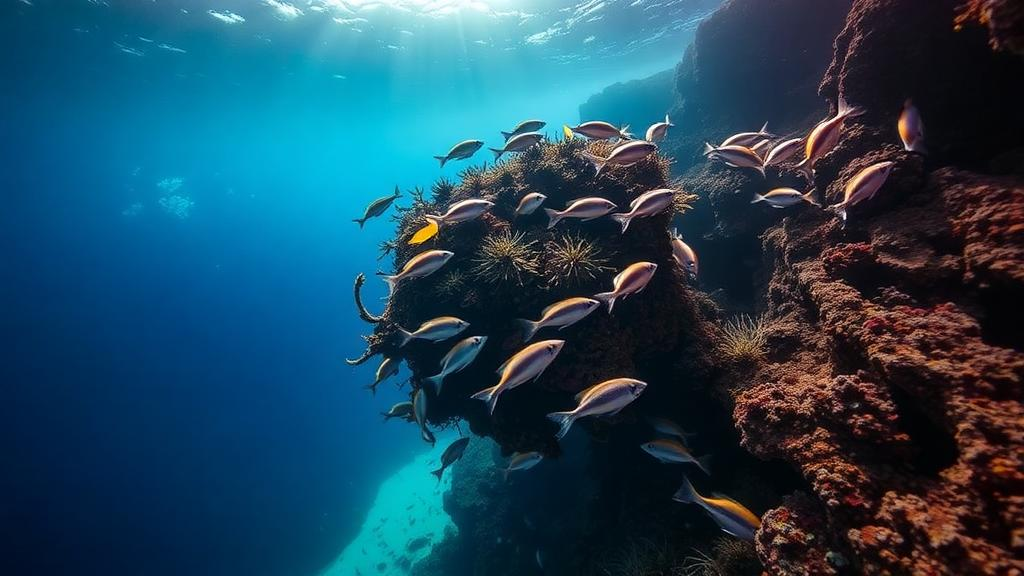
Beneath the turquoise surface of Mexico’s Islas Marietas National Park, a quiet census has been running for ten years, and its findings read like a warning label for coral reefs everywhere. Between 2013 and 2022, marine ecologists from the Universidad de Guadalajara and collaborating institutions counted more than 150,000 individual fish across two volcanic islands, documenting 81 species along 600 belt transects. Their decade-long record, published in Discover Ecology, captures something rare in reef science: a continuous, standardized window into how a protected coral community’s fish assemblages reorganize themselves when the climate turns hostile. The story that emerges is one of resilience with a deadline, an ecosystem currently buffered by geography and connectivity, but showing unmistakable signs of strain.
The study site could hardly be better suited to the question. Islas Marietas National Park sits roughly eight kilometers off the coast of Nayarit in the Central Mexican Pacific, an oceanographic crossroads where the cold, low-salinity California Current meets the warm Mexican Coastal Current and the high-salinity water mass of the Gulf of California. The result is a sharply seasonal regime: sea surface temperatures swing from 18 to 21 degrees Celsius between January and May, then climb to 27 to 30 degrees from July to November. Layered on top of this annual rhythm are internal waves, seasonal upwellings that drop pH and spike nutrients, and the interannual whiplash of the El Niño-Southern Oscillation, which has pushed temperatures above 31 degrees for weeks at a time and, in La Niña years, dragged them a full degree below normal. Any fish community living here must be built for volatility.
The research team, led by Cassandra de Alba-Guzmán, designed their monitoring to capture volatility at every scale. Divers conducted diurnal visual censuses along 25-by-4-meter belt transects at depths of 3 to 13 meters, five transects per site per season per year, across six sites split between Isla Larga and Isla Redonda. Alongside fish counts, they quantified the benthic foundation of the reef, recording the percentage cover of branching and submassive corals, macroalgae, turf, rock, and sand using PVC quadrats placed every four meters. Crucially, the team went beyond simply tallying species. They classified every fish by six functional traits, body length, schooling behavior, diet, mobility, position in the water column, and activity period, and then computed a full suite of functional diversity metrics, from functional richness to functional vulnerability, using the mFD package in R.
The first headline finding is that the two islands, separated by less than a kilometer, host strikingly different fish communities, and the difference is written in the seafloor. Isla Redonda, with its steep slopes, rocky substrates, large caves, and tunnels, supported the highest species richness, with a mean of 36.7 species per transect compared to 32.5 on Isla Larga, along with higher exponential Shannon diversity, functional richness, functional evenness, and functional redundancy. Several species, including the finespotted moray Muraena lentiginosa and the tiger snake eel Echidna nebulosa, were recorded only on Isla Redonda, likely exploiting the island’s unique structural refuges. Isla Larga, by contrast, carries roughly 15 percent more live coral cover, dominated by branching Pocillopora colonies that form continuous plates with narrow, homogeneous spaces between them. That framework shelters juvenile fish, but the low diversity of benthic components limits the variety of niches available, producing assemblages dominated by a few coral-dependent species rather than a broad functional portfolio.
This contrast delivers a counterintuitive lesson: more coral is not automatically more fish diversity. The researchers argue that what matters is the diversity of benthic components, not just their total cover. When a single coral morphofunctional group expands and outcompetes hydrocorals, sponges, and octocorals, the reef becomes structurally and functionally simpler, even as raw coral percentage climbs. On Isla Redonda, the mosaic of algal turfs, hydrocorals, octocorals, crustose coralline algae, and articulated calcareous algae creates microhabitats that allow species with different trophic roles to coexist, reducing interspecific competition and boosting functional redundancy, the ecological insurance policy that keeps a reef running when individual species falter.
The temporal record is where the decade’s drama unfolds. The most significant break in fish composition came after 2016, following the El Niño event of 2015-2016, when sea temperatures exceeded 31 degrees Celsius for more than six consecutive weeks. The schooling planktivore Apogon pacificus, a cardinalfish that had been abundant, declined sharply, and the composition of the assemblage shifted markedly. Extreme heat does not merely discomfort fish; it disrupts larval development, suppresses recruitment, and can cause outright mortality, while simultaneously degrading the benthic habitats and food resources on which reef-associated species depend. By 2018 and into 2019, species richness had fallen from 36.58 to 31.83 species on average, a decline the authors attribute primarily to habitat homogenization as benthic diversity eroded.
Then the pendulum swung the other way. The La Niña event of 2020-2022 brought abnormally cool temperatures, down as much as 1.0 degree Celsius, which drove subsurface influxes of nutrient-rich water and fueled plankton proliferation. Planktivorous species responded dramatically: the abundance of the blue-and-gold chromis Azurina atrilobata and the goatfish Mulloidichthys dentatus surged between 2019 and 2020, with M. dentatus jumping by more than 1,200 percent in functional entity terms. Functional dispersion rose in two significant steps, in 2020 and again in 2022, reflecting a community increasingly spread across functional space, with a few dominant species pulling away from the pack. Meanwhile, the benthic data showed Pocillopora coral expanding after 2020, further squeezing out other benthic components and narrowing the ecological stage.
Seasonality, too, left its fingerprints on the assemblage. Apogon pacificus, Abudefduf troschelii, and Mulloidichthys dentatus peaked in abundance during the cold season, when the California Current delivers nutrient-rich waters that boost primary production and the planktonic food web. Azurina atrilobata, the spotted grunt Haemulon maculicauda, and the grouper Cephalopholis colonus dominated the warm, oligotrophic months. The researchers link these cycles to reproductive timing, since temperature and currents regulate spawning aggregations and larval survival, and to foraging migrations, exemplified by the mackerel scad Decapterus macarellus, which vanished from every warm-season survey as it tracked favorable feeding grounds elsewhere.
What kept the system from unraveling, the authors suggest, is connectivity. Functional divergence and functional vulnerability, the metrics that measure how exposed a community is to losing its rare functions, showed no significant changes across the entire decade. With the two islands less than a kilometer apart, individuals, larvae, and nutrients flow freely between them, and niche complementarity spreads risk across the park as an integrated whole. The coexistence of the two most abundant species, the planktivorous Azurina atrilobata and the omnivorous wrasse Thalassoma lucasanum, illustrates how dietary differentiation defuses what should be fierce competition between similarly sized fish. But the researchers are explicit that this buffering capacity is conditional: if natural and anthropogenic stressors intensify, the connectivity that currently stabilizes the park could be overwhelmed.
The stakes extend well beyond the park’s boundaries. Coral reefs support food security and livelihoods for more than 500 million people worldwide, and reef fish are the engines of those services, grazing macroalgae to clear space for coral settlement, preying on echinoderms and crustaceans to steady the trophic web, and even contributing calcium carbonate to the reef framework itself. Islas Marietas is also a tourist hotspot, facing pressure from boats, snorkeling, diving, and illegal fishing, which compounds the climatic stress documented here. The study’s authors recommend that future monitoring incorporate direct measurements of habitat complexity, potentially through 3D photogrammetry, and trophic network analyses to sharpen predictions. Their broader message is sobering and actionable in equal measure: protecting reefs means protecting the diversity of the seafloor’s building blocks, not just counting coral, because when benthic variety collapses, the fish community’s functional architecture follows, and the resilience that ecosystems like Marietas have shown over this decade may prove to be a loan rather than a gift.
Subject of Research: Decadal taxonomic and functional changes in coral reef fish assemblages at Islas Marietas National Park, Mexican Pacific
Article Title: Decadal changes in the fish assemblage structure and function within an insular coral community
Article References: de Alba-Guzmán, C., Rodríguez-Troncoso, A. P., Cupul-Magaña, A. L., Rodríguez-Zaragoza, F. A., Cabral-Tena, R. A., & de Jesús Adolfo Tortolero-Langarica, J. (2025). Decadal changes in the fish assemblage structure and function within an insular coral community. Discover Ecology, 1(1), Article 15. https://doi.org/10.1007/s44396-025-00015-8
Image Credits: AI Generated
DOI: 10.1007/s44396-025-00015-8
Keywords: coral reef fish, functional diversity, El Niño, ENSO, Mexican Pacific, Islas Marietas, benthic habitat, long-term monitoring, species richness, ecosystem resilience, marine protected area, planktivores
Cite Scienmag News
Margaret Porter. (September 30, 2026). A Decade Underwater: El Niño Reshaped Fish Life on Mexico’s Island Reef. Scienmag. https://scienmag.com/a-decade-underwater-el-nino-reshaped-fish-life-on-mexicos-island-reef/
Margaret Porter. "A Decade Underwater: El Niño Reshaped Fish Life on Mexico’s Island Reef." Scienmag, 30 September 2026, https://scienmag.com/a-decade-underwater-el-nino-reshaped-fish-life-on-mexicos-island-reef/. Accessed 4 October 2026.
Margaret Porter. "A Decade Underwater: El Niño Reshaped Fish Life on Mexico’s Island Reef." Scienmag. September 30, 2026. https://scienmag.com/a-decade-underwater-el-nino-reshaped-fish-life-on-mexicos-island-reef/


