

Friday, July 31, 2026
Science
No Result
View All Result
  • Login
  • HOME
  • SCIENCE NEWS
  • CONTACT US
  • HOME
  • SCIENCE NEWS
  • CONTACT US
No Result
View All Result
Scienmag
No Result
View All Result
Home Science News Biology

A change of direction

May 28, 2024
in Biology
Reading Time: 3 mins read
0
A change of direction
66
SHARES
597
VIEWS
Share on FacebookShare on Twitter
ADVERTISEMENT

As embryos grow from conception to birth, cells multiply rapidly and move in a highly organized manner to create the skeleton, organs and other crucial systems. But how do cells know to move in precisely the right direction at the right time to create a fully formed, complex living organism? This is a deeply challenging question for scientists.

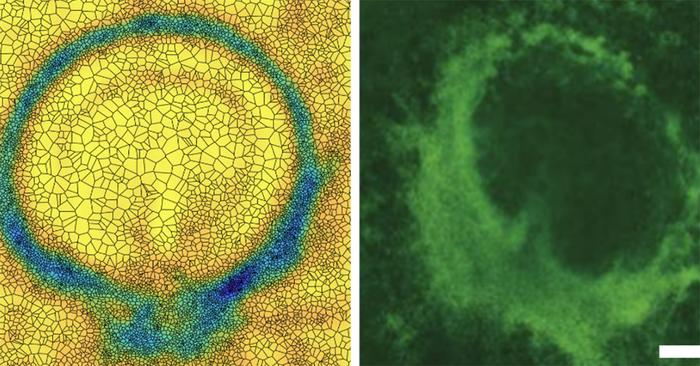
computer simulation vs experiment

Credit: UC San Diego

As embryos grow from conception to birth, cells multiply rapidly and move in a highly organized manner to create the skeleton, organs and other crucial systems. But how do cells know to move in precisely the right direction at the right time to create a fully formed, complex living organism? This is a deeply challenging question for scientists.

To help uncover the answer, University of California San Diego Assistant Professor of Physics Mattia Serra and colleagues at Politecnico di Milano (Italy) have developed a new method that can manipulate the movement of embryonic cells using short-time attractors — a concept Serra had previously developed and adopted to help search and rescue operations at sea. Their work appears in Physical Review Letters.

Short-time attractors are structures that influence a system’s dynamics and motion for a limited time, but do not determine long-term behaviors. By modulating the spatial distribution of myosin — the molecular motor that drives cell movement — the researchers were able to control the positioning of these attractors, directing cell accumulation to targeted areas of the embryo.

While myosin drives cell movement within the embryo, there are also external forces, or disturbances, that push and pull against the embryo as well. These disturbances are imposed on rather than controlled by the embryo.

This is a delicate dance. The embryo must optimally distribute myosin so that cells move toward the attractors necessary for development while also contending with the imposed disturbances.

Using theory and simulations, the researchers were able to devise an optimal control strategy to create and steer short-time attractors in flows similar to those found in embryo development.

To confirm their theory, collaborators in the Weijer group at the University of Dundee (Scotland) manipulated the myosin distribution of a chick embryo. Normally, the embryo develops a short-time attractor as a line — this is where the main body axis forms. Serra’s predictions suggested that with a particular distribution of myosin, they could make a ring-shaped short-time attractor. The Weijer group was able to implement the suggested myosin distribution in a living embryo, and it developed a circular attractor rather than a linear one.

This new method of controlling cell flows can be used in engineering synthetic organs and organoids and may help in regenerative medicine applications.
“Multicellular flows are complex and can be overwhelming to study. Attractors and repellers compress this complexity into its essential units, that can be controlled and used to unravel the underlying principles driving multicellular flows,” stated Serra.

Full list of authors: Mattia Serra (UC San Diego), Carlo Sinigaglia and Francesco Braghin (both Politecnico di Milano).


Journal

Physical Review Letters

DOI

10.1103/PhysRevLett.132.218302

Method of Research

Experimental study

Subject of Research

Animal tissue samples

Article Title

Optimal Control of Short-Time Attractors in Active Nematics

Article Publication Date

22-May-2024

Share26Tweet17
Previous Post

Specific microbial hallmarks in vagina could indicate gynecological cancers

Next Post

Mortality risk among women with premenstrual disorders in Sweden

Related Posts

Cemiplimab and fianlimab with neoadjuvant chemotherapy in early-stage high-risk -negative breast cancer
Biology

Cemiplimab and fianlimab with neoadjuvant chemotherapy in early-stage high-risk -negative breast cancer

July 30, 2026
Combined phage therapy and faecal microbiota transplantation to treat recurrent urinary tract infection: a case series
Biology

Combined phage therapy and faecal microbiota transplantation to treat recurrent urinary tract infection: a case series

July 30, 2026
Essential genetic mutations impair DNA damage repair and modulate tumor immune microenvironment in ccRCC
Biology

Essential genetic mutations impair DNA damage repair and modulate tumor immune microenvironment in ccRCC

July 30, 2026
Microbiota-derived 10-hydroxystearic acid activates PPARα to restore gut epithelial barrier integrity and enhance anti-retroviral therapy
Biology

Microbiota-derived 10-hydroxystearic acid activates PPARα to restore gut epithelial barrier integrity and enhance anti-retroviral therapy

July 30, 2026
Amazonian ‘zombie’ fungus harbors a hidden stage inside forest mosses, new study reveals
Biology

Amazonian ‘zombie’ fungus harbors a hidden stage inside forest mosses, new study reveals

July 30, 2026
Shining a light on constructing blood supply systems for artificial tissues
Biology

Shining a light on constructing blood supply systems for artificial tissues

July 30, 2026
Next Post
Mortality risk among women with premenstrual disorders in Sweden

Mortality risk among women with premenstrual disorders in Sweden

  • Mothers who receive childcare support from maternal grandparents show more

    Mothers who receive childcare support from maternal grandparents show more parental warmth, finds NTU Singapore study

    27656 shares
    Share 11059 Tweet 6912
  • University of Seville Breaks 120-Year-Old Mystery, Revises a Key Einstein Concept

    1061 shares
    Share 424 Tweet 265
  • Bee body mass, pathogens and local climate influence heat tolerance

    682 shares
    Share 273 Tweet 171
  • Researchers record first-ever images and data of a shark experiencing a boat strike

    546 shares
    Share 218 Tweet 137
  • Groundbreaking Clinical Trial Reveals Lubiprostone Enhances Kidney Function

    531 shares
    Share 212 Tweet 133
Science

Embark on a thrilling journey of discovery with Scienmag.com—your ultimate source for cutting-edge breakthroughs. Immerse yourself in a world where curiosity knows no limits and tomorrow’s possibilities become today’s reality!

RECENT NEWS

  • Ancient DNA reveals Ice Age humans preferred female mammoths
  • Public research and development money unlocks private investment and lasting economic growth
  • Satellite mapping reveals global inequities in lake water quality: over one-third of lakes fail to meet good water quality standards
  • One million euros allocated to six EUniWell study programmes on the way towards the Joint European Degree Label

Categories

  • Agriculture
  • Anthropology
  • Archaeology
  • Athmospheric
  • Biology
  • Biotechnology
  • Blog
  • Bussines
  • Cancer
  • Chemistry
  • Climate
  • Earth Science
  • Editorial Policy
  • Marine
  • Mathematics
  • Medicine
  • Pediatry
  • Policy
  • Psychology & Psychiatry
  • Science Education
  • Social Science
  • Space
  • Technology and Engineering

Subscribe to Blog via Email

Success! An email was just sent to confirm your subscription. Please find the email now and click 'Confirm Follow' to start subscribing.

Join 5,147 other subscribers

© 2025 Scienmag - Science Magazine

Welcome Back!

Login to your account below

Forgotten Password?

Retrieve your password

Please enter your username or email address to reset your password.

Log In
No Result
View All Result
  • HOME
  • SCIENCE NEWS
  • CONTACT US

© 2025 Scienmag - Science Magazine
