


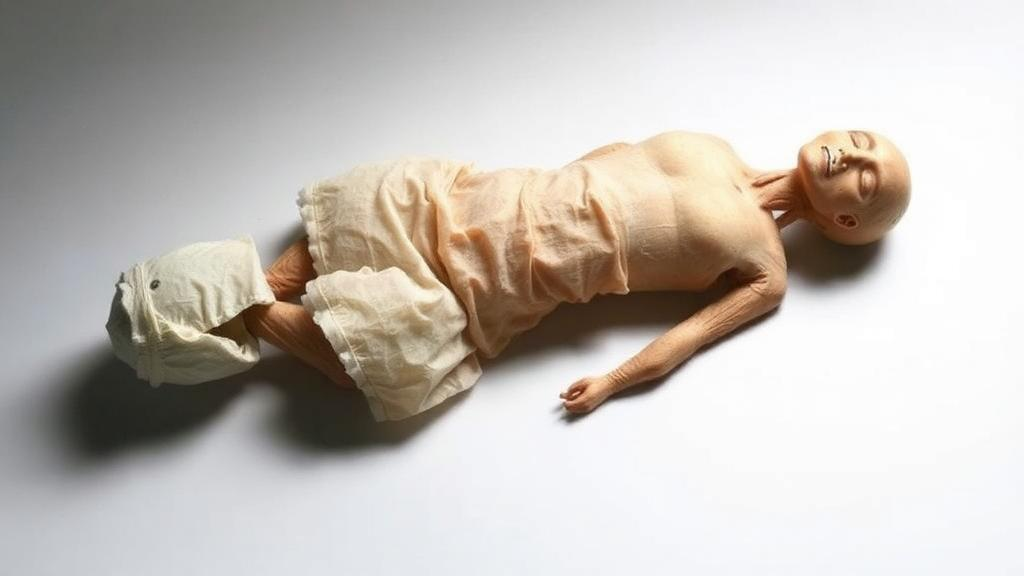
When forensic pathologists in southern France were called to examine a male body discovered encrusted in a thick, crystalline crust of salt, they knew they were looking at something extraordinary. The body was not wrapped, treated, or deliberately preserved. Instead, the environment itself had done the work of an embalmer, coating the remains in a layer of halite roughly four centimeters thick and transforming the tissue into a dry, leathery shell. According to a case report published in the International Journal of Legal Medicine by Clémence Delteil of Marseille University Hospital and her colleagues, this is the first modern forensic case of natural salt mummification ever described, and it offers a rare glimpse into how extreme chemistry can rewrite the rules of human decomposition.
Mummification is usually associated with deliberate ritual practice, from the embalmers of ancient Egypt to the salt-packing techniques documented in historical funerary customs. But nature occasionally produces the same result on its own. Salt works as a preservative through two complementary mechanisms. First, it is strongly hygroscopic, drawing water out of tissue by osmosis and creating a desiccated state in which the chemical reactions of decay slow dramatically. Second, high salinity is antimicrobial: most of the bacteria that drive putrefaction cannot tolerate concentrated brine, so the microbial ecosystem that normally dismantles a corpse simply collapses. Deprived of both moisture and microbes, soft tissue can survive for months, years, or even millennia.
The archaeological record is full of proof. The most famous examples are the salt men of Chehrābād in northwestern Iran, miners who perished in collapses at the Douzlākh salt mine as early as the fourth century BC and were preserved so completely that ancient DNA, isotopic signatures of their diet, and even the fibers of their clothing have been recovered. Previous laboratory work, including experiments in which human tissue was deliberately mummified in salt, has confirmed how rapidly salt halts both microbial growth and DNA degradation. Yet despite this rich archaeological literature, no forensic scientist had ever documented a naturally salt-mummified body in a contemporary medico-legal context, until now.
The French case is unusual not only because it happened at all, but because of where it happened. Unlike the Iranian salt men, who were entombed in a dry, cool salt mine, this body was found in a warm, humid, anthropogenic saline environment, a human-made salt production setting in the Mediterranean south of France. The region has a seventy-year history of managed coastal salinas, shallow basins where seawater is evaporated to harvest salt, and abandoned sites where hypersaline water pools and crystallizes under the intense Provençal sun. Local geochemical studies of nearby lagoons such as Lavalduc have documented active precipitation of halite, the mineral form of sodium chloride, in and around these basins. It was in this evaporative, salt-saturated setting that the body lay undisturbed long enough for a crystalline shell to grow around it.
External examination revealed a completely desiccated body, brown and leathery in appearance, with the facial features and the morphology of the limbs and extremities remarkably preserved. That degree of anatomical integrity is forensically valuable: it allowed the team to attempt a biological profile of the deceased, the standard assessment of sex, age, and body characteristics that forms the first step toward identification. In many decomposed or skeletonized bodies, such profiling is severely compromised by tissue loss. Here, the salt had effectively frozen the external anatomy in place, demonstrating that natural mummification can paradoxically make a body more identifiable, not less.
Autopsy, however, told a more complicated story. Inside the leathery exterior, the researchers found extensive tissue desiccation consistent with prolonged exposure to a highly saline environment, but the preservation was strikingly uneven. Some regions showed classic mummified changes, while others displayed focal putrefactive alteration, including complete liquefaction of the brain. This hybrid pattern, in which desiccation and decay coexist in the same body, had not previously been described in the modern forensic literature. The authors attribute it to the specific dynamics of the anthropogenic saline setting: fluctuations in salinity, intermittent moisture, and ambient heat likely allowed pockets of decomposition to proceed before full desiccation took hold, producing a mosaic of preservation that contrasts with the uniform mummification seen in mine contexts.
The case also illustrates the hard limits of forensic science when preservation is this unusual. Toxicological analyses of visceral samples came back negative for drugs and toxic substances, ruling out chemical causes of death detectable in the preserved tissue. DNA analysis and fingerprint examination were both performed, but neither produced an identification. The failure is instructive. Even when tissue appears well preserved, the same osmotic and chemical stresses that stop decay can fragment genetic material in ways that defeat standard amplification, and desiccated skin often cannot yield usable friction ridge prints. For the identification effort, the team had to fall back on contextual and morphological evidence rather than laboratory confirmation.
Perhaps the most innovative part of the investigation was environmental. Rather than relying solely on the body itself, the researchers reconstructed the salinity dynamics, evaporation rates, and local climate conditions of the site, and used that reconstruction to support a tentative hypothesis about the post-mortem interval, the elapsed time since death. The logic is analogous to entomological dating, where insect development stages clock the interval, but here the clock is geochemical: the thickness of the salt crust, the rate at which brine evaporates under the regional climate, and the seasonal behavior of the saline basin together constrain how long the body must have lain there. The authors emphasize that this estimate is tentative, but the approach itself is a proof of concept for reading time from the environment in cases where conventional markers are absent.
The report arrives amid growing attention to what forensic scientists call complex bodies, remains whose preservation state falls outside the familiar categories of fresh, decomposed, skeletonized, burned, or water-immersed. Recent systematic reviews and procedural proposals have argued that such cases demand a multidisciplinary response, combining pathology, anthropology, radiology, genetics, toxicology, entomology, botany, and environmental science, guided by standardized on-site inspection protocols such as those developed by the European Council of Legal Medicine. The salt mummy of southern France is a textbook argument for that approach: no single discipline could have interpreted the body, but the combined evidence of morphology, chemistry, and environmental reconstruction extracted real forensic information from an apparently intractable case.
For the wider forensic community, the implications are twofold. First, investigators encountering desiccated remains in or near saline environments, from abandoned salinas to industrial brine facilities, should now consider natural salt mummification as a genuine possibility rather than a curiosity confined to archaeology. Second, the case expands the known range of environments capable of natural preservation into warm, humid, human-modified settings, which means the global geography of potential salt mummies is far larger than the arid mines and deserts of the archaeological record. As the authors conclude, environmental analysis and multidisciplinary investigation are essential tools for identification and post-mortem interval estimation in complex bodies, and this unique case, a man sealed in salt under the Mediterranean sun, may be only the first of its kind to surface.
Subject of Research: Natural salt mummification of human remains in a forensic context
Article Title: Natural salt mummification in a forensic context: a case report and environmental considerations
Article References: Delteil, C., Zuck, S., Capuani, C., Carballeira-Alvarez, A., Ardagna, Y., & Tuchtan, L. (2026). Natural salt mummification in a forensic context: a case report and environmental considerations. International Journal of Legal Medicine. https://doi.org/10.1007/s00414-026-04040-4
Image Credits: AI Generated
DOI: 10.1007/s00414-026-04040-4
Keywords: salt mummification, forensic pathology, mummification, post-mortem interval, forensic anthropology, decomposition, halite, saline environment, taphonomy, case report, DNA analysis, environmental forensics
Cite Scienmag News
Ophelia Keating. (October 10, 2026). A Body Encased in Salt: Forensic Scientists Report First Modern Case of Natural Salt Mummification. Scienmag. https://scienmag.com/a-body-encased-in-salt-forensic-scientists-report-first-modern-case-of-natural-salt-mummification/
Ophelia Keating. "A Body Encased in Salt: Forensic Scientists Report First Modern Case of Natural Salt Mummification." Scienmag, 10 October 2026, https://scienmag.com/a-body-encased-in-salt-forensic-scientists-report-first-modern-case-of-natural-salt-mummification/. Accessed 10 October 2026.
Ophelia Keating. "A Body Encased in Salt: Forensic Scientists Report First Modern Case of Natural Salt Mummification." Scienmag. October 10, 2026. https://scienmag.com/a-body-encased-in-salt-forensic-scientists-report-first-modern-case-of-natural-salt-mummification/


