


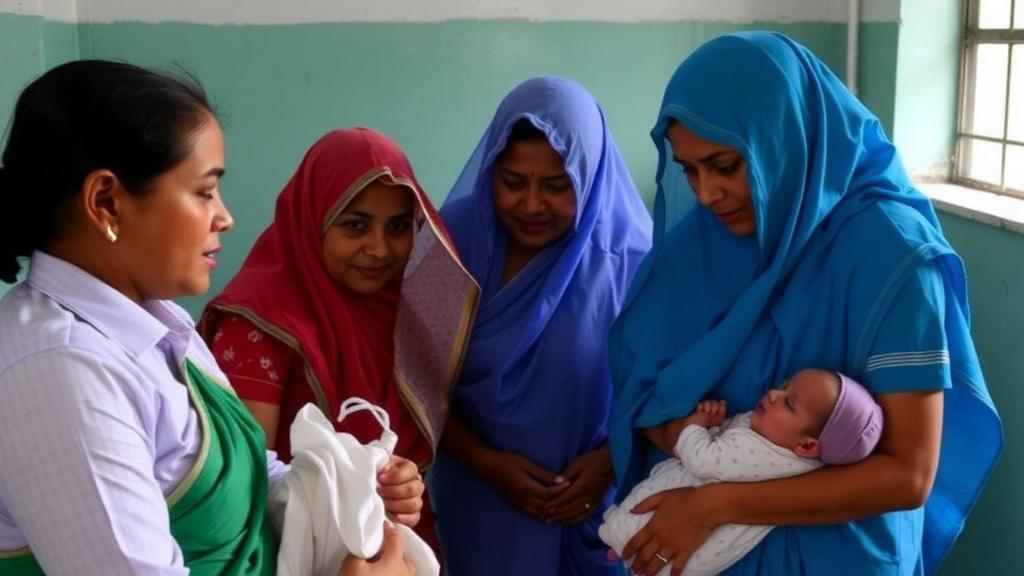
Bangladesh has become one of the developing world’s most striking success stories in getting women to give birth inside health facilities rather than at home. According to a new analysis published in BMC Health Services Research, the share of women delivering in a health facility climbed from just 37 percent in 2014 to 65 percent in 2022, a remarkable shift in a country where home births were once the overwhelming norm. Yet the same study delivers a sobering counterpoint: when researchers adjusted that coverage figure for how well equipped the facilities actually were to handle deliveries, the true measure of safe, supported childbirth rose only from 23 percent to 33 percent over the same period. The gap between women walking through the door and facilities being genuinely ready to care for them widened dramatically, from 14 percentage points to 32.
The research, led by Abu Bakkar Siddique of the International Centre for Diarrhoeal Disease Research, Bangladesh (icddr,b), together with colleagues at NIPORT, the Bangladesh Bureau of Statistics and Johns Hopkins University Bloomberg School of Public Health, tackles a deceptively simple question with a technically sophisticated approach. Utilization statistics, the standard currency of maternal health monitoring, tell policymakers how many women use services but say nothing about whether those services can deliver safe care. A woman may reach a facility in time, but if that facility lacks trained staff, essential medicines, functioning equipment or clinical guidelines, the theoretical benefit of facility birth may never materialize. The study argues that this distinction matters enormously for a country whose celebrated decline in maternal mortality has recently stalled.
Methodologically, the team performed a cross-sectional analysis linking two independent national data systems: the Bangladesh Demographic and Health Surveys (BDHS) from 2014, 2017-18 and 2022, which interview households about where women delivered, and the Bangladesh Health Facility Surveys (BHFS) from the corresponding years, which audit facilities directly. Facility readiness was scored using tracer indicators spanning five domains: human resources, guidelines, equipment, diagnostics, and medicines and commodities. These are the structural ingredients that WHO and health systems researchers consider prerequisites for quality childbirth care, from skilled birth attendants and partographs to magnesium sulfate, oxytocic drugs and neonatal resuscitation equipment.
The linking procedure was ecological rather than individual. The researchers calculated weighted mean readiness scores for facilities by division, facility type and mode of delivery, then assigned each woman in the household survey a readiness score corresponding to the facilities in her area and the type of birth she reported. Readiness-adjusted coverage was then computed by multiplying each woman’s facility-delivery indicator by the corresponding readiness score and taking the survey-weighted population mean. In effect, the measure discounts crude coverage by the probability that the facility a woman used was structurally prepared. If half of women deliver in facilities but those facilities score only 50 percent on readiness, readiness-adjusted coverage is roughly a quarter, a far more honest picture of effective coverage.
The headline finding is the divergence between the two curves. Facility-delivery coverage gained 28 percentage points between 2014 and 2022, while readiness-adjusted coverage gained only 11, moving from roughly 22-23 percent to 33 percent. Because the numerator of progress was utilization rather than capacity, the absolute gap between the two measures more than doubled, from 14 to 32 percentage points. In plain terms, a rapidly growing fraction of Bangladeshi women are giving birth in settings that are not fully prepared for childbirth, and the study suggests this mismatch may help explain why maternal mortality reductions have slowed even as facility births surged.
What exactly is dragging readiness down? The 2022 data point to specific, actionable deficits: limited numbers of trained staff, scarcity of clinical guidelines, weak logistics systems and shortages of essential medicines. These are not exotic requirements but the basic plumbing of obstetric care. A facility without guidelines cannot standardize management of postpartum hemorrhage or pre-eclampsia; a facility without reliable supply chains cannot guarantee that oxytocin is available at three in the morning when a woman is bleeding. The readiness score, by aggregating tracer indicators across domains, exposes precisely which links in the chain are broken and where investment would translate most directly into safer deliveries.
The equity analysis is equally revealing. In 2022, readiness-adjusted coverage ranged from 22 percent among the poorest women to 44 percent among the wealthiest, a twofold disparity that mirrors and amplifies existing gradients in access, education and geography. The researchers also examined differences by residence and administrative division, finding that socioeconomic position remained a powerful determinant of whether a woman’s facility birth was backed by genuine readiness. This matters because the women least likely to reach a facility at all are also those most likely, when they do reach one, to encounter the weakest facilities, a compounding disadvantage that crude coverage statistics render invisible.
One of the study’s most consequential findings concerns the private sector. Private facilities accounted for 45 percent of all live births in Bangladesh by 2022, meaning nearly half of the country’s babies are now born in private institutions, yet the readiness of these facilities was generally lower than that of their public counterparts. This is a structural warning for health policy. Bangladesh’s facility-birth transition has been driven substantially by private-sector growth, often in urban and peri-urban areas, but the regulatory and quality-assurance architecture has not kept pace. If nearly half of births occur in facilities that are less prepared than public ones, the private boom may be inflating coverage statistics without delivering proportional gains in safety.
The technical approach also carries lessons for global measurement. Coverage indicators enshrined in the Sustainable Development Goal framework, including skilled birth attendance and institutional delivery, measure contact, not capability. The readiness-adjusted coverage metric demonstrated here offers a template that other countries with paired household and facility surveys could adopt, converting two parallel data streams into a single effective-coverage estimate. The authors argue that such equity-focused readiness measures should be incorporated into routine monitoring, so that health ministries track not only whether utilization is rising but whether the system behind that utilization is keeping up. The BDHS and BHFS pairing in Bangladesh, conducted in corresponding survey years, made the analysis possible; few countries have maintained both series with comparable rigor.
The study’s implications converge on a clear prescription. Bangladesh does not primarily need more women in facilities; it needs the facilities those women already reach to be staffed, supplied, equipped and guided to deliver safe care. Strengthening essential facility inputs, particularly in the private sector where readiness lags, and embedding readiness metrics in routine health information systems could ensure that the utilization gains of the past decade are converted into mortality reductions. As the authors conclude, the increase in facility-based delivery has outpaced improvement in readiness-adjusted coverage, and closing that widening gap is now the central challenge for maternal health in Bangladesh. For a country that has already proved it can move millions of births into facilities, the next transformation, making those facilities genuinely ready, is both the harder and the more urgent task.
Subject of Research: Readiness-adjusted coverage of facility-based childbirth in Bangladesh using linked household and health facility survey data
Article Title: Measuring readiness-adjusted coverage for facility delivery using health facility and household surveys in Bangladesh, 2014, 2017, and 2022
Article References: Siddique, A. B., Saha, A., Modasser, R. B., Ashiquzzaman, Hossain, A. T., Mamun, M. H., Zahirul Islam, S. M., Sakib, S. J., Lucky, N., Mostofa, M. M., Mehjabin, M., Chakraborty, A., Hossen, M. A., Wilson, E., Akseer, N., Amouzou, A., Ahmed, A., Arifeen, S. E., & Rahman, A. E. (2026). Measuring readiness-adjusted coverage for facility delivery using health facility and household surveys in Bangladesh, 2014, 2017, and 2022. BMC Health Services Research. https://doi.org/10.1186/s12913-026-15810-6
Image Credits: AI Generated
DOI: 10.1186/s12913-026-15810-6
Keywords: Bangladesh, facility delivery, readiness-adjusted coverage, maternal health, health facility readiness, health surveys, health equity, private health sector, DHS, health services research, maternal mortality, effective coverage
Cite Scienmag News
Ophelia Keating. (October 10, 2026). Bangladesh’s Childbirth Boom in Clinics Hides a Growing Readiness Gap. Scienmag. https://scienmag.com/bangladeshs-childbirth-boom-in-clinics-hides-a-growing-readiness-gap/
Ophelia Keating. "Bangladesh’s Childbirth Boom in Clinics Hides a Growing Readiness Gap." Scienmag, 10 October 2026, https://scienmag.com/bangladeshs-childbirth-boom-in-clinics-hides-a-growing-readiness-gap/. Accessed 10 October 2026.
Ophelia Keating. "Bangladesh’s Childbirth Boom in Clinics Hides a Growing Readiness Gap." Scienmag. October 10, 2026. https://scienmag.com/bangladeshs-childbirth-boom-in-clinics-hides-a-growing-readiness-gap/


