

Thursday, September 3, 2026
Science
No Result
View All Result
  • Login
  • HOME
  • SCIENCE NEWS
  • CONTACT US
  • HOME
  • SCIENCE NEWS
  • CONTACT US
No Result
View All Result
Scienmag
No Result
View All Result
Home Science News Technology and Engineering

A better way to ride a motorcycle

May 6, 2024
in Technology and Engineering
Denise Maddox
By Denise Maddox Scienmag Editorial Profile - Mechanical Engineering
Reading Time: 2 mins read
0
A better way to ride a motorcycle
71
SHARES
641
VIEWS
Share on FacebookShare on Twitter
ADVERTISEMENT

Motorcycles are designed to accommodate the average-sized rider, leaving taller and shorter riders vulnerable to discomfort.

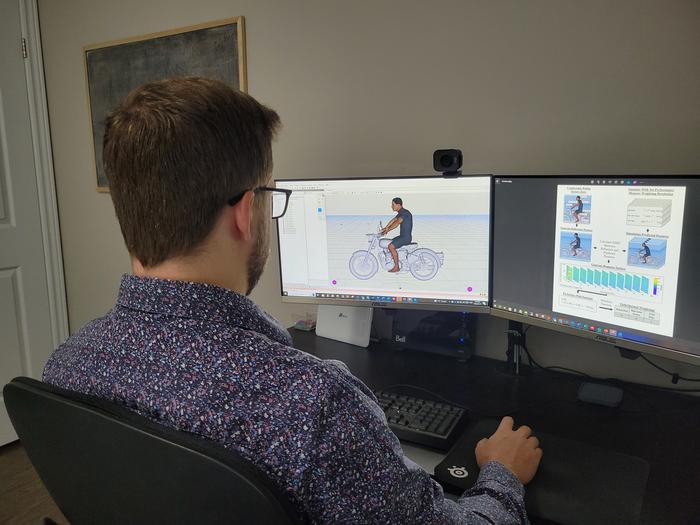
Studying motorcycle riding posture

Credit: University of Waterloo

Motorcycles are designed to accommodate the average-sized rider, leaving taller and shorter riders vulnerable to discomfort.

A new study from the University of Waterloo used software that predicted realistic motorcycle riding behaviours, considering human factors and ergonomic trade-offs. It found that shorter and taller statures require joint adjustments to achieve their preferred riding posture.

Taller riders are required to flex their ankles, knees, hips and elbows more to interact with the motorcycle properly, and shorter riders have fewer options in possible joint angle configurations, allowing them to reach the seat, handlebars and foot pegs simultaneously.

The study was conducted using a digital human model (DHM) — a human representation in the form of an avatar of any weight, size or sex — in a virtual environment. The tool allows researchers to observe human interactions with components or products such as motorcycles.

“The use of DHMs in early two-wheeled motor vehicle design could help manufacturers improve safety, posture and comfort, in addition to saving costs,” said Justin Davidson, Biomechanics PhD candidate in Waterloo’s Department of Kinesiology and Health Sciences and co-author of the study.

“If a vehicle manufacturer were to consider using DHMs earlier in their design, it could remove some of the earlier trial and error steps. We can change the design and improve it within the computer software before building anything, making it much cheaper in the long run.”

Davidson added that the hope for the future is that companies will improve their designs to accommodate groups that fall outside the average size range, which could be done by studying avatars with various weights, heights and sexes within the DHM.

The ergonomics of motorcycle riding is a fairly understudied area despite motorcycle riding being an increasingly popular activity around the globe. Davidson suggested that as motorcycle sales increase, motorcycle design companies are trying to find technologies like DHMs to help them gain an edge.

“DHMs aren’t as commonly used as they could be, and their potential for early design intervention could be useful not only when applied to motorcycles but for sitting in a car or even sitting in your office,” Davidson said.

“Part of our goal in this research is to try to move the field forward in a way that people can use DHM tools more confidently so that we can start intervening and making things better for people earlier on, hopefully making people safer and more comfortable.”

The study, authored by Davidson and Waterloo’s Dr. Steven Fischer, was recently published in Taylor & Francis online. 


Journal

Ergonomics

Subject of Research: Technology and Engineering

Article Title: A better way to ride a motorcycle

Article References: Original research article

Image Credits: AI Generated

DOI: Not provided

Keywords: Not provided

Cite Scienmag News

Denise Maddox. (May 6, 2024). A better way to ride a motorcycle. Scienmag. https://scienmag.com/a-better-way-to-ride-a-motorcycle/

Denise Maddox. "A better way to ride a motorcycle." Scienmag, 6 May 2024, https://scienmag.com/a-better-way-to-ride-a-motorcycle/. Accessed 3 September 2026.

Denise Maddox. "A better way to ride a motorcycle." Scienmag. May 6, 2024. https://scienmag.com/a-better-way-to-ride-a-motorcycle/

Share28Tweet18
Previous Post

Study sheds light on 11th century Arab-Muslim optical scientist whose work laid ground for modern-day physics

Next Post

GIST-MIT CSAIL researchers develop a biomechanical dataset for badminton performance analysis

Related Posts

Functionalized graphene slows asphalt aging via matrix-specific anti-aging mechanisms
Technology and Engineering

Functionalized graphene slows asphalt aging via matrix-specific anti-aging mechanisms

September 3, 2026
Mechanical properties of eggshell and paper-based epoxy hybrid bio-composites: a study toward biomedical applications
Technology and Engineering

Mechanical properties of eggshell and paper-based epoxy hybrid bio-composites: a study toward biomedical applications

September 3, 2026
Helical magnetic field triggers ferromagnetic phase transition in DPPH
Technology and Engineering

Helical magnetic field triggers ferromagnetic phase transition in DPPH

September 3, 2026
Microwave Sintering Rewrites the Rules for Making Stronger Metals Faster
Technology and Engineering

Microwave Sintering Rewrites the Rules for Making Stronger Metals Faster

September 3, 2026
Design, fabrication and characterization of a wearable Fiber Bragg grating sensor for cardiorespiratory monitoring using finger plethysmography
Technology and Engineering

Design, fabrication and characterization of a wearable Fiber Bragg grating sensor for cardiorespiratory monitoring using finger plethysmography

September 3, 2026
KAIST opens the era of industrial-scale microbial foods, proposing growth strategies for the next-generation protein market
Technology and Engineering

KAIST opens the era of industrial-scale microbial foods, proposing growth strategies for the next-generation protein market

September 3, 2026
Next Post
GIST-MIT CSAIL researchers develop a biomechanical dataset for badminton performance

GIST-MIT CSAIL researchers develop a biomechanical dataset for badminton performance analysis

  • Mothers who receive childcare support from maternal grandparents show more optimized

    Mothers who receive childcare support from maternal grandparents show more parental warmth, finds NTU Singapore study

    27656 shares
    Share 11059 Tweet 6912
  • University of Seville Breaks 120-Year-Old Mystery, Revises a Key Einstein Concept

    1061 shares
    Share 424 Tweet 265
  • Bee body mass, pathogens and local climate influence heat tolerance

    682 shares
    Share 273 Tweet 171
  • Researchers record first-ever images and data of a shark experiencing a boat strike

    546 shares
    Share 218 Tweet 137
  • Groundbreaking Clinical Trial Reveals Lubiprostone Enhances Kidney Function

    531 shares
    Share 212 Tweet 133
Science

Embark on a thrilling journey of discovery with Scienmag.com—your ultimate source for cutting-edge breakthroughs. Immerse yourself in a world where curiosity knows no limits and tomorrow’s possibilities become today’s reality!

RECENT NEWS

  • Endoscopic robot with deep learning path planning for liver biopsy
  • Territory-specific CT perfusion tracks blood flow changes after chronic MCA revascularization
  • Cellulase production by Aspergillus niger using palm kernel cake in solid state fermentation
  • γδ T cells play dual roles in non-small cell lung cancer therapy

Categories

  • Agriculture
  • Anthropology
  • Archaeology
  • Athmospheric
  • Biology
  • Biotechnology
  • Blog
  • Bussines
  • Cancer
  • Chemistry
  • Climate
  • Earth Science
  • Editorial Policy
  • Marine
  • Mathematics
  • Medicine
  • Pediatry
  • Policy
  • Psychology & Psychiatry
  • Science Education
  • Social Science
  • Space
  • Technology and Engineering

Subscribe to Blog via Email

Enter your email address to subscribe to this blog and receive notifications of new posts by email.

Join 5,151 other subscribers

© 2025 Scienmag - Science Magazine

Welcome Back!

Login to your account below

Forgotten Password?

Retrieve your password

Please enter your username or email address to reset your password.

Log In
No Result
View All Result
  • HOME
  • SCIENCE NEWS
  • CONTACT US

© 2025 Scienmag - Science Magazine

Discover more from Science

Subscribe now to keep reading and get access to the full archive.

Continue reading