


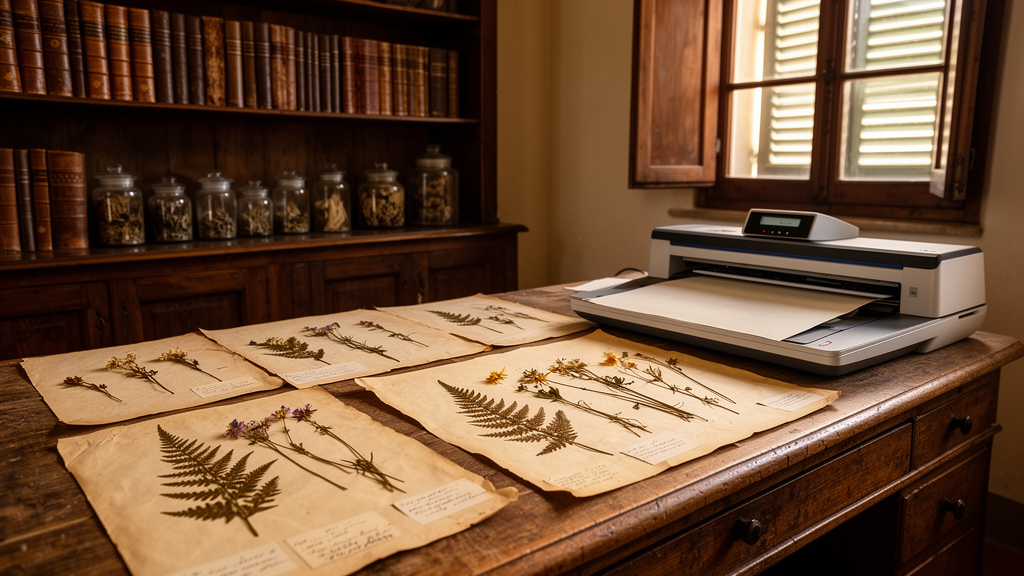
In the storerooms of the Botanic Museum of the University of Pisa, a collection that lay forgotten for decades before its rediscovery in 1930 has now completed a very modern journey. The Herbarium of Giovanni Giannini (1793–1871), preserved under the international code PI and designated PI-GIANN, has been fully digitized and made freely accessible to researchers worldwide through the online database Virtual Herbaria JACQ and a personalized virtual herbarium of the Botanic Museum. The project, published in Italian Botanist, catalogues 1,314 specimens of plants, algae, fungi, and lichens assembled by one of the most respected Tuscan botanists of the first half of the nineteenth century, and the results are reshaping how scientists understand the historical flora of the region.
Giannini was born on 1 December 1793 in Tereglio, a mountain village in the province of Lucca, Tuscany. After graduating in Medicine from the University of Bologna, he spent about a year in 1822 working as a public health physician in Goletta, Tunisia. But his true passion was the spontaneous flora of the northern Apennine and the Apuan Alps, where he collected relentlessly throughout his life. His specimens and observations were repeatedly acknowledged in the era’s major botanical works, including Bertoloni’s Flora Italica, Puccinelli’s Synopsis plantarum in agro lucensi sponte nascentium, Parlatore’s Flora Italiana, and Caruel’s Prodromo della Flora Toscana. Over the course of his life, Giannini assembled two herbaria: one of approximately 5,200 specimens now preserved at a secondary school in Cuneo, and a second consisting of 25 small packets held at Pisa, which was donated by his brother Adriano after Giannini’s death and rediscovered in the storerooms of the Botanic Garden and Museum by director Ugolino Martelli in 1930.
The digitization process followed a rigorous workflow. Each specimen was first stamped with a unique identification number, then scanned using a Bookeye 4 Professional planetary scanner at 600 dpi with 24-bit colour depth in .tiff format, accompanied by metric and colorimetric references. High-resolution images were uploaded to a web server of the University of Pisa, while label data were entered into the Virtual Herbaria JACQ database in Vienna. A personalized virtual herbarium of the Botanic Museum mirrors the JACQ data, ensuring broad accessibility. Georeferencing was inferred from label information, which ranged from precise locality descriptions to broad geographical areas, and the team referred to a manuscript by Giannini preserved at the Science Library of the University of Florence to decipher difficult-to-locate sites.
The collection’s taxonomic composition is dominated by flowering plants, with eudicots accounting for 73.6% of specimens, followed by monocots at 16.8%. Among the vascular plants, after nomenclatural updates, 115 families, 568 genera, and 1,115 specific and subspecific taxa are represented. The most abundant families are Asteraceae (10.8%), Fabaceae (6.5%), Poaceae (5.8%), Apiaceae (4.8%), Brassicaceae (4.4%), and Rosaceae (4.1%), while the most numerous genera are Trifolium, Ranunculus, Carex, Euphorbia, and Veronica. These patterns likely reflect the personal collecting preferences of Giannini himself, a bias already recognized in other large-scale herbarium digitization projects.
Geographically, the collection is overwhelmingly Tuscan. Of the 955 specimens collected in Italy with known localities, 951 come from the province of Lucca, with the most represented sites being Tereglio (155 specimens), Mt. Rondinaio (66), Musceta (48), Valdottavo (47), Mt. Prato Fiorito (46), and Pozzuolo (37). Only seven specimens come from Lake Baccio in Emilia-Romagna, three from Lago Nero in the province of Pistoia, and one from the Botanic Garden of Pisa. Giannini himself collected 98.5% of the specimens, with the remainder contributed by Benedetto Puccinelli, Lorenzo Chiostri, Pietro Savi, and Attilio Tassi, confirming the professional network of specimen exchanges in which Giannini played a significant role among Tuscan botanists of his era.
Among the most striking discoveries is a specimen of Taraxacum pauckertianum, revised from Giannini’s original label as Taraxacum palustre, which represents the only documented record of this species in Italy and must be considered extinct at the national level. Similarly, specimens of Utricularia minor collected at Monte Pisano and Vaccinium oxycoccos from the Bientina marsh belong to two species that are now regionally extinct in Tuscany, providing historical evidence of their occurrence at the recorded localities. A specimen of Santolina etrusca documents the historical presence of this central Italian endemic in northern Tuscany, where it became locally extinct during the twentieth century. In total, PI-GIANN preserves 58 taxa included in the Italian Red Lists, of which six are of high conservation interest for the Tuscan flora.
The digitization also uncovered 30 specimens belonging to 27 Italian endemic taxa, several of which are restricted to the Apuan Alps and the northern Apennine. Among them are Aquilegia lucensis, Carum appuanum subsp. appuanum, Globularia incanescens, Moltkia suffruticosa subsp. bigazziana, Pinguicula christinae, Rhinanthus apuanus, Siler montanum subsp. appuanum, Thliphthisa apuana, and Viola ferrarinii. Narrow endemics of the Apuan Alps include Astrantia pauciflora subsp. pauciflora, Salix crataegifolia, and Silene lanuginosa. These specimens underscore the value of historical herbaria as essential sources of information for plant extinction risk assessments and long-term biodiversity baselines.
Two floristic novelties emerged from the comparison with regional and local floras. The specimen reported by Giannini as Centaurea austriaca was revised to Centaurea phrygia subsp. pseudophrygia, a subspecies previously considered only doubtfully present in Tuscany; based on this specimen, it should be regarded as at least historically occurring in the region. Additionally, Euphrasia officinalis subsp. kerneri is newly recorded as historically occurring in the province of Lucca. A third taxon, Avena sativa subsp. praegravis, was determined to be a cultivated variety lacking taxonomic value and is now treated as a synonym of Avena sativa.
PI-GIANN also preserves 42 specimens of species non-native to Tuscany, including six casual aliens, 24 naturalized, and eight invasive species, plus two taxa reported as aliens without a specific status. This presence of non-native taxa highlights the relevance of historical herbaria for biodiversity monitoring, conservation biology, and invasion ecology, offering a baseline against which modern distributions can be compared.
The integration of images and metadata into open-access digital platforms significantly enhances the interoperability of collections, aligning with global efforts to modernize natural history data. As of January 2026, the Herbarium of Pisa has digitized 65,000 specimens, including 524 type specimens, with other fully digitized separate collections including the herbarium of Michele Guadagno, Giuseppe Raddi’s Brazilian pteridophyte collection, and two small bound herbaria attributed to Antonio Bottini. PI-GIANN now stands as a reliable baseline for reconstructing past floristic patterns and evaluating changes in species distributions, a research line recognized as essential in contemporary biodiversity studies.
Subject of Research: Botany
Article Title: Digitization of the historical Herbarium of Giovanni Giannini at Pisa (PI-GIANN)
Article References: Roma-Marzio, F., Gallerini, G., & Peruzzi, L. (2026). Digitization of the historical Herbarium of Giovanni Giannini at Pisa (PI-GIANN). Italian Botanist, 21, 19-34. https://doi.org/10.3897/italianbotanist.21.182950
Image Credits: AI Generated
DOI: 10.3897/italianbotanist.21.182950
Keywords: herbarium digitization, Giovanni Giannini, University of Pisa, Tuscany flora, plant conservation, biodiversity, historical specimens, Virtual Herbaria JACQ, endemic species, extinct plants, Digitization, historical
Cite Scienmag News
Margaret Porter. (October 17, 2026). A 19th-Century Botanist’s Herbarium Goes Digital, Revealing Extinct and Lost Plants of Tuscany. Scienmag. https://scienmag.com/a-19th-century-botanists-herbarium-goes-digital-revealing-extinct-and-lost-plants-of-tuscany/
Margaret Porter. "A 19th-Century Botanist’s Herbarium Goes Digital, Revealing Extinct and Lost Plants of Tuscany." Scienmag, 17 October 2026, https://scienmag.com/a-19th-century-botanists-herbarium-goes-digital-revealing-extinct-and-lost-plants-of-tuscany/. Accessed 17 October 2026.
Margaret Porter. "A 19th-Century Botanist’s Herbarium Goes Digital, Revealing Extinct and Lost Plants of Tuscany." Scienmag. October 17, 2026. https://scienmag.com/a-19th-century-botanists-herbarium-goes-digital-revealing-extinct-and-lost-plants-of-tuscany/


