

Saturday, May 2, 2026
Science
No Result
View All Result
  • Login
  • HOME
  • SCIENCE NEWS
  • CONTACT US
  • HOME
  • SCIENCE NEWS
  • CONTACT US
No Result
View All Result
Scienmag
No Result
View All Result
Home Science News Space

K-space translation strategy lets metasurfaces project multiple images without crosstalk

May 30, 2024
in Space
Reading Time: 2 mins read
0
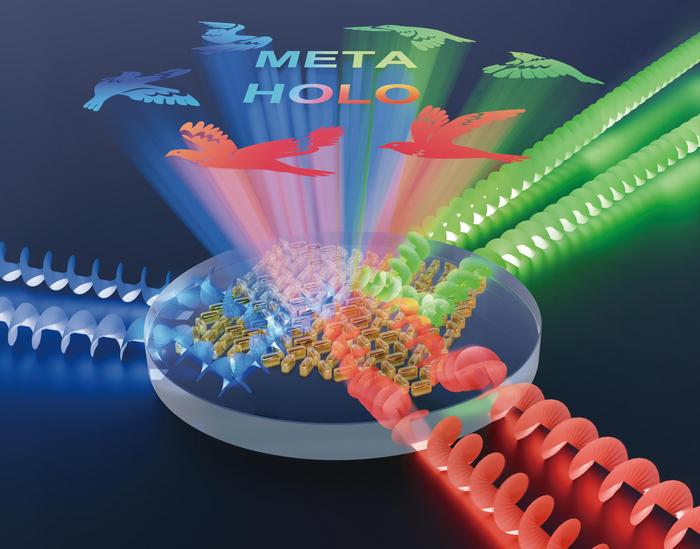
Figure 1. Artistic rendering of the waveguide-based metahologram for six-channel holographic projection.
67
SHARES
608
VIEWS
Share on FacebookShare on Twitter
ADVERTISEMENT

Researchers have developed a new type of holograms, known as “metaholograms”, capable of projecting multiple high-fidelity images free of crosstalk. This breakthrough paves the way for next-generation technologies including virtual/augmented reality (AR/VR) displays, information storage, and image encryption.

Figure 1. Artistic rendering of the waveguide-based metahologram for six-channel holographic projection.

Credit: by Zeyang Liu, Hao Gao, Taigao Ma, Vishva Ray, Niu Liu, Xinliang Zhang, L. Jay Guo, and Cheng Zhang

Researchers have developed a new type of holograms, known as “metaholograms”, capable of projecting multiple high-fidelity images free of crosstalk. This breakthrough paves the way for next-generation technologies including virtual/augmented reality (AR/VR) displays, information storage, and image encryption.

Metaholograms offer several advantages over traditional holograms, including broader operational bandwidth, higher imaging resolution, wider viewing angle, and more compact size. However, a major challenge for metaholograms has been their limited information capacity that only allows to project a few independent images. Existing methods typically can provide a small number of display channels and often suffer from inter-channel crosstalk during image projections.

To overcome this limitation, the new research introduces an innovative approach based on the k-space translation design strategy, enabling multiple target images to seamlessly switch between “displayed” and “hidden” states. The proposed metahologram employs the geometric phase encoding method and consists of millions of subwavelength-scale poly-silicon nanopillars, each measuring approximately 100 nm, all identical in size but with spatially varying rotation angles. The device further incorporates a planar glass waveguide to convey incident light and leverages properties such as polarization and angle to switch the projection of up to six unique high-fidelity images without crosstalk. Additionally, the researchers have created a two-channel full-color metahologram and even an eighteen-channel metahologram using a combination of different multiplexing techniques.

This innovation has the potential to significantly improve AR/VR displays by enabling the projection of more complex and realistic scenes. It also holds promise for applications in image encryption, where the information is encoded into multiple holographic channels for enhanced security.

The research is a significant step forward in developing high-performance metaholograms with a vastly increased information capacity. This study paves the way for exciting new possibilities in various fields, from advanced displays to information encryption and information storage.


Journal

eLight

DOI

10.1186/s43593-024-00063-9

Share27Tweet17
Previous Post

Physical and chemical properties of boiled oil: A traditional method of extracting oil from boiled olive fruits

Next Post

Study examines prescribing patterns of drug associated with cognitive impairment

Related Posts

Flies Adapt and Recover Under Intense Hypergravity Conditions — Space
Space

Flies Adapt and Recover Under Intense Hypergravity Conditions

May 1, 2026
UBCO Discovery Poised to Revolutionize Future Wireless Networks — Space
Space

UBCO Discovery Poised to Revolutionize Future Wireless Networks

April 30, 2026
Slimmer Silhouette of Giant Planet Revealed — Space
Space

Slimmer Silhouette of Giant Planet Revealed

April 30, 2026
Enhancing Navigation Accuracy: Using Map Coloring to Minimize Visual Drift in GNSS-Denied Environments — Space
Space

Enhancing Navigation Accuracy: Using Map Coloring to Minimize Visual Drift in GNSS-Denied Environments

April 30, 2026
Hidden Cold Traps May Reveal the Secrets of Lunar Ice — Space
Space

Hidden Cold Traps May Reveal the Secrets of Lunar Ice

April 30, 2026
Horizontal Transport Drives Nightside Chemistry on Hot Exoplanet — Space
Space

Horizontal Transport Drives Nightside Chemistry on Hot Exoplanet

April 30, 2026
Next Post

Study examines prescribing patterns of drug associated with cognitive impairment

  • Mothers who receive childcare support from maternal grandparents show more parental warmth, finds NTU Singapore study

    Mothers who receive childcare support from maternal grandparents show more parental warmth, finds NTU Singapore study

    27639 shares
    Share 11052 Tweet 6908
  • University of Seville Breaks 120-Year-Old Mystery, Revises a Key Einstein Concept

    1042 shares
    Share 417 Tweet 261
  • Bee body mass, pathogens and local climate influence heat tolerance

    677 shares
    Share 271 Tweet 169
  • Researchers record first-ever images and data of a shark experiencing a boat strike

    540 shares
    Share 216 Tweet 135
  • Groundbreaking Clinical Trial Reveals Lubiprostone Enhances Kidney Function

    527 shares
    Share 211 Tweet 132
Science

Embark on a thrilling journey of discovery with Scienmag.com—your ultimate source for cutting-edge breakthroughs. Immerse yourself in a world where curiosity knows no limits and tomorrow’s possibilities become today’s reality!

RECENT NEWS

  • Physical Disorders, ADLs, Cognition, Depression in Nursing Homes
  • Precise Spatiotemporal Cardiac Repair and Regeneration
  • Paul and Shelia Schlosberg Family Foundation Advances Military Brain Health with Pioneering $3 Million Grant
  • Early Detection of Keratoconus Enhanced by Light Polarization and AI

Categories

  • Agriculture
  • Anthropology
  • Archaeology
  • Athmospheric
  • Biology
  • Biotechnology
  • Blog
  • Bussines
  • Cancer
  • Chemistry
  • Climate
  • Earth Science
  • Editorial Policy
  • Marine
  • Mathematics
  • Medicine
  • Pediatry
  • Policy
  • Psychology & Psychiatry
  • Science Education
  • Social Science
  • Space
  • Technology and Engineering

Subscribe to Blog via Email

Enter your email address to subscribe to this blog and receive notifications of new posts by email.

Join 5,146 other subscribers

© 2025 Scienmag - Science Magazine

Welcome Back!

Login to your account below

Forgotten Password?

Retrieve your password

Please enter your username or email address to reset your password.

Log In
No Result
View All Result
  • HOME
  • SCIENCE NEWS
  • CONTACT US

© 2025 Scienmag - Science Magazine

Discover more from Science

Subscribe now to keep reading and get access to the full archive.

Continue reading
