

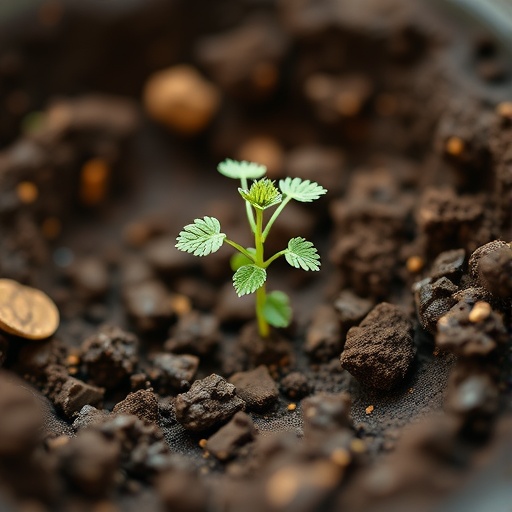
In the relentless pursuit of sustainable agriculture, scientists are continuously uncovering unseen allies beneath our feet—microbial players whose influence extends beyond their microscopic scale. Recently, an eye-opening study has spotlighted soil-dwelling Naegleria, a free-living protist, as a powerful enhancer of plant performance. This discovery unfolds a compelling narrative wherein Naegleria stimulates beneficial bacterial functions within the rhizosphere, the critical zone of soil surrounding plant roots, fundamentally altering our understanding of plant-microbe-soil interactions.
Soil ecosystems are notoriously complex, comprising a multitude of microorganisms that engage in intricate biochemical dialogues. Historically, the bulk of research has concentrated on bacteria and fungi, often overlooking protists as peripheral entities. This new research challenges that paradigm by highlighting Naegleria, a genus of amoeboflagellates, which deftly navigate the soil environment and seemingly engineer microbial communities to favor plant growth. Their role transcends mere predation, suggesting an active participation in optimizing bacterial functions pivotal to nutrient cycling and disease suppression.
At the core of this phenomenon lies the rhizosphere, a hyperactive microbial metropolis fueled by root exudates. It serves as a dynamic interface where plants and microorganisms engage in mutually beneficial exchanges. The presence of Naegleria appears to catalyze these interactions, particularly by enhancing the metabolic activities of key bacterial taxa known for nitrogen fixation, phosphorus solubilization, and plant hormone production. By modulating these microbial processes, Naegleria indirectly but significantly boosts plant vigor and resilience.
The investigative team employed a blend of metagenomics, transcriptomics, and metabolomics to dissect the rhizosphere microbiome landscape in the presence and absence of Naegleria. Their data revealed an unmistakable upregulation of bacterial genes involved in nutrient acquisition and stress tolerance when Naegleria was active in the soil. This functional shift correlated strongly with improved root architecture and accelerated seedling emergence, highlighting Naegleria’s potential as a natural biofertilizer agent.
Moreover, Naegleria’s predatory behavior, traditionally viewed as a mechanism for microbial population control, was recast in a new light. By selectively grazing on less beneficial or pathogenic microorganisms, Naegleria appears to fine-tune the microbial assembly, favoring a consortium of plant-beneficial bacteria. This trophic interaction not only enhances nutrient availability but also fortifies plants against biotic stressors, reflecting a sophisticated ecological balance within the rhizosphere.
This venture into the unexplored functions of free-living protists is backed by the researchers’ innovative use of soil microcosm experiments that teased apart direct and indirect effects of Naegleria. These controlled environments allowed the team to observe how Naegleria modulates microbial consortia over time, elucidating a trajectory where initial microbial diversity might be subdued in favor of a more robust and beneficial bacterial population.
The study’s implications stretch beyond academic curiosity, injecting a fresh momentum into agricultural biotechnologies. Harnessing Naegleria or its functional analogs could pave the way for ecologically sound crop enhancement strategies, reducing dependence on chemical fertilizers and pesticides. Such biological interventions might foster sustainable intensification of food production, crucial for feeding an ever-growing global population under the strains of climate change.
Crucial to these advances is the revelation that Naegleria enhances bacterial functions not by introducing new microbes but by leveraging existing soil inhabitants. This subtle yet powerful mechanism hints at the sophistication of soil microbial networks and underscores the importance of maintaining soil biodiversity. Agricultural practices that protect or invigorate protist populations could thus have ternary benefits—supporting soil health, microbial functionality, and ultimately plant productivity.
A particularly intriguing aspect of the research centers on the molecular signaling pathways activated within bacterial cells in response to Naegleria presence. The authors identified enhanced expression of genes coding for quorum sensing molecules and biofilm components, suggesting that Naegleria influences bacterial community organization and communication. Such modifications in microbial social behavior may underlie the increased effectiveness in nutrient mobilization and pathogen suppression.
The robustness of these findings is further strengthened by field trials conducted across diverse soil types and crop species. The consistent observation of improved plant biomass and yield metrics in Naegleria-enriched soils validates the translational potential of this discovery. At the same time, it prompts questions about the ecological thresholds and management practices required to sustain beneficial protist populations under variable environmental conditions.
In exploring the evolutionary context, the study hints that the symbiotic relationships between protists and bacteria in soil may be ancient and broadly conserved. This co-evolutionary perspective enriches our appreciation of soil as a living system where microbial eukaryotes and prokaryotes form synergistic alliances conducive to plant health. Recognizing these multi-kingdom interactions could revolutionize ecological theory and applied agronomy alike.
Despite its groundbreaking insights, the research also acknowledges challenges ahead in fully harnessing Naegleria. Soil ecosystems are notoriously difficult to manipulate predictably, and the long-term ecological impacts of artificially boosting protist populations require careful assessment. Furthermore, understanding the conditions under which Naegleria thrives and exerts its beneficial influences will be pivotal in devising practical applications for agriculture.
Nonetheless, the enthusiasm surrounding these findings is palpable within the scientific community. They herald a transformative approach to crop management that embraces complexity and taps into the natural ingenuity of microbial interactions. As researchers continue to decrypt the molecular underpinnings of protist-bacteria-plant triads, an era of more sustainable and productive agriculture seems increasingly attainable.
This landmark study not only widens the aperture on rhizosphere biology but also invites a reconceptualization of soil health, integrating often-overlooked microbial eukaryotes into the fold of agronomic innovation. By doing so, it champions a vision where soil ecosystems are not just the stage but active participants in agricultural success stories.
The ramifications also extend to biotechnology, where engineered protists or their effectors might be developed into targeted biostimulants. Such biotechnological innovations could offer precision tools for managing microbial consortia, improving nutrient use efficiency, and mitigating stress effects on crops, thereby aligning productivity goals with environmental stewardship.
In sum, the discovery of Naegleria’s role in enhancing beneficial bacterial functions spotlights a new frontier in soil biology and crop science. It challenges us to revisit and deepen our understanding of the rhizosphere’s ecological web, promoting integrative strategies that honor the complexity and dynamism of soil life.
As agricultural landscapes face mounting pressures from climate shifts and land degradation, harnessing the natural potential of soil protists like Naegleria could become a cornerstone of future farming systems—offering hope for more resilient crops, healthier soils, and improved food security worldwide.
Cite this news
SCIENMAG. (October 13, 2025). Soil Naegleria Boosts Plants by Activating Bacteria. https://scienmag.com/soil-naegleria-boosts-plants-by-activating-bacteria/
SCIENMAG. "Soil Naegleria Boosts Plants by Activating Bacteria." Scienmag, 13 October 2025, https://scienmag.com/soil-naegleria-boosts-plants-by-activating-bacteria/. Accessed 28 August 2026.
SCIENMAG. "Soil Naegleria Boosts Plants by Activating Bacteria." Scienmag. October 13, 2025. https://scienmag.com/soil-naegleria-boosts-plants-by-activating-bacteria/


