


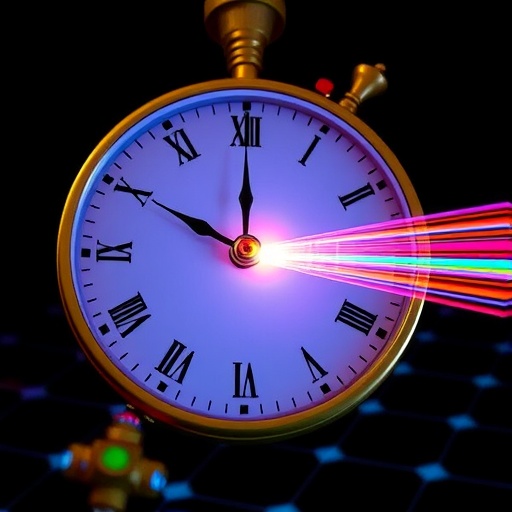
In a groundbreaking development in the field of precision metrology, researchers have introduced an innovative quantum measurement technique that significantly enhances the performance of optical lattice clocks. These clocks, which currently define the frontier of timekeeping accuracy, operate near the standard quantum limit, a fundamental boundary defined by quantum noise. By integrating a novel approach called quantum-amplified global-phase spectroscopy, the team has pushed the envelope beyond this limit, promising transformative impacts on next-generation atomic clocks and quantum sensors.
Optical lattice clocks achieve their extraordinary precision by trapping ultracold atoms in a grid of laser light, enabling exceptionally stable frequency measurements of atomic transitions. However, this precision is fundamentally constrained by quantum noise, arising from the probabilistic nature of quantum states. Overcoming this limit necessitates harnessing quantum entanglement, a state where particles become deeply linked such that the measurement outcome of one instantaneously influences the other, enabling precision enhancements unachievable by classical means.
While the theoretical advantages of entanglement are well-established, practical implementation in scalable and robust atomic clocks has been historically challenging. Complexities arise from the need for precise measurements and the inherent difficulty in generating and maintaining entangled states across large ensembles of atoms without introducing excessive decoherence or noise. Addressing these challenges, the research team has adapted the concept of holonomic quantum gates—a framework originally developed for fault-tolerant quantum computing—to the realm of atomic clock spectroscopy.
Central to their methodology is a novel form of Rabi spectroscopy termed global-phase spectroscopy, exploiting the global Aharonov–Anandan phase. Unlike traditional frequency measurements based on population changes, this phase-based method encodes frequency information into a geometric phase that accumulates globally across all the atoms. This approach fundamentally alters the measurement paradigm by amplifying the sensitivity to detuning, the difference between the laser frequency and the atomic resonant frequency, thereby enhancing the signal without increasing technical noise.
Implementing this technique required the introduction of a rotary echo sequence, a sophisticated pulse protocol that counteracts inhomogeneities in light–atom coupling. These inhomogeneities typically degrade coherence and limit measurement fidelity. The rotary echo effectively “reverses” these imperfections in time, preserving the collective quantum state and maintaining sensitivity across the entire atomic ensemble. This ensures that the quantum advantages of entanglement are not compromised by experimental disparities.
Another critical innovation in the experiment is the use of a noise-cancelling differential measurement strategy. By symmetrically encoding the phase information across two nuclear spin states, the team successfully cancels out laser frequency noise that commonly obscures precise frequency detection. This differential encoding method amplifies the true atomic signal while suppressing common-mode errors, thereby refining the measurement precision beyond prior benchmarks.
The results are remarkable: the team directly observed a 2.4 dB metrological gain, a measure of improved precision beyond the standard quantum limit, and demonstrated a 4.0 dB enhancement in sensitivity to laser noise. This represents a significant advance in harnessing entanglement for practical measurement gains, marrying theoretical quantum advantages with experimental robustness and feasibility in real-world atomic clock systems.
The global nature of the underlying entangling interaction enables the technique to scale gracefully to larger atomic ensembles, a vital attribute for building future clocks with unparalleled accuracy. Furthermore, the method’s resilience to experimental imperfections makes it highly adaptable in diverse setups, reducing technical overhead and enhancing reliability. These qualities position global-phase spectroscopy as a promising candidate for widespread adoption in quantum metrology.
This work also charts a path forward in the ongoing quest for quantum sensors operating at fundamental precision limits. By mitigating key barriers related to scalability and measurement resolution, it opens opportunities for exploiting quantum entanglement in other precision devices beyond clocks, including magnetometers, inertial sensors, and beyond. The potential for such quantum-enhanced sensors to impact technology, fundamental physics tests, and navigation is profound.
Importantly, this advancement reflects a sophisticated interdisciplinary fusion of concepts from quantum information science, atomic physics, and precision measurement. The adaptation of holonomic quantum gates, typically reserved for quantum computing, to enhance spectroscopy exemplifies the innovative cross-pollination driving progress in quantum technologies today.
Looking ahead, researchers anticipate that further refinements could push metrological gains yet higher, closing the gap toward Heisenberg-limited precision—the ultimate boundary set by quantum mechanics. The demonstrated approach also lays the groundwork for integrating dynamic quantum error correction schemes and variational quantum algorithms that may optimize measurement sequences in real time, tailoring system performance to experimental conditions.
In summary, this pioneering work showcases quantum-amplified global-phase spectroscopy as a transformative leap in optical lattice clock technology. By transcending traditional quantum noise limits with a scalable, noise-resilient strategy, it heralds new horizons for quantum-enhanced timekeeping and precision measurement, driving both fundamental inquiry and technological innovation into the quantum era.
Cite Scienmag News
Katie Riggs. (October 8, 2025). Quantum-Enhanced Spectroscopy on Optical Clock Transitions. Scienmag. https://scienmag.com/quantum-enhanced-spectroscopy-on-optical-clock-transitions/
Katie Riggs. "Quantum-Enhanced Spectroscopy on Optical Clock Transitions." Scienmag, 8 October 2025, https://scienmag.com/quantum-enhanced-spectroscopy-on-optical-clock-transitions/. Accessed 4 September 2026.
Katie Riggs. "Quantum-Enhanced Spectroscopy on Optical Clock Transitions." Scienmag. October 8, 2025. https://scienmag.com/quantum-enhanced-spectroscopy-on-optical-clock-transitions/


