


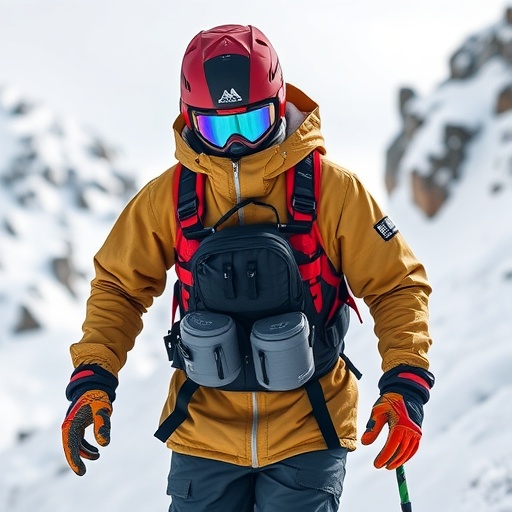
In the unforgiving domain of avalanche emergencies, the race against time is brutal and unforgiving. Every minute counts when a victim is buried beneath a dense snowpack, often leading to fatal outcomes primarily due to asphyxiation. The Norwegian company behind the Safeback SBX device recently sought the expertise of Eurac Research to rigorously and independently assess the efficacy of their lifesaving equipment under real-world avalanche burial conditions. Led by physician and researcher Giacomo Strapazzon, an international team set out on a clinical trial that would not just validate this technology but potentially redefine survival protocols for avalanche victims.
This experimental trial posed considerable logistical and ethical challenges, primarily because it involved deeply burying volunteers under snow, mimicking the most threatening scenarios faced in avalanche accidents. The volunteer group consisted of ski mountaineers aged between 23 and 54 years, precisely selected for their experience and resilience, offering a balanced gender representation that strengthened the study’s applicability across demographics. Throughout the trial, subjects were carefully monitored using state-of-the-art physiological sensors, ensuring safety while providing real-time data on the device’s performance.
Avalanche burial mortality is chiefly driven by respiratory failure, with asphyxiation accounting for approximately two-thirds of deaths. Rapid oxygen deprivation starts typically within minutes, making the interval immediately following burial crucial for survival. The Safeback SBX device innovatively exploits the inherent porosity of snow coupled with an electrically powered air pump to deliver oxygen-rich air directly to the nose and mouth, counteracting the swift oxygen depletion usually experienced. Such a mechanism is designed to sustain life beyond the critical initial 35 minutes after burial, which classical survival gear has struggled to achieve effectively.
Activated manually via a handle on the wearer’s backpack, this device forces a flow of up to 150 liters of oxygenated air per minute, markedly extending the survival window for avalanche victims. The ability of this device to maintain blood oxygen saturation—observed to remain above 80 percent during the entire test period—is particularly groundbreaking. The device addresses the carbon dioxide accumulation challenge effectively, ensuring the air pocket remains breathable despite the victim’s exhalations accumulating within a confined snow cavity.
One of the crucial scientific breakthroughs underpinning this technology lies in its ability to consistently deliver oxygen in highly variable snow conditions. Snow, contrary to what one might assume, exhibits a porous structure that allows some air exchange. The Safeback SBX leverages this characteristic: by actively pumping air rather than passively relying on ambient air pockets, it creates a continual fresh air supply, optimizing gas exchange and preventing the build-up of toxic carbon dioxide concentrations that typically accelerate asphyxiation.
In-depth physiological monitoring revealed no decline below safe oxygen saturation in any participant during the critical timeframe, a testament to the device’s life-preserving capability. This finding is noteworthy given the high metabolic demands and stress imposed on buried individuals. Preservation of oxygen levels directly correlates to improved neurological outcomes post-rescue, emphasizing not just survival but quality of life after such traumatic events.
The collaboration across institutions spanning Europe and Norway—encompassing entities from the University of Bergen, Haukeland University Hospital, Norwegian Air Ambulance Foundation, and other alpine safety organizations—ensured robust scientific rigor and comprehensive logistical support throughout the study. Each partner brought specialized expertise, from medical supervision to search-and-rescue operational insights, exemplifying how multidisciplinary cooperation strengthens innovations in life-threatening environments.
Equally important was the involvement of national alpine rescue teams and ski lift staff who facilitated safe access to testing sites and rapid evacuation capabilities. Such integration of field operational support exemplifies best practices when translating technology from lab settings into the high-stakes arena of wilderness survival. This synergy between research and practical deployment underpins the real-world applicability of the Safeback SBX.
Despite these promising outcomes, the researchers stress that no device can supplant fundamental safety practices in avalanche terrain. Prevention through education, appropriate equipment, weather assessment, and companion rescue remain paramount. The Safeback SBX device is positioned as a critical adjunct, a lifeline that buys precious time when the worst occurs and professional rescue may be delayed.
The path forward includes ongoing studies and potential refinements, aiming to increase device accessibility and integration with other avalanche safety tools. Its performance under extreme winter sports circumstances signals a notable paradigm shift, as it moves beyond conceptual promise into demonstrated efficacy validated by rigorous randomized clinical trials—the gold standard in evidence-based medicine.
The clinical trial’s publication in the prestigious Journal of the American Medical Association (JAMA) underscores the broader medical community’s acknowledgment of its significance. The study sets a precedent for future innovations in respiratory support devices that could have implications beyond avalanche safety, potentially informing approaches to respiratory rescue in other hypoxic emergencies.
As winter approaches and snow-covered alpine activities surge worldwide, the Safeback SBX device stands as a beacon of hope for mountain enthusiasts and rescue professionals alike. The integration of cutting-edge technology within natural environments—skillfully calibrated through rigorous scientific inquiry—marks a monumental leap in safeguarding lives that depend on timely oxygenation amid the caprices of winter’s coldest disasters.
Cite Scienmag News
Ophelia Keating. (October 8, 2025). User-Carried Safety Device Boosts Avalanche Survival Time by Fivefold. Scienmag. https://scienmag.com/user-carried-safety-device-boosts-avalanche-survival-time-by-fivefold/
Ophelia Keating. "User-Carried Safety Device Boosts Avalanche Survival Time by Fivefold." Scienmag, 8 October 2025, https://scienmag.com/user-carried-safety-device-boosts-avalanche-survival-time-by-fivefold/. Accessed 4 September 2026.
Ophelia Keating. "User-Carried Safety Device Boosts Avalanche Survival Time by Fivefold." Scienmag. October 8, 2025. https://scienmag.com/user-carried-safety-device-boosts-avalanche-survival-time-by-fivefold/


